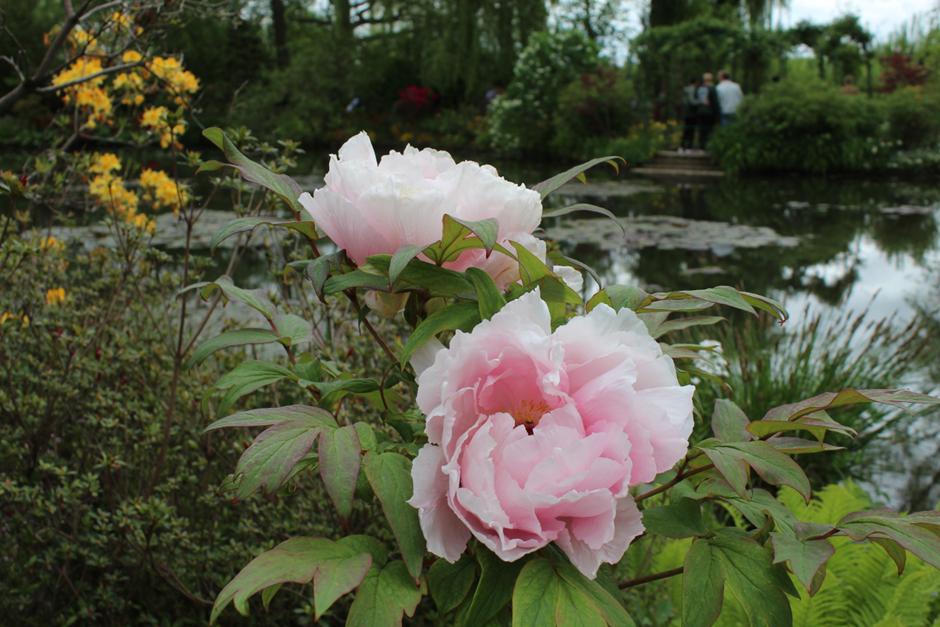
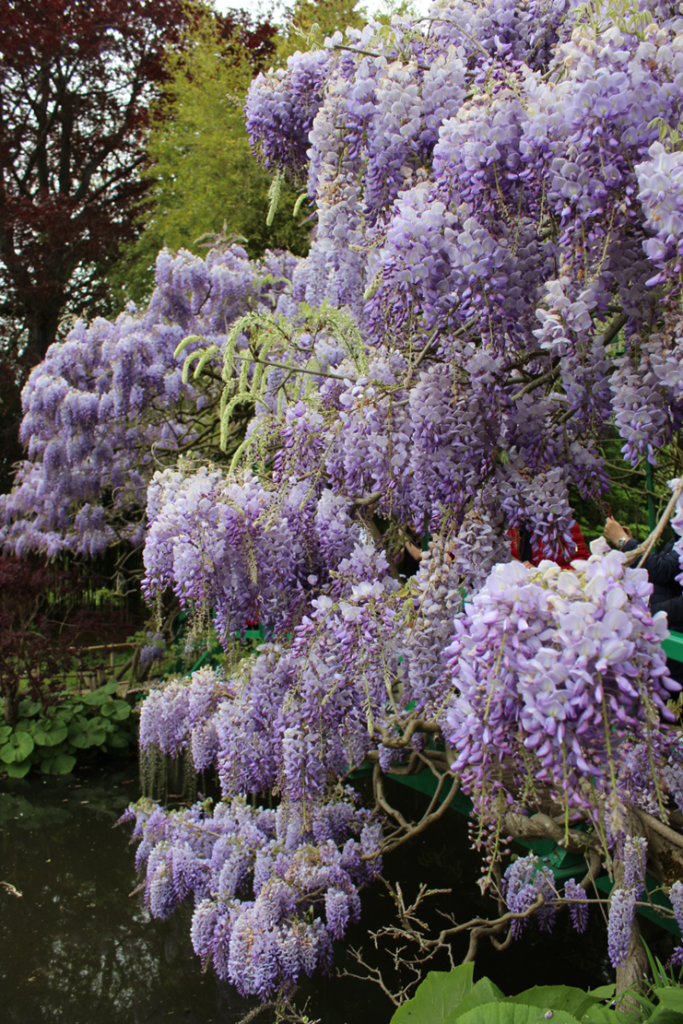
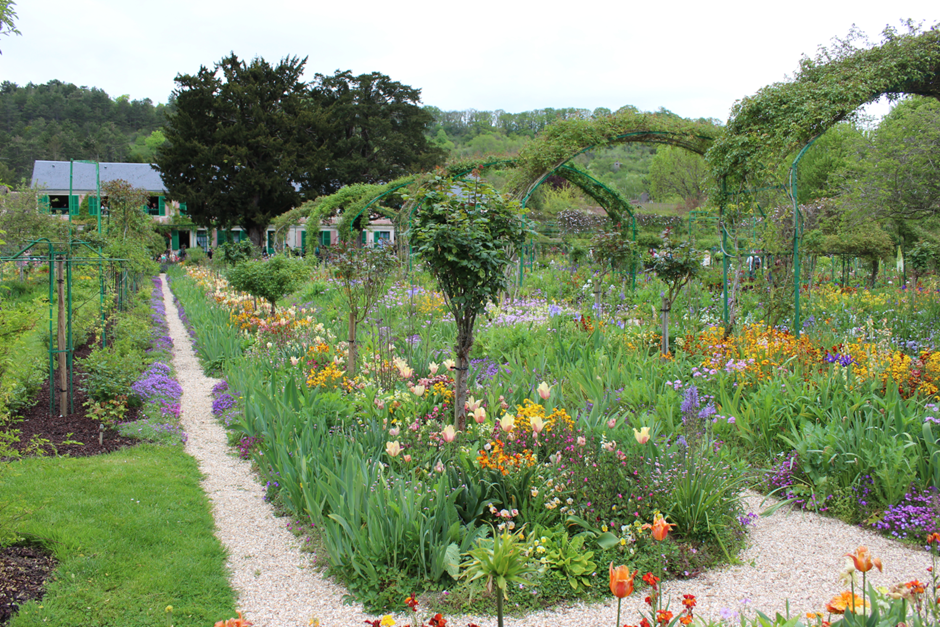
Throughout May I was kept very busy with Travel Editions tours to Normandy and Lille/Antwerp. Monet and Impressionists in Normandy, which has been running very successfully for many years, includes a full day in Giverny to visit Monet’s famous house and garden, the Museum of Impressionism and Monet’s final resting place. Early May is a perfect time to visit Monet’s water garden, as the lilac and white wisteria on the Japanese bridge are usually in full bloom. I was lucky to catch the tree peonies at their best. In the Clos Normand, the garden surrounding his house, the irises should be out. But at what ever time of the year you visit the gardens, there will be beautiful flowers to see: in early spring tulips followed by geraniums in early summer and sunflowers in late summer. My favourite feature is the grand ally, which originally took visitors from the house to the Japanese bridge. In late summer the ground is covered with vibrant nasturtiums. Monet’s ‘garden of an artist’ may well inspire your own green fingers!
Live lecture for June
Art Nouveau/Jugendstil in Strasbourg
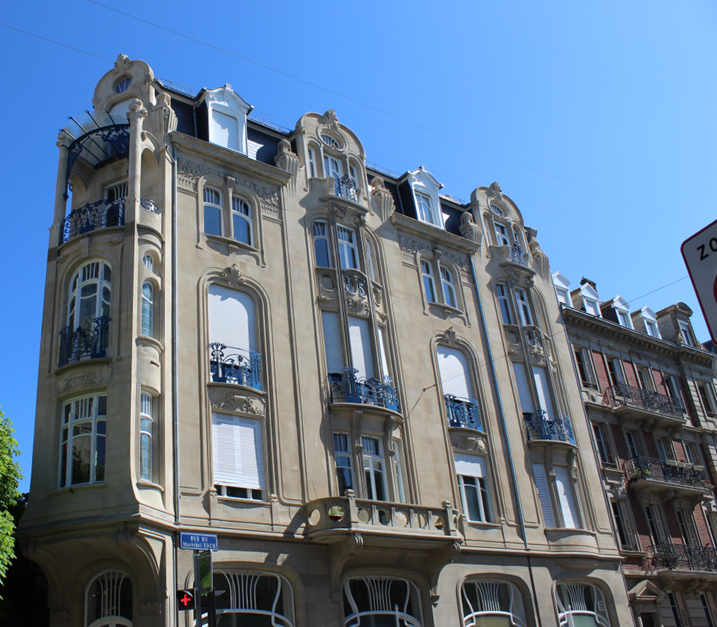
Finally, after several cancellations due to COVID restrictions, I was able to lead my new Travel Editions tour to Strasbourg and Karlsruhe. After Paris and Nancy, Strasbourg boasts the largest concentration of Art Nouveau architecture in France. However, the local architects were influenced as much by German Jugendstil and the Vienna Secession as they were by the whiplash style of Hector Guimard’s Paris Metro Stations. Falling into the annexed territories ceded to Prussia after the 1870-71 Franco-Prussian war, Strasbourg became a cultural crossroads. Most of the Art Nouveau buildings can be found in the Neustadt and Neudorf areas developed under Prussian rule. Many of the architects had German origins or had studied in Germany. Architectural duos, who co-authored of buildings, are a local peculiarity: Franz Lütke (1860–1929) and Heinrich Backes (1866–1931); Jules (Julius) Berninger (1856–1926) and Gustave (Gustav) Krafft (1861–1927); and Ferdinand Kalweit and Max Geist.
Join me to discover the idiosyncratic nature of Art Nouveau in Strasbourg!
Immeuble, 22 Rue Du Général de Castelnau, Built 1903, Franz Lütke and Heinrich Backes, architects
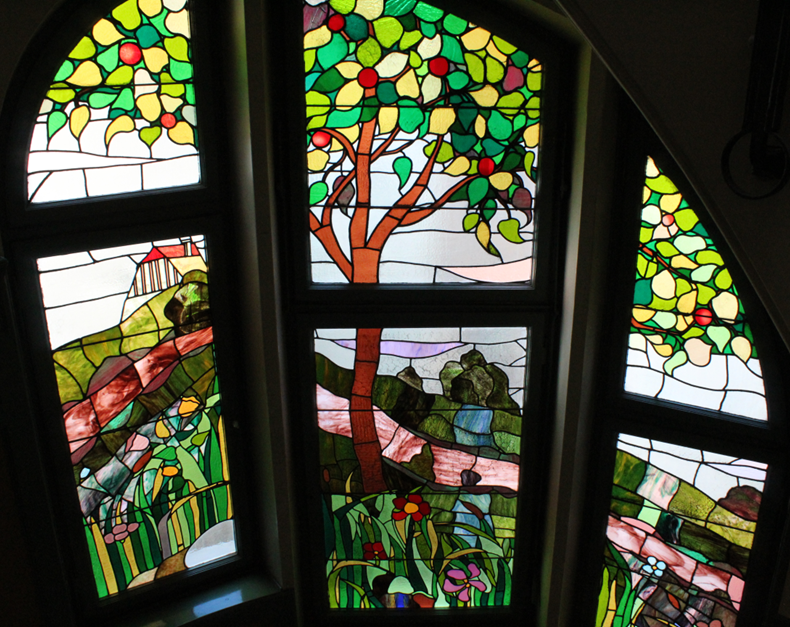
Immeuble, 22 Rue Du Général de Castelnau, Built 1903, Franz Lütke and Heinrich Backes, architects. Window on the staircase.
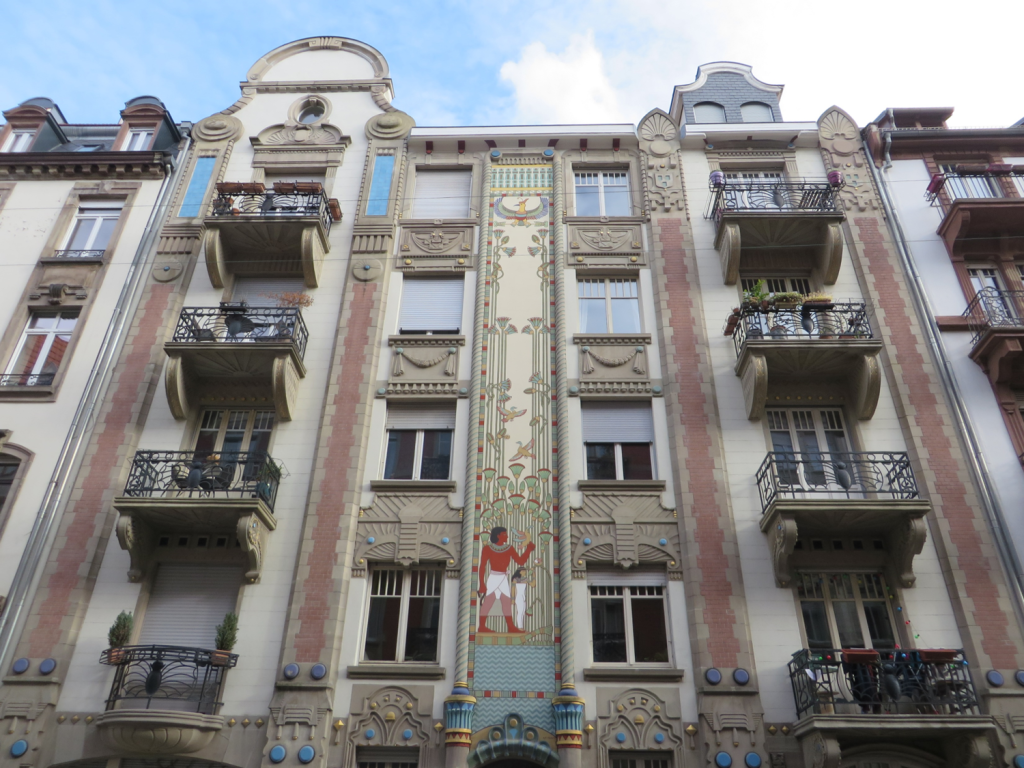
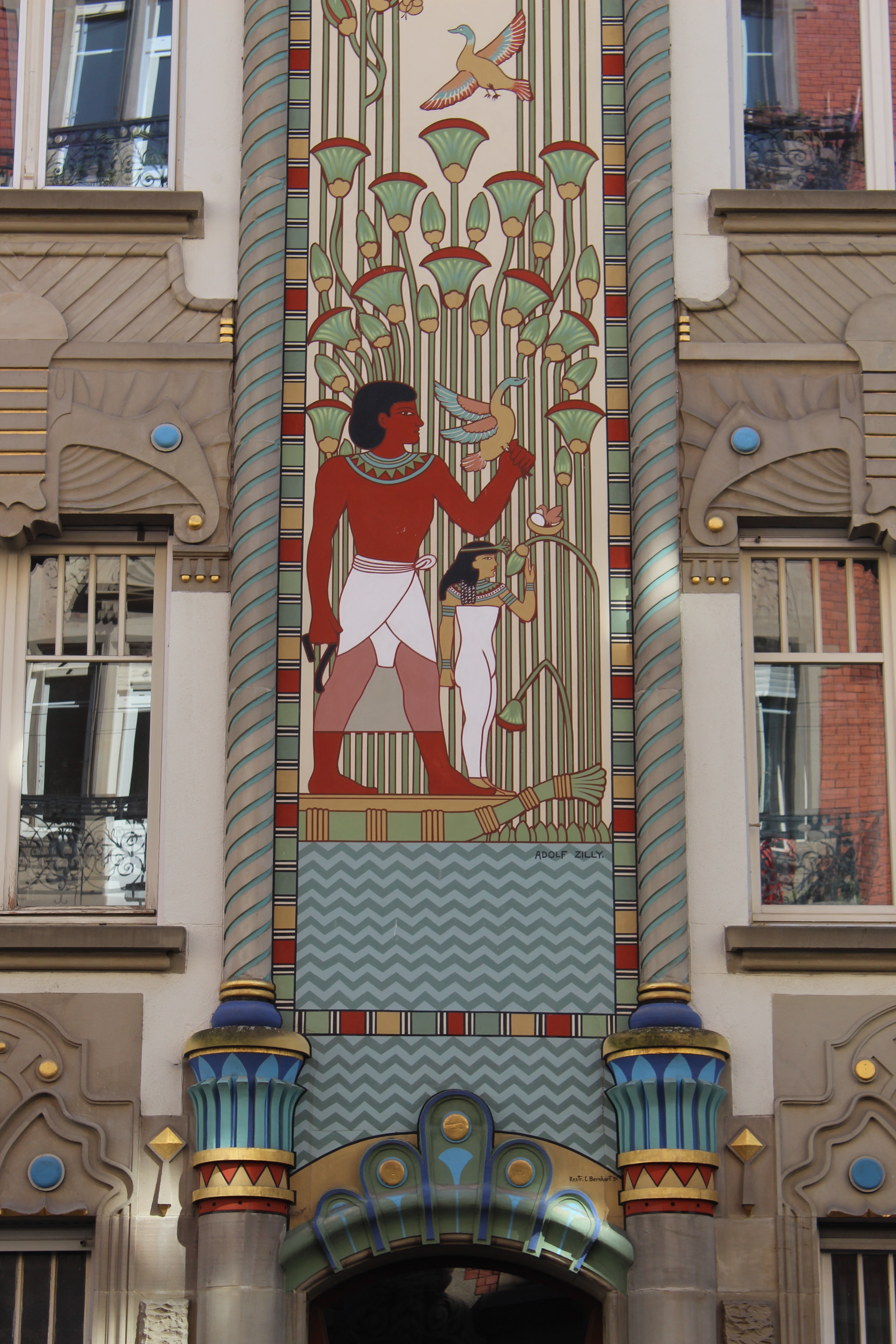
Maison “egyptienne”10 Rue du Général Rapp, Built 1905.Franz Scheyder, architect, Adolphe Zilly painter
You can pay by PayPal to watch this lecture at your leisure
Strasbourg
Art Nouveau/Jugendstil in Strasbourg
£10.00
Live and in Person!Thursday 15th June 2023
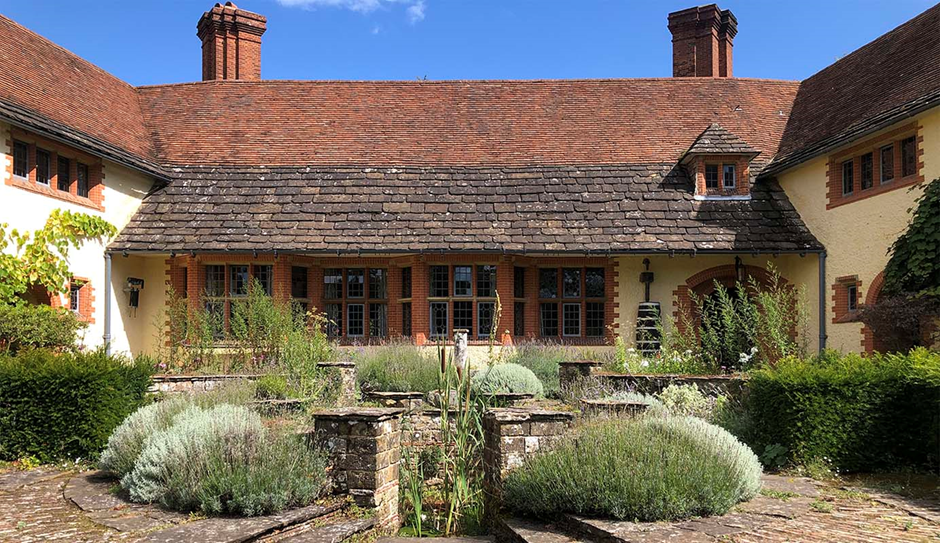
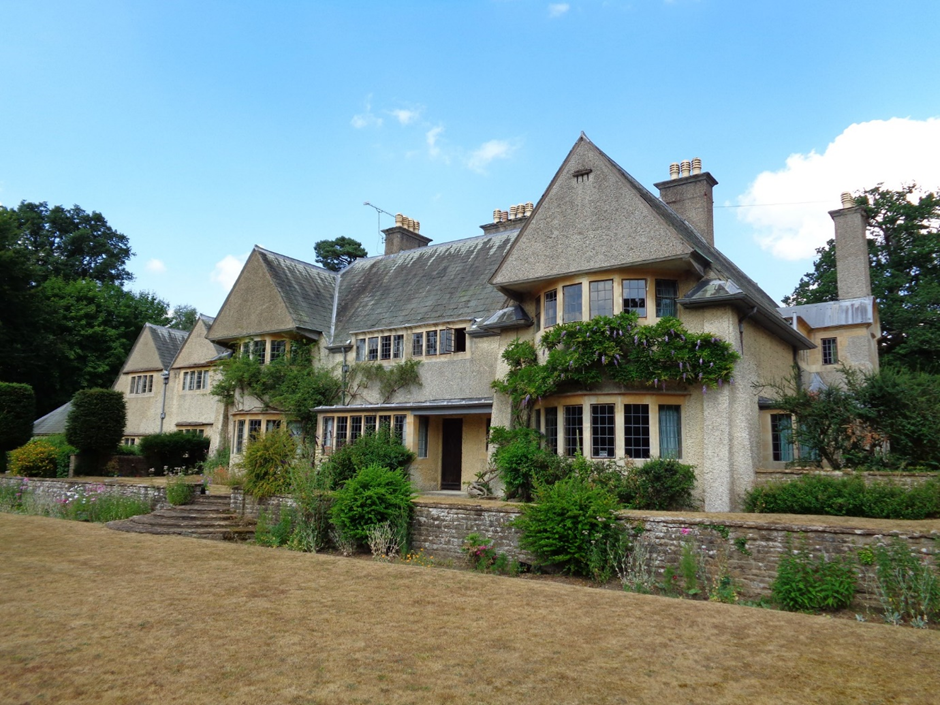
The Arts and Crafts Movement in Surrey have asked me to deliver a study day on C.F.A. Voysey to be held at Goddards, a wonderful house designed by Edwin Lutyens with gardens by Gertrude Jekyll. Owned by the Landmark Trust, the property is normally rented out. So, this is rare opportunity to see the property. I will be offering two lectures, Voysey’s Surrey Houses and The De Morgans, the Lovelaces and Voysey. Before these two lectures you will have the opportunity to tour the house.
Ticket prices includes a welcome drink and tea/cake: Members £24 and Non-members £26.
Numbers are limited to 30 people. There are just three places left.
contact@artsandcraftsmovementinsurrey.org.uk
or Carolyn Smith, chair ACMS, cmsatreelhall@btinternet.com
Lutyens/Jekyll, Goddards, Surrey
C.F.A. Voysey, Norney Grange, Shackleford, Surrey
What’s New on the Channel
Why not have a look at what’s just been released on our free access channel: Anne Anderson Art and Design History Channel on YouTube.
Margaret Macdonald Mackintosh
Margaret Macdonald Mackintosh (1864 –1933) was an English-born artist who attended classes at the Glasgow School of Art and whose art and design work became one of the defining features of the Glasgow Style in the years around 1900. It was at the School of Art that she met her future husband Charles Rennie Mackintosh, often seen as Scotland’s greatest architect. Her work has been somewhat marginalised in comparison, by later art and design historians, but in recent decades has been recognised as a major contribution to the progressive style and output of the Glasgow Four, the group that included her sister Frances and her husband Herbert MacNair, as well as Mackintosh.
Travel Editions Tours
Some news for those of you who are interested in the art and heritage tours, in the UK and/or abroad, that Scott and I undertake through the Travel Editions company. Following a successful series of UK tours in 2022,Travel Editions is running an interesting range of tours this summer and autumn. Below are listed some of our tours scheduled for later this year, that might be of interest to you.
Arts and Crafts Houses and Gardens, 31 July – 02 August (based in Cheltenham) Following in the footsteps of William Morris, artists and craftsmen settled in villages throughout the Cotswolds, including picturesque Broadway and Chipping Campden, drawn here by its rich craft tradition and natural charm.
Gothic Castles to French Impressionism, 14 – 16 August (based in Cardiff) It was a love of Gothic Revivalism that bought the 3rd Marquess of Bute together with architect William Burges to sumptuously remodel Cardiff Castle and create the Neo-Gothic fairytale Castell Coch in the late 1800s, a main features of your visit to Cardiff. The tour also looks at the magnificent French Impressionist art collection, one of the most important private collections in Britain, formed by the Davies sisters and housed in the National Museum of Wales.
For further details on these and other tours, please visit the Travel Editions website: https://www.traveleditions.co.uk to check booking details etc.
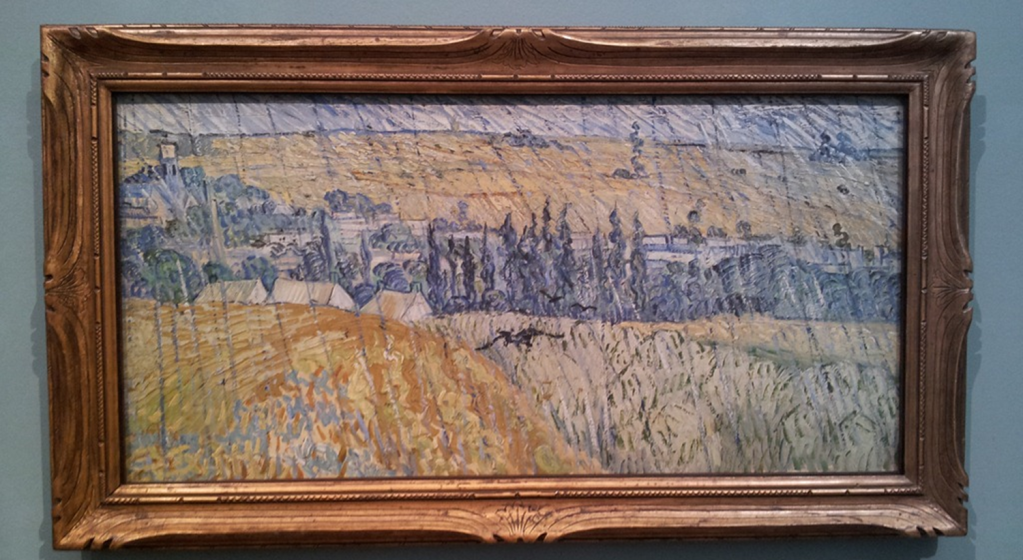
Vincent van Gogh (1853-90), Landscape at Auvers in the Rain. 1890. Purchased Paris 1920. Bequeathed to the National Gallery of Wales by Gwendoline Davies, 1952
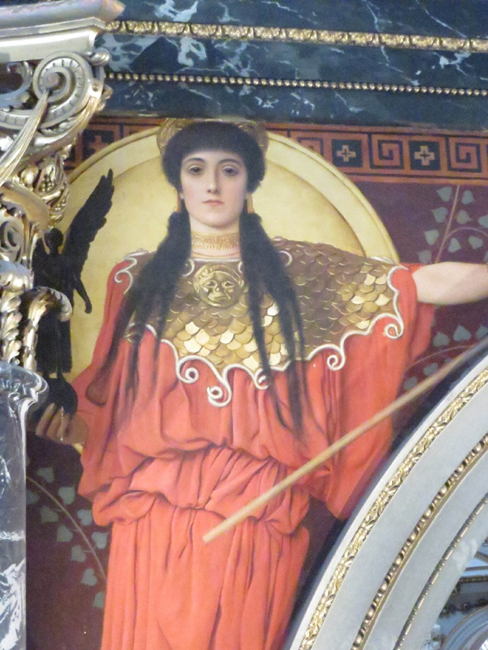
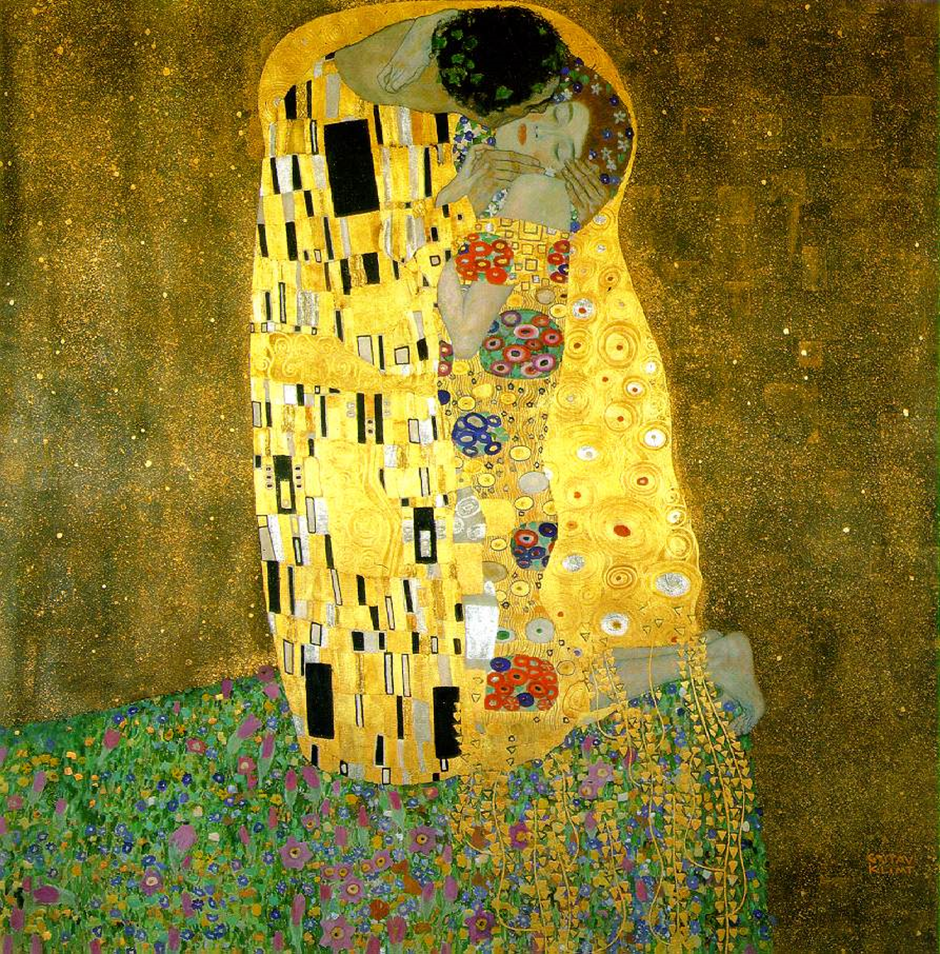
The highlight of my visit to Vienna in 2018 was the chance to scale scaffolding to get up close to Klimt’s paintings on the staircase of the Kunsthistorisches Museum. I came face to face with his larger-than-life image of Athena/Minerva, the Greek goddess of War and the Arts, who would become the talisman of the Vienna Secession in 1897.
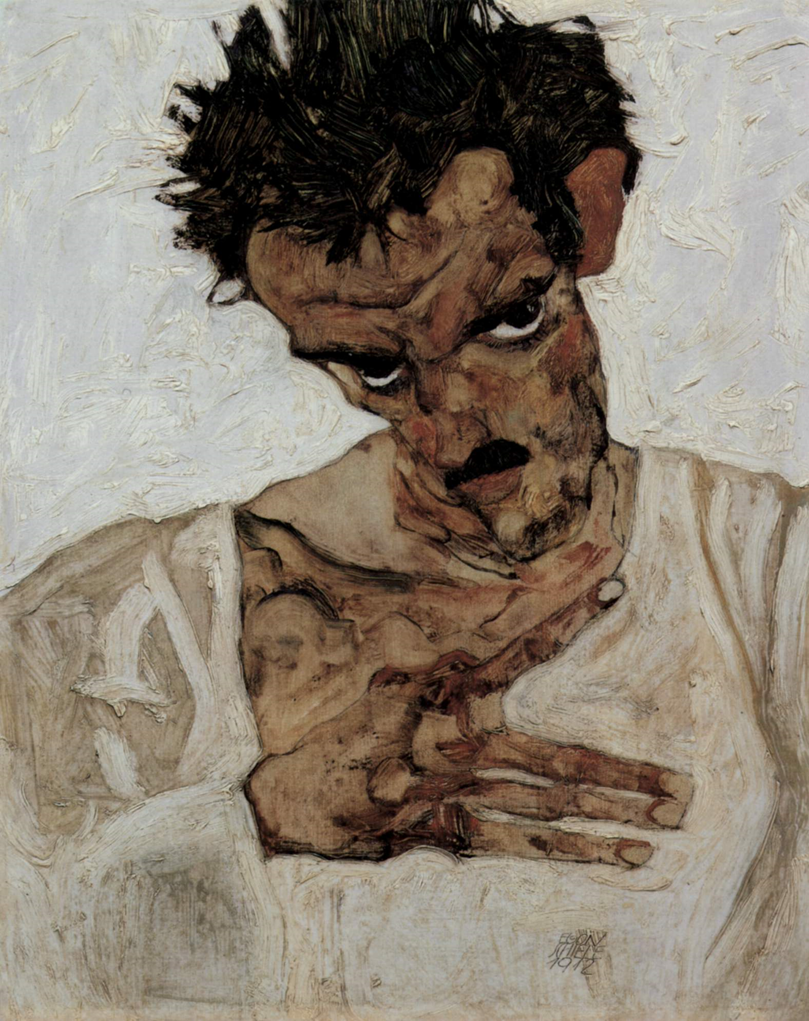
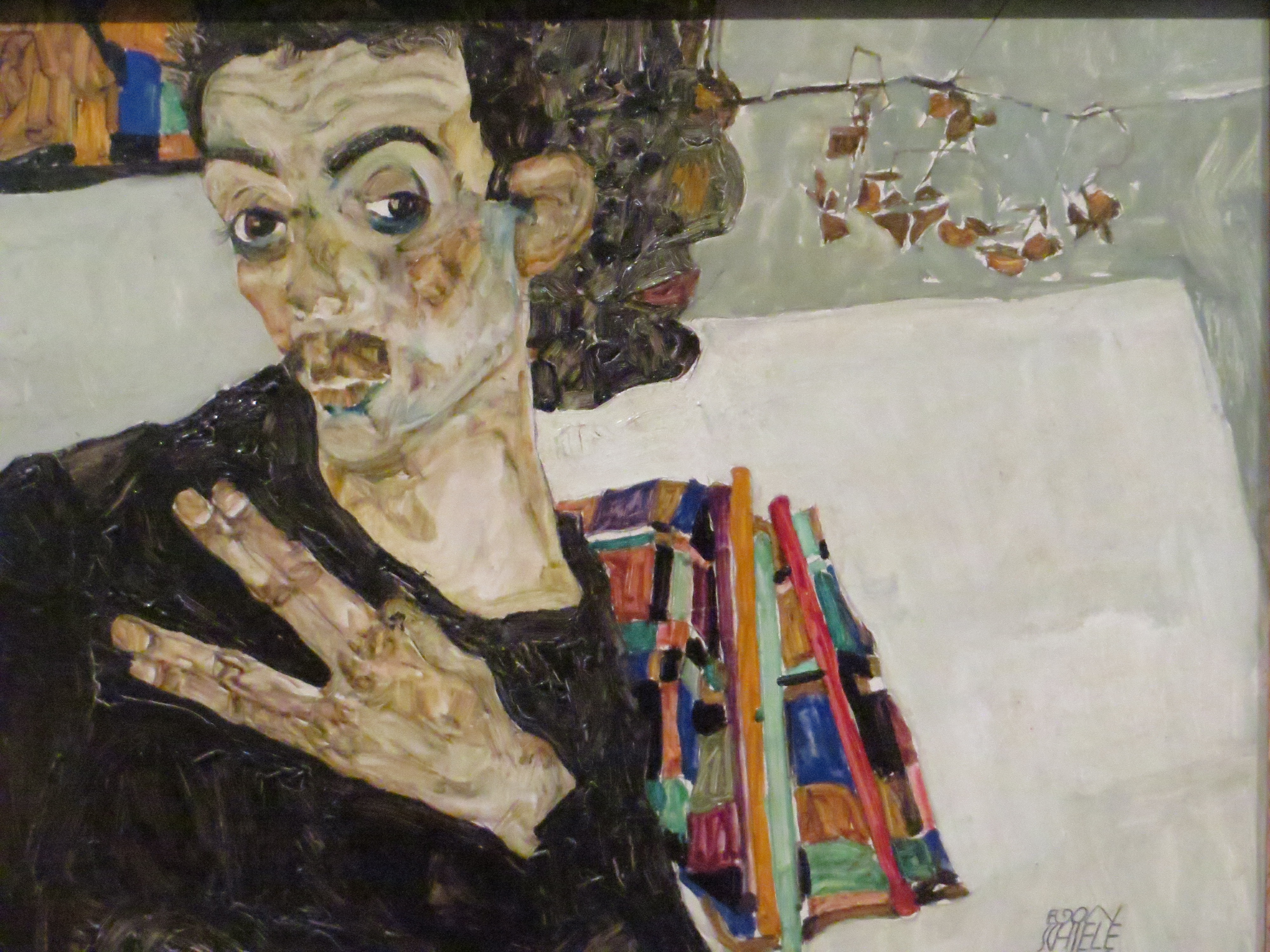
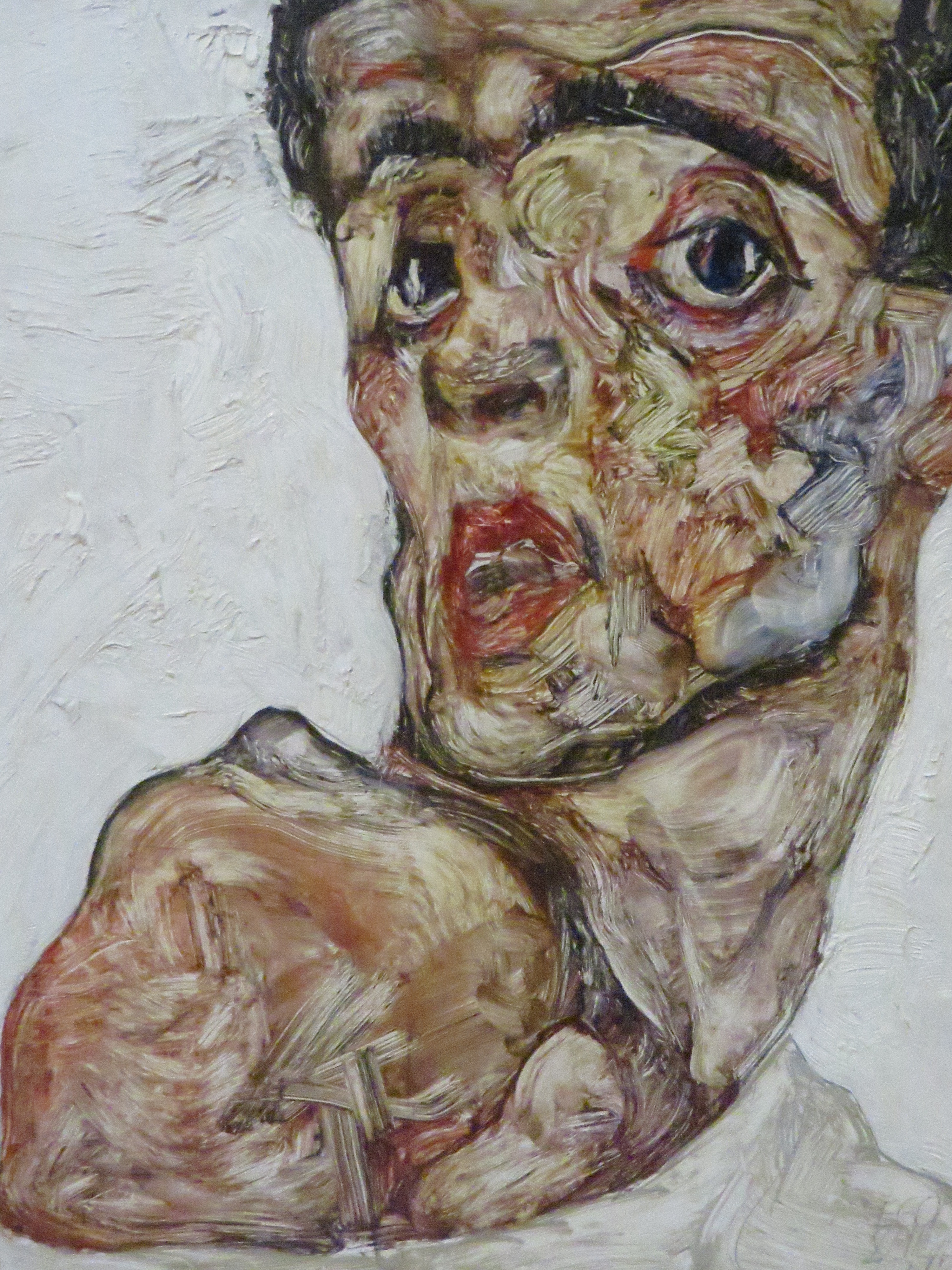
As its titular leader, Klimt was the foremost artist of the Secession. His world renown rests on his golden images of Adele Bloch Bauer and The Kiss. Egon Schiele was the Secession’s wild child, whose subjects still have the power to shock. However, it was the architect Otto Wagner and his student Joseph Maria Olbrich who transformed Vienna into a modern city, collaborating on the construction of the Vienna Stadtbahn. Another student, Josef Hoffman, renounced useless ornament in favour of simple squares. Inspired by the Arts and Crafts movement, Hoffmann and Kolo Moser founded the Wiener Werkstätte/ Vienna Workshops with financial backing from the industrialist Fritz Wärndorferin 1903. Advocating the concept of a building as a Gesamtkunstwerk or ‘total artwork’, Hoffmann’s greatest achievement was the Palais Stoclet, Brussels (1905-11)
Over three lectures I will explore the paintings, architecture, and design of fin de siècle Vienna.
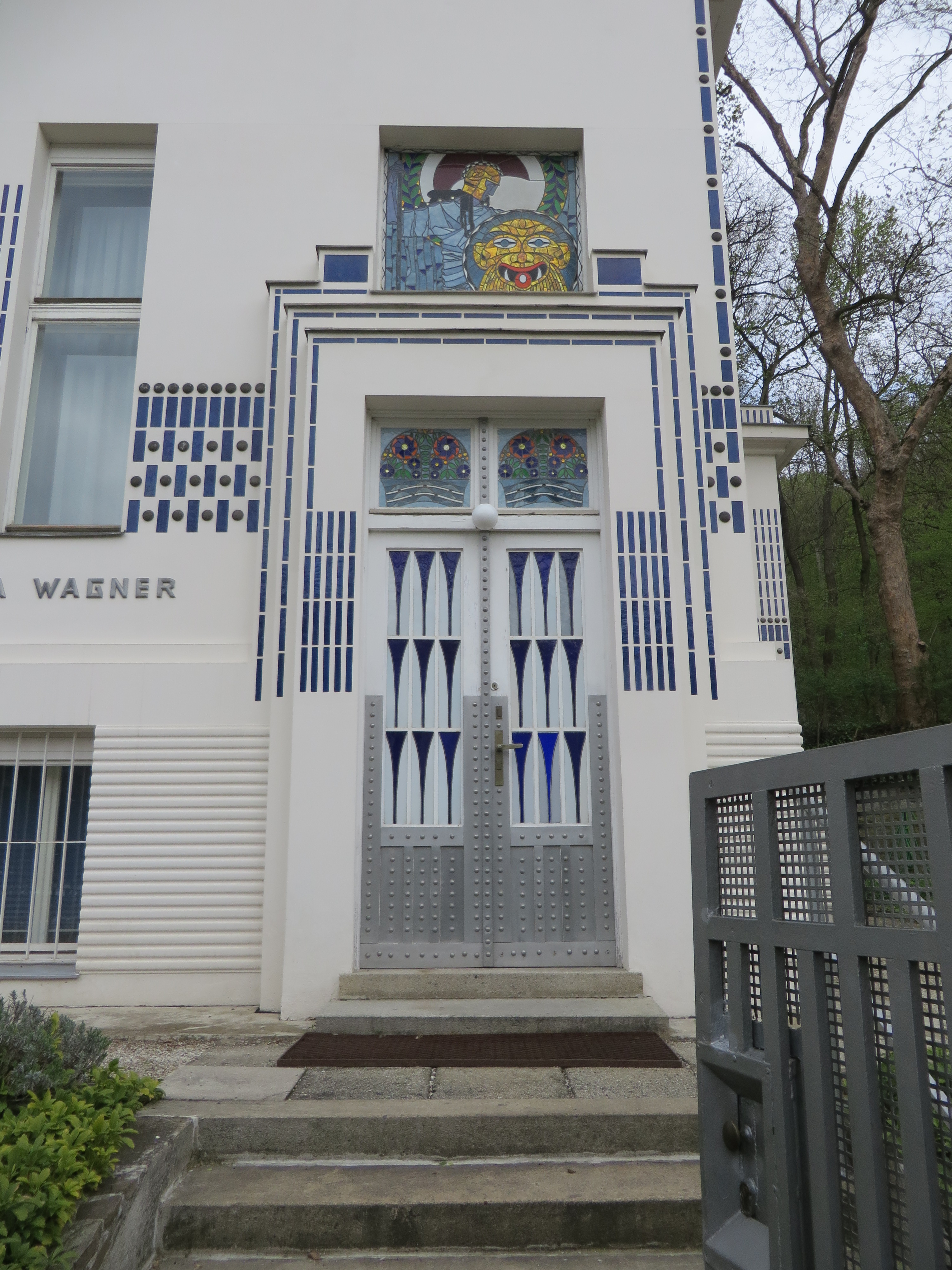
The architecture of the Vienna Secession: from Otto Wagner to Adolf Loos
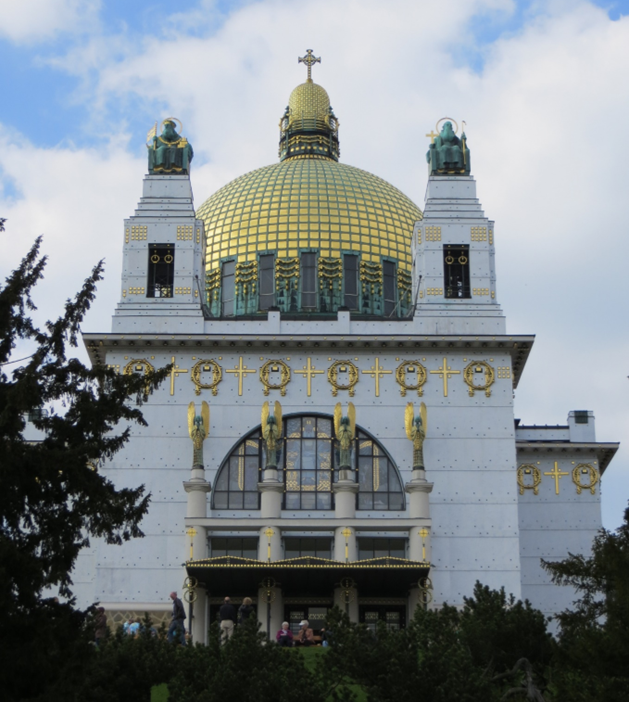
Olbrich’s Secession House (1898), known locally as the ‘Golden Cabbage’, and Wagner’s House with medallions (1898/99) set the tone for the white and gold phase of the Secession. The commission for the Church of St Leopold/ Kirche am Steinhof (1902/07) allowed Wagner to realise his dreams for a modern style of church construction. At the centre of a large new psychiatric hospital, this ‘total artwork’ is both beautiful and practical.
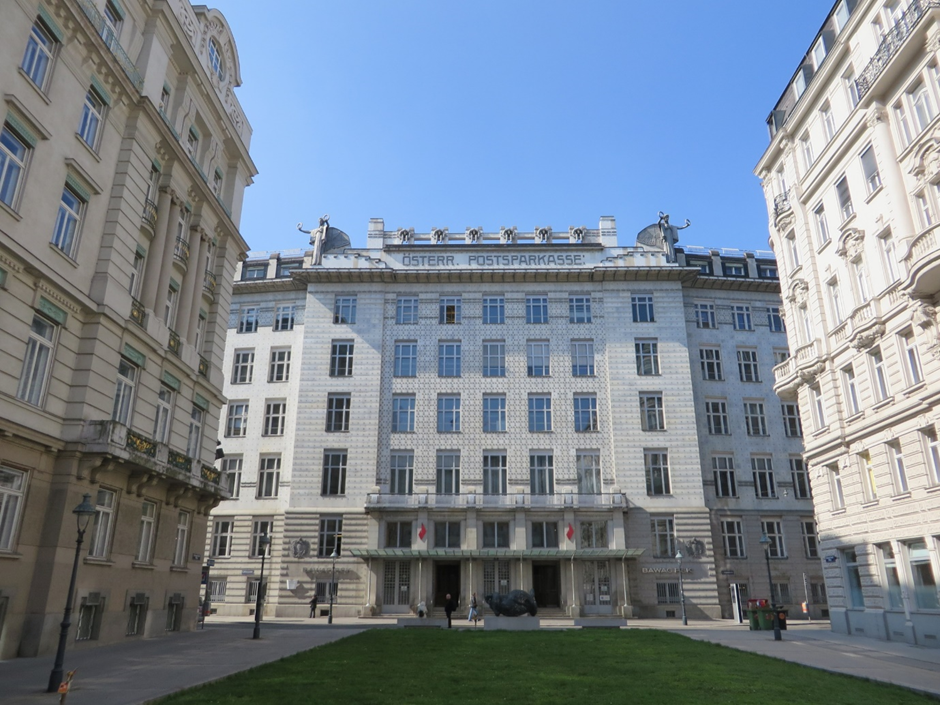
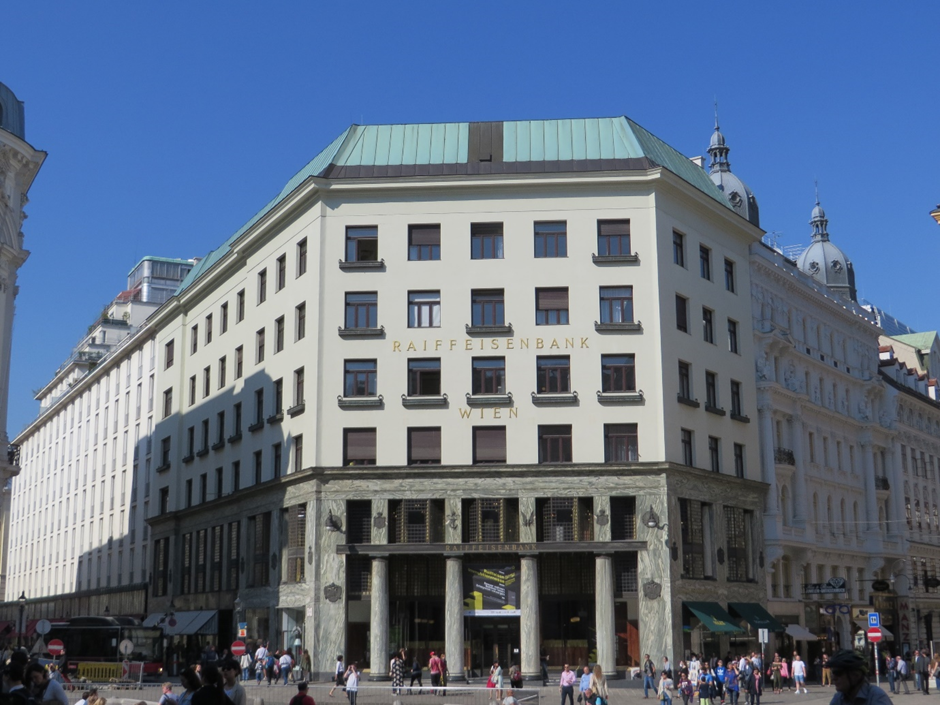
Declaring ‘Necessity is the only mistress of art’, practically led Wagner to develop a Nutztil or ‘Use-Style’ for the Österreichische Postsparkasse/ Austrian Postal Savings Bank (1904-06). Architect Adolf Loos went even further declaring ornament to be a crime! Lavish decoration was to be swept away by smooth and clear surfaces. The Looshaus (1912) exemplifies his functionalist outlook. Yet although starkly plain, the building uses sumptuous materials. Its nakedness was an affront to emperor Franz-Joseph’s sensibilities. Loos conceded to his objections by adding some decoration, flowerpots!
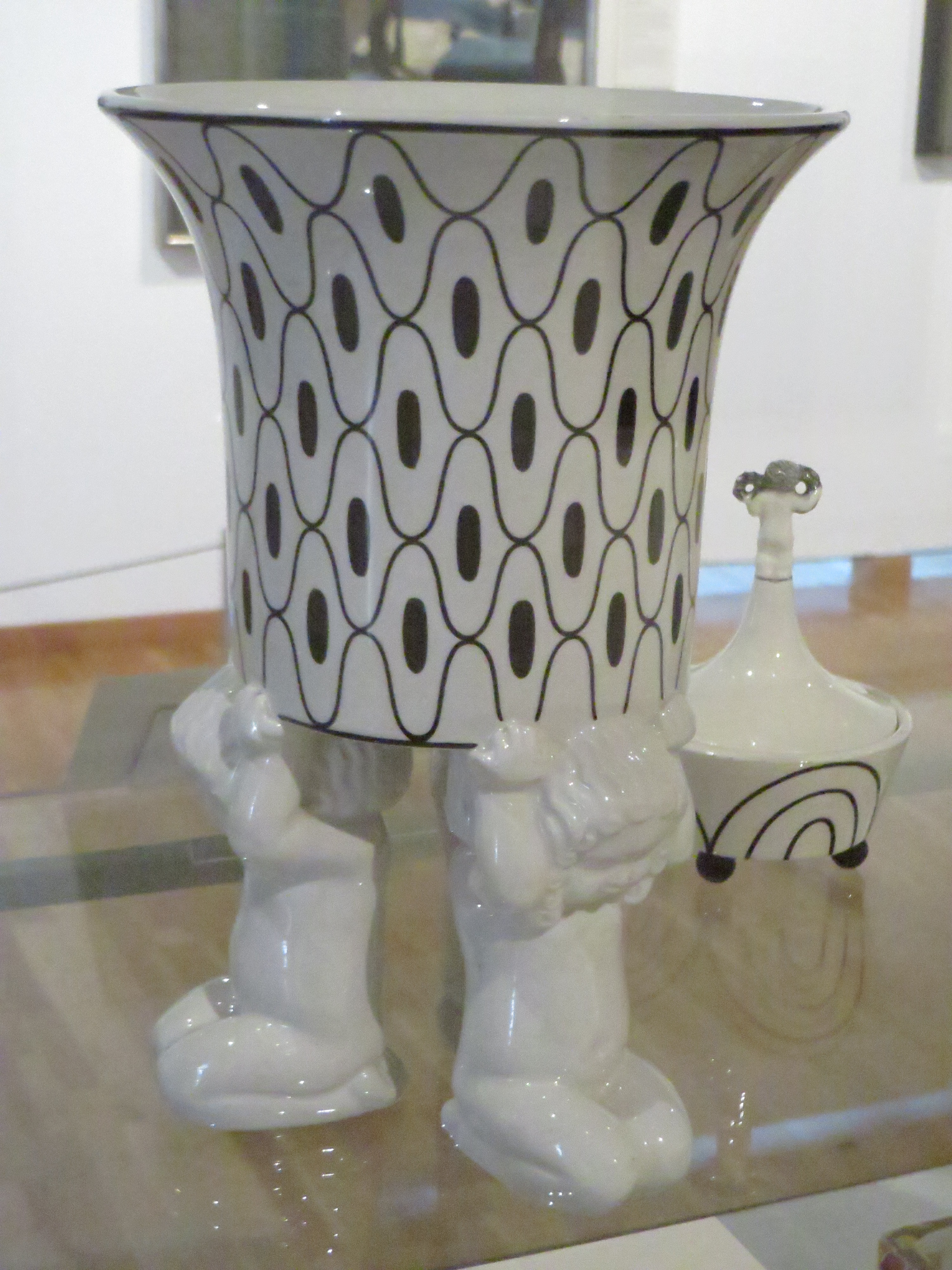
The Wiener Werkstätte: the designs of Josef Hoffmann and Koloman Moser
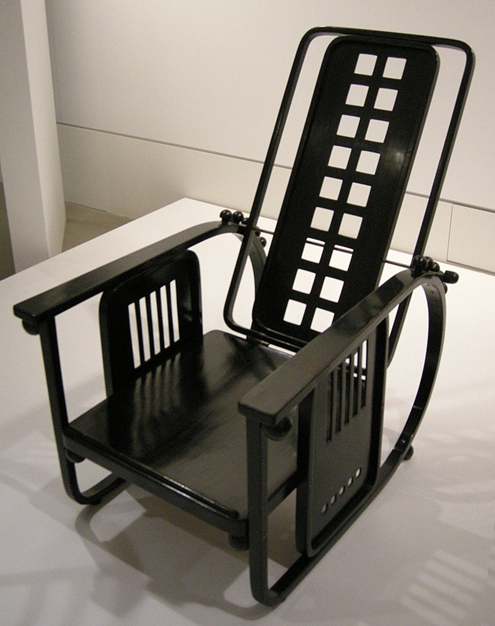
Inspired by the English Arts and Crafts ethos, artist designed hand-crafted products, Hoffmann and Moser founded the Wiener Werkstätte. The range of products was inclusive, furniture, metalwork, ceramics, leatherwork, bookbinding, postcards, jewellery, and clothing. Influenced by Charles Rennie Mackintosh and Margaret Macdonald, who showed their designs at the 8th Secession exhibition of 1900, they adopted a restrained, linear style rather than the organic curvilinear forms associated with Paris and Brussels. The square and grid, often expressed in black and white, would become the signature of the Wiener Werkstätte, as seen in Hoffmann’s Sitzmaschine Armchair (1905) and Glitterwerk metal baskets (c.1906-1916). Hoffmann’s constant use of squares and cubes earned him the nickname Quadratl-Hoffmann (“Square Hoffmann”). Similarly, Moser’s design for a wallpaper, Die Reifezeit (Harvest Time) (1901), is dominated by a black and white grid pattern.
Gustav Klimt, Egon Schiele, and Freud
Klimt and Schiele tackled taboo subjects; Klimt celebrated the sexualised woman, while Schiele was fascinated by the fragility of youthful innocence. With the advent of psychoanalysis, both artists appear to reflect the thinking of Sigmund Freud. Critics accused them of creating pornography, of revelling in the sordid and bringing art down into the gutter. In today’s climate of ‘political correctness’, audiences might still be shocked by their subject matter. However, with the distance of time, their works allow us to tackle sensitive issues allowing us to explore aspects of the human condition, especially birth and death, love and loss and desire.
Please join me to explore the Vienna Secession
Lecture One Architecture
The architecture of the Vienna Secession: from Otto Wagner to Adolf Loos
£7.00
Lecture Two Design
The Wiener Werkstätte: the designs of Josef Hoffmann and Koloman Moser
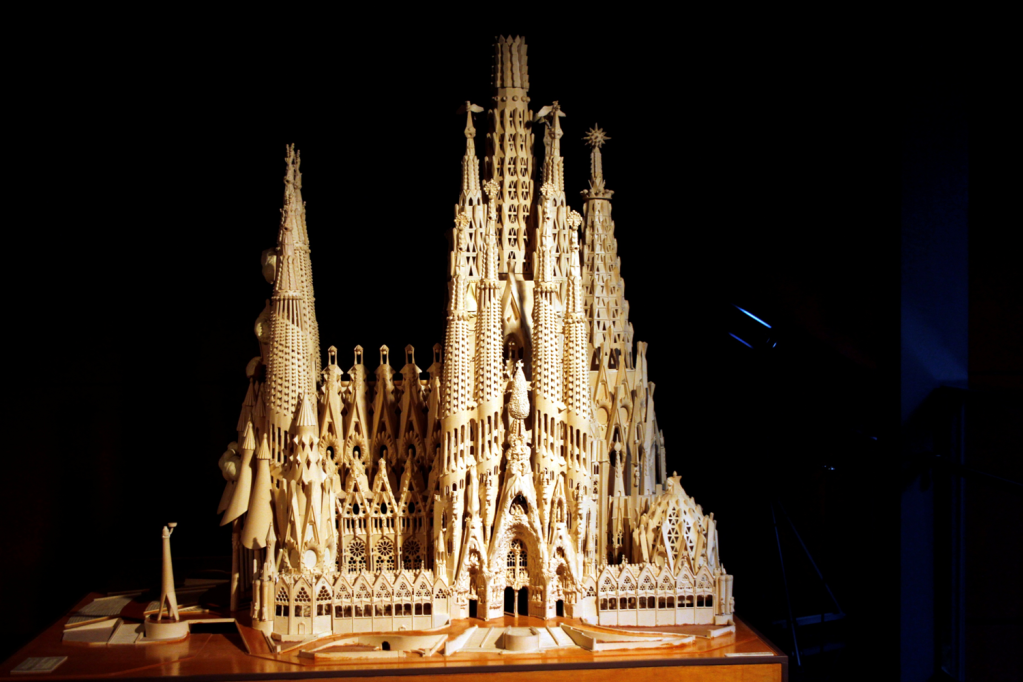
I am all too often asked when Gaudi’s Sagrada Familia, often mistaken for the city’s cathedral, will be finished. Hopefully in 1926 to celebrate the centenary of his death.
Everything about Gaudi is larger than life including his death. Knocked down by a tram, the shabbily dressed architect was mistaken for a tramp and failed to receive proper medical treatment. He died three days later in a pauper’s ward. Thousands citizens attended the funeral of ‘God’s architect’. He was buried in the crypt of his beloved Sagrada Familia, the ’magna opus’ which had dominated his every waking moment since 1915. Becoming a virtual recluse Gaudi lived and worked on the site. Yet very little was completed upon his death, only the crypt, apse, and part of the Nativity façade. After WW1, the Sagrada Familia was ridiculed as a folly. In the age of austere international Modernism, Gaudi’s uniquely personal vision was not appreciated. His workshop was vandalised during the Spanish civil war in 1936, with many precious plans and models destroyed. However, in the 1950s another visionary artist, Salvador Dali, began to champion Gaudi. Today, partly thanks to the Olympics held in Barcelona in 1992, few have not heard of the Sagrada Familia, the church’s unfinished state adding an intriguing twist. Some 2.5 million people visit it each year, the ticket money going towards the cost of completion.
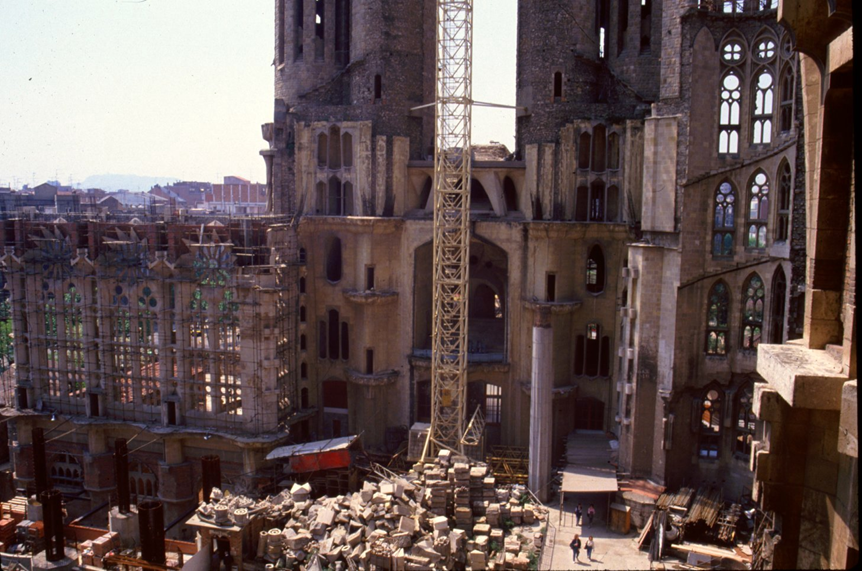
When I first saw Gaudi’s Sagrada Familia in the mid-1980s, the building could have been mistaken for a ruin rather than a building site. By that stage the Nativity façade had been completed but the shell of the nave had no roof.
Construction of the Sagrada Familia Church in the spring of 1988.
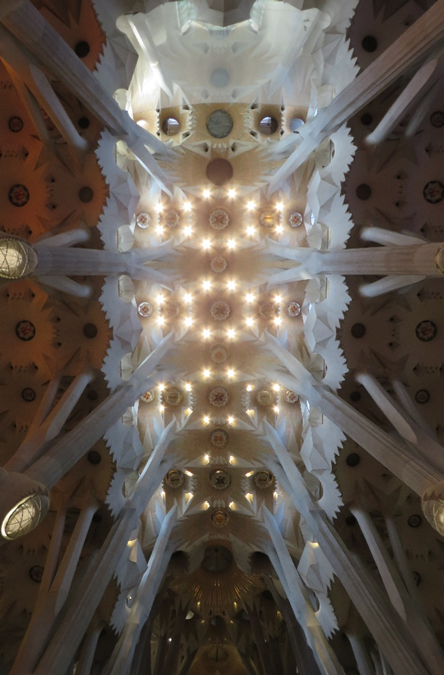
The mind-numbingly mathematically complex stone vaults, using helicoids, hyperboloids, and hyperbolic paraboloids, covering the nave and transepts were finally completed in 2010 and the basilica consecrated by Pope Benedict XVI. Looking up at the vault, Gaudi envisioned a dense canopy of trees with sunlight shining through.
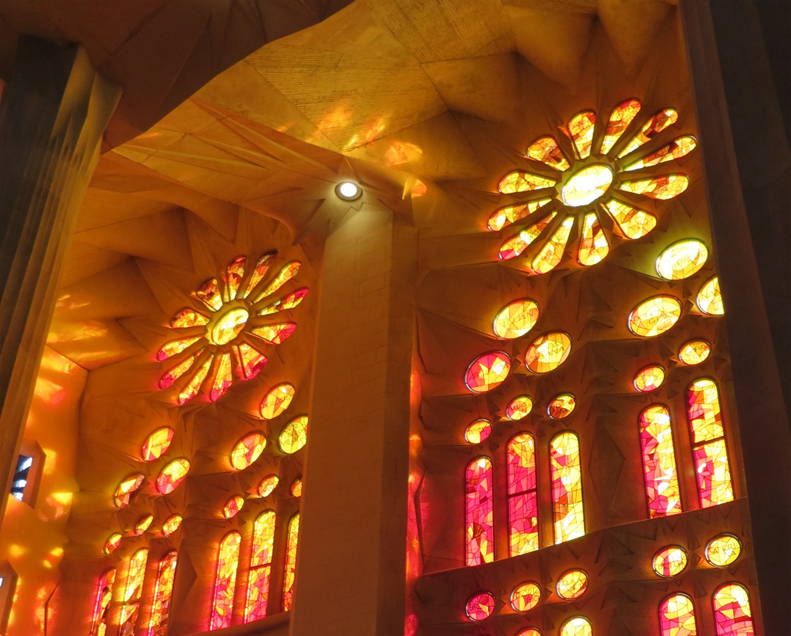
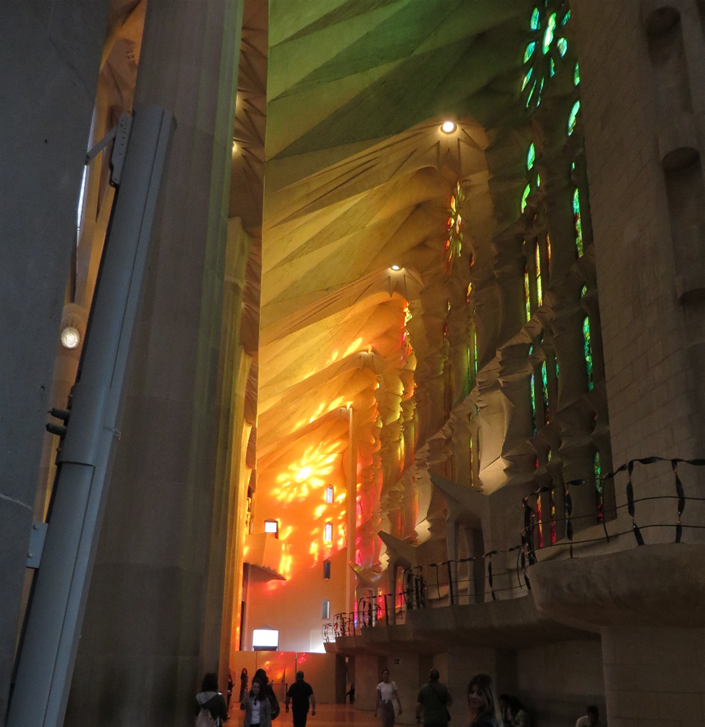
This luminous effect was brought to life once the stained-glass windows by Joan Vila-Grau were installed. Positioned east/west, the light streaming through passes from cool blues and greens in the morning to the vibrant yellows, orange and red of sunset. Inspired by Tiffany, Gaudi experimented with coloured glass at La Seu, the cathedral in Palma de Mallorca. He envisioned a symphony of coloured light with‘the light gliding over the windows like water over pebbles.’ Using leading and glass of different textures and thickness, Vila-Grau was able to achieve Gaudi’s luminism.Despite all the tourists, a mystic light imbues the church with a soul, creating a transcendent atmosphere. Many are moved by the experience.
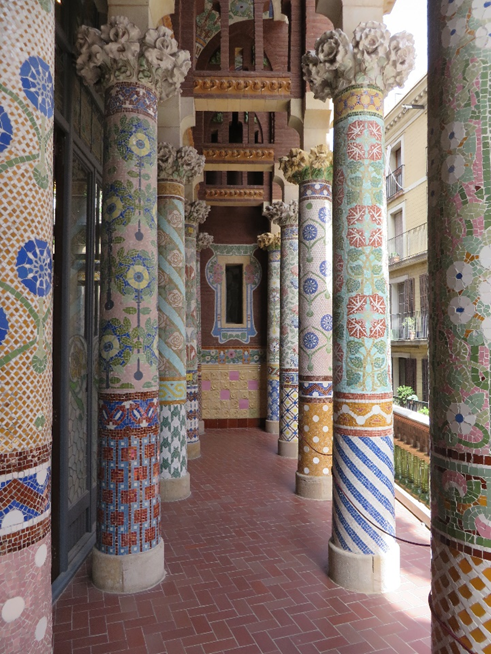
Many visitors are equally in astonished by the interior of the Palau de la Música Catalana, created by Barcelona’s other outstanding Modernsita architect Lluís Domènech i Montaner. The city boasts many masterpieces by Domènech: the Hospital de Santa Creu i Sant Pau, the Casa Lleo Morera and the Hotel Espana, where I longingly hope to stay one day!
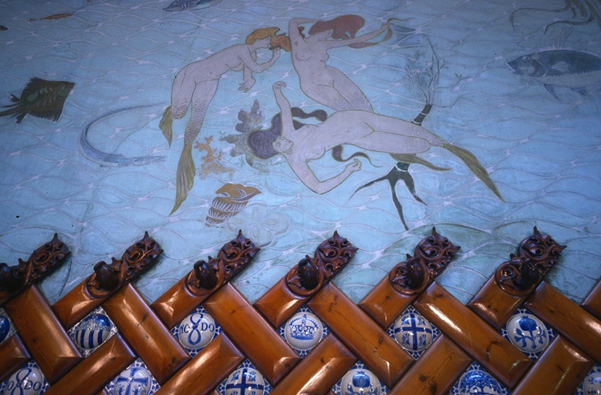
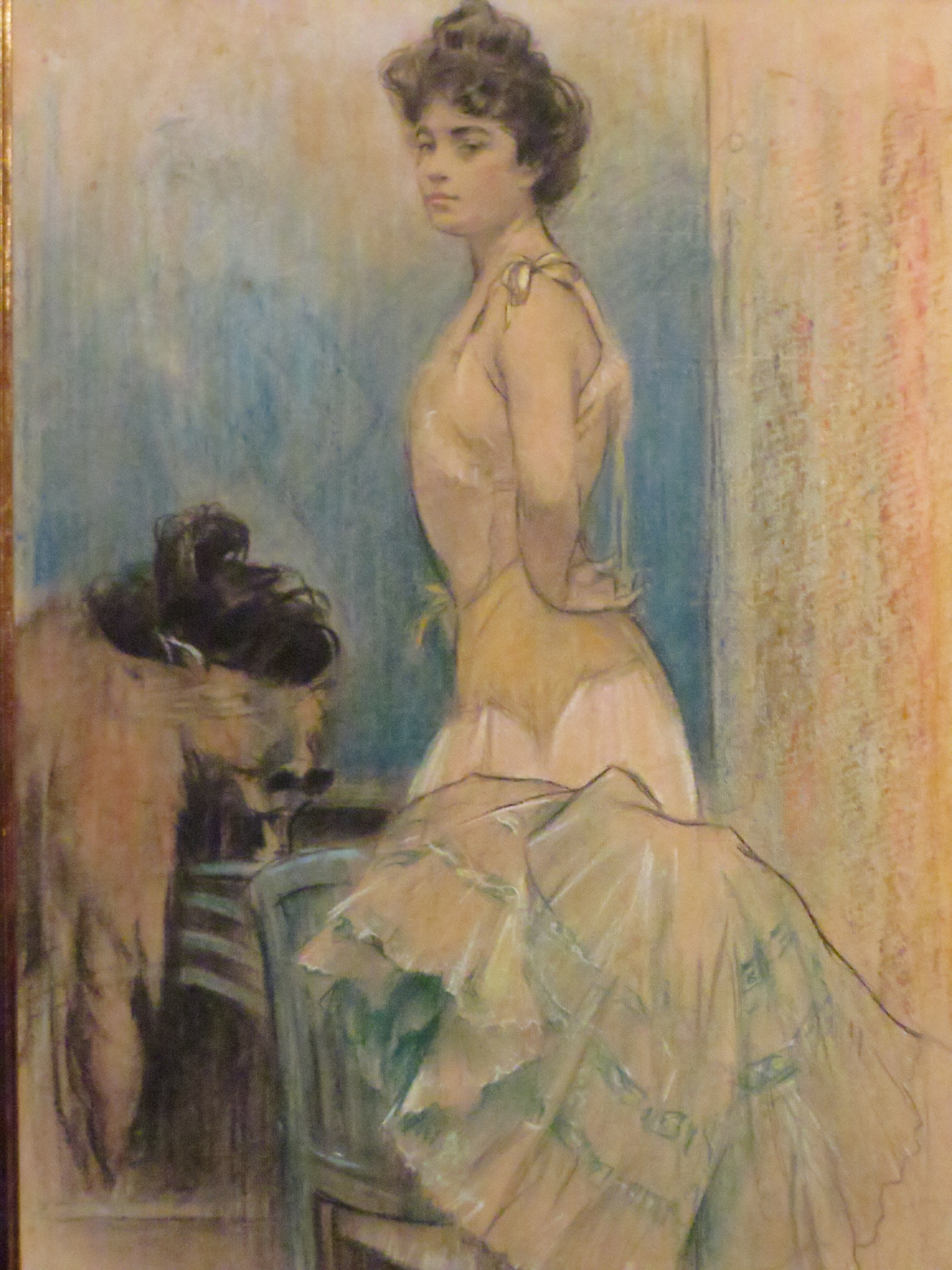
The Saló de les Sirenes (Mermaids Room), with paintings attributed to Ramon Casas, now serves as the Breakfast room.
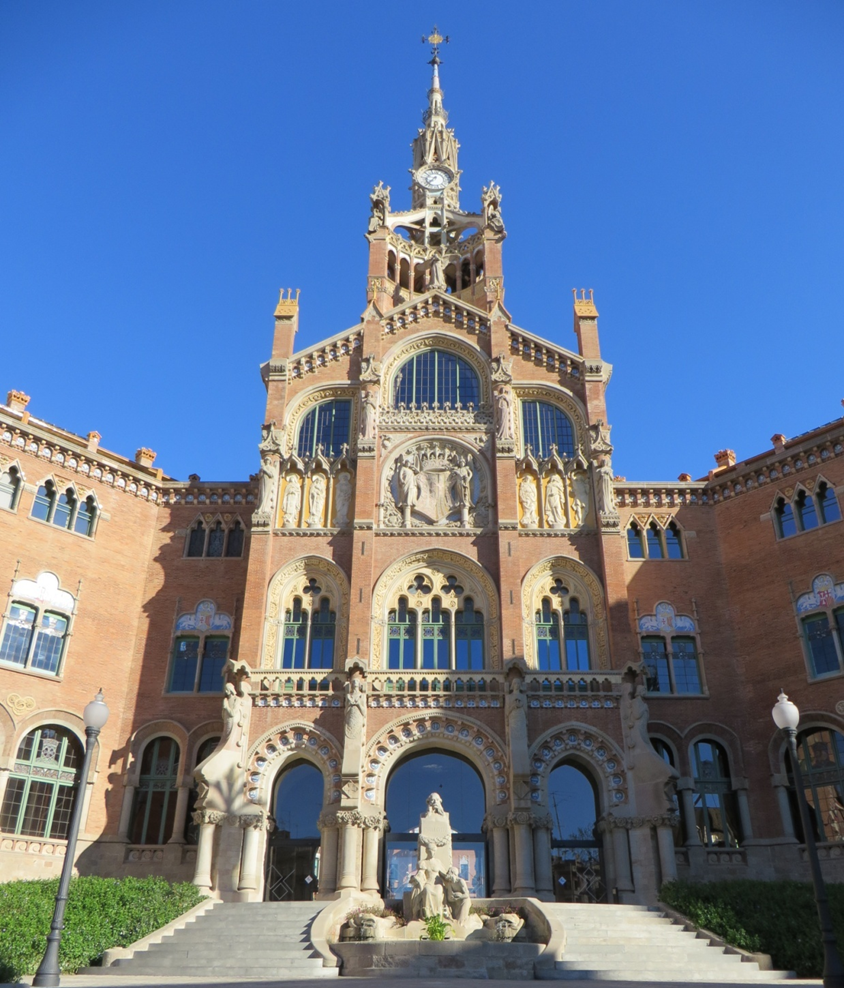
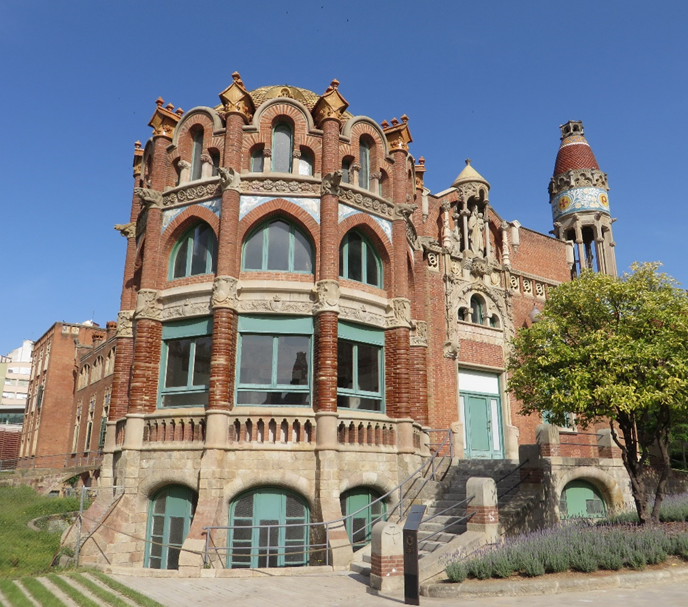
Domènech, Hospital de la Santa Creu i Sant Pau 1901-30
In fact, Barcelona is awash with Modernista, the Catalan name for Art Nouveau, with around 1000 buildings designated of architectural interest. However, Barcelona’s Modernista buildings belong to a much wider cultural Renaissance or Renaixença. Modernisme encompassed all aspects of Catalonian culture, literature and music as well as painting and the decorative arts. This can be read as a form of National Romanticism, an attempt to assert Catalonian identity in the face of ‘oppression’. As Catalonia grew in wealth and power, the region strove to re-establish its national identity, separate to Castilian Spain, firstly by restoring its language after 150 years of repression and secondly by a conscious injection of modern ideas.
With defeat in the 1898 Cuban War, and the ensuing loss of its last overseas colonies, Spain seemed mired in nostalgia, unable to grabble with the loss of imperial status. Against the image of an isolated decadent Spain, arose the vision of a modern European Catalonia driven by industry and commerce. Entrepreneurs, a mercantile class that had reaped the benefits of industrialisation and colonisation, saw the benefits of supporting Modernista architecture: Eusebi Güell i Bacigalupi, 1st Count of Güell, initially made his fortune from textiles; the fortune of Pere Milà and his wife Roser Segimón came from coffee plantations in South America; and Josep Batlló i Casanovas, a textile industrialist, married Amàlia Godó Belaunzarán, from the family that founded the newspaper La Vanguardia.Casa Amatller celebrates the fortune made by Antoni Amatller i Costa from coco and chocolate. Architects and patrons came together, devising a ‘coherent cultural ideology’ based on Modernisme, Nationalism and Mercantilism.
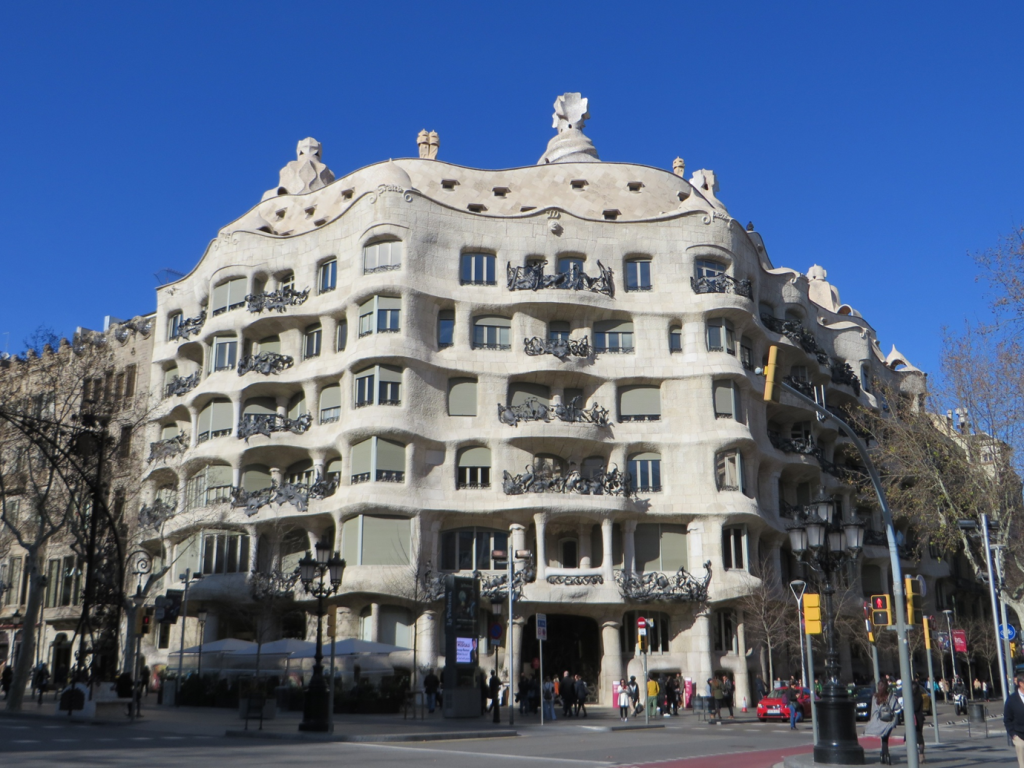
Antoni Gaudi, Casa Mila (La Pedrera), 1906-1912
Join me to explore three aspects of Catalonia Modernisme, the work of Gaudi, Domènech and the impact of Realism and Impressionism on Catalan painting.
Antoni Gaudí i Cornet
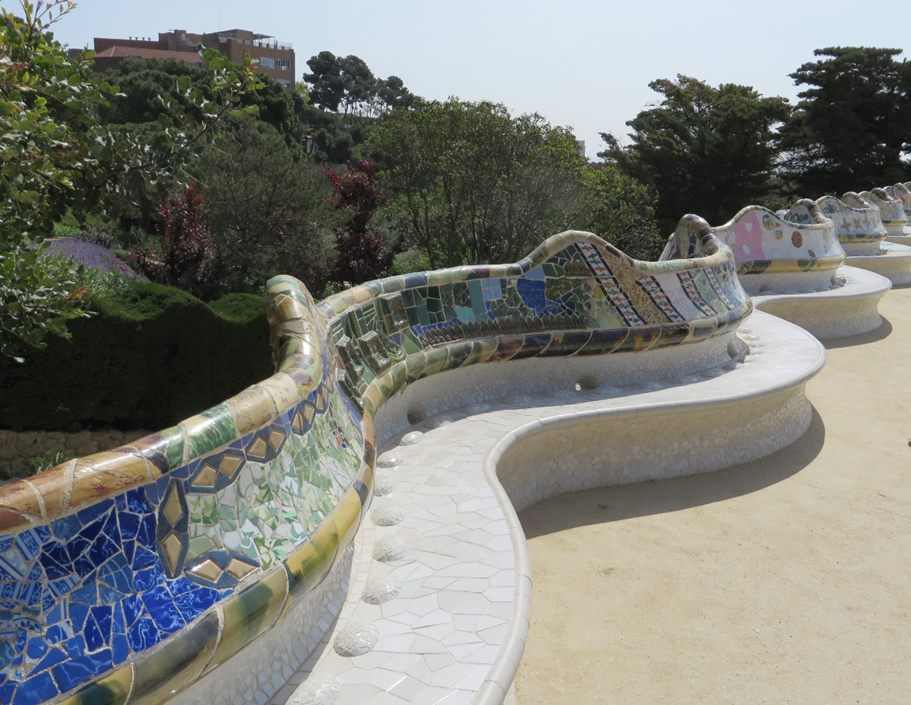
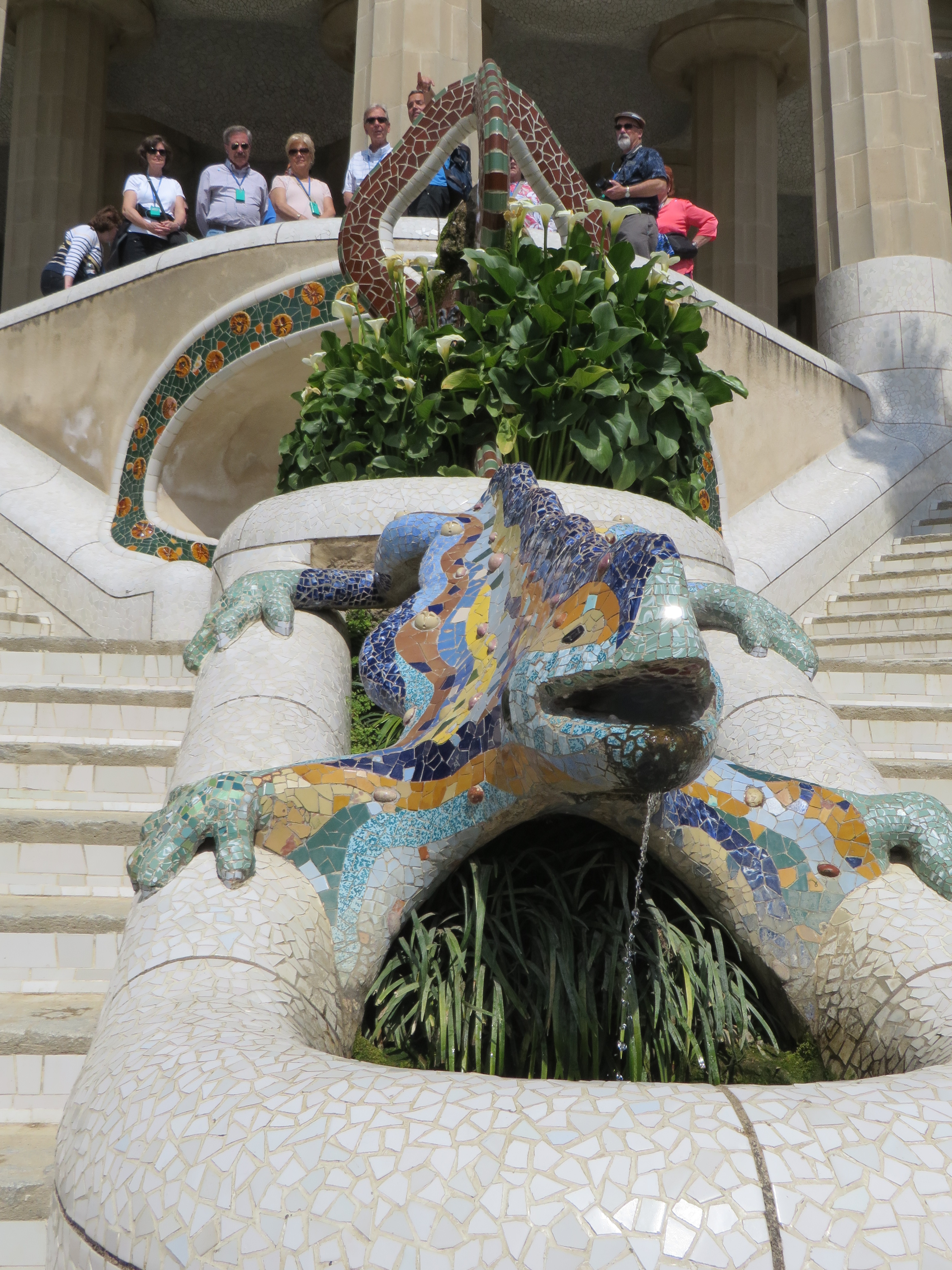
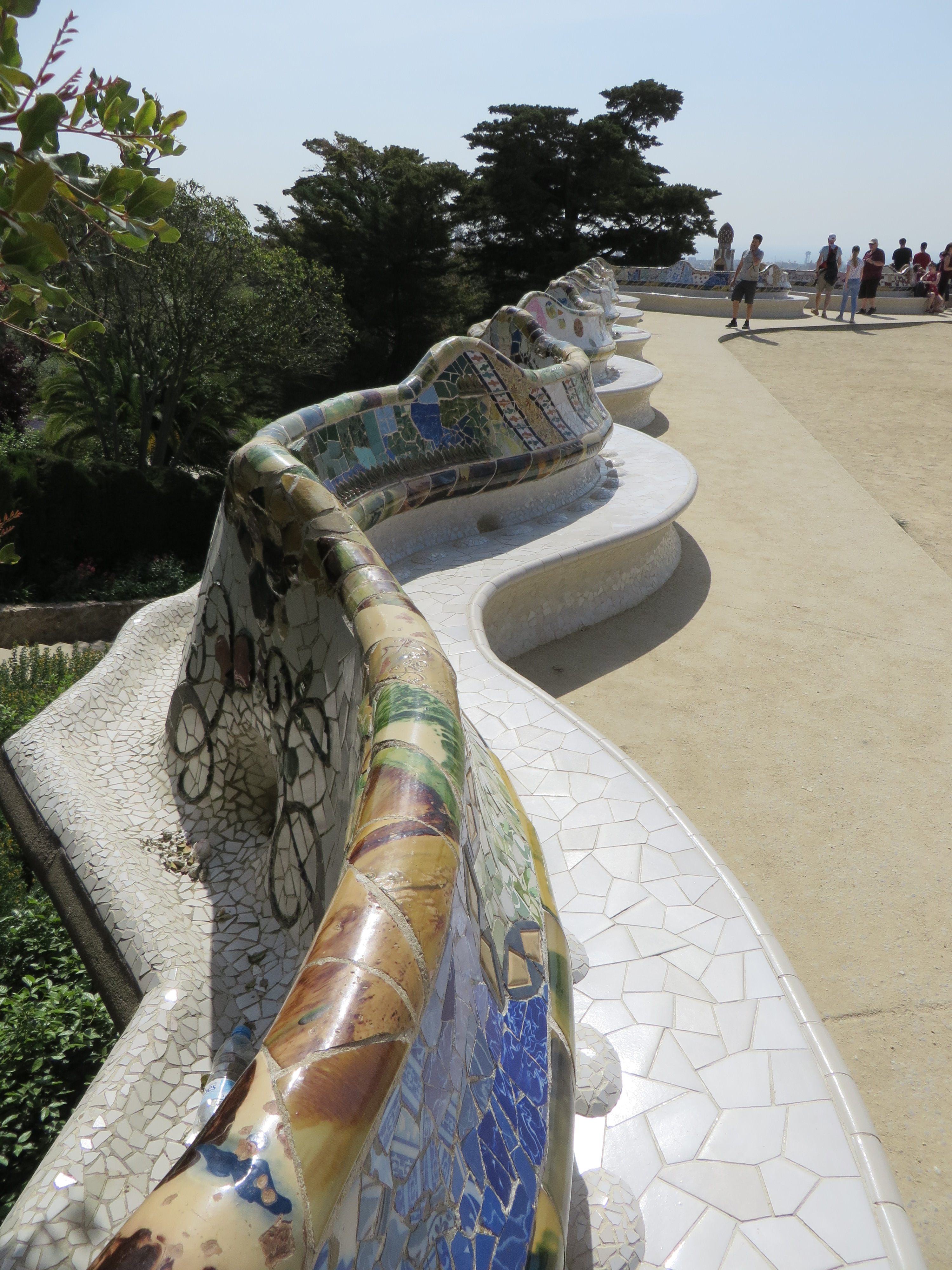
Gaudi took the tenets of Modernista architect to daring extremes and developed a style unmistakably his own, as seen in the serpentine curves of the bench of the Park Güell (1911-13), the undulating forms of the Casa Milà (1906-12) to the impossibly grandiose Roman Catholic Temple Expiatori de la Sagrada Familia (1882-), where nature informs both the structure and the decoration. His designs came ‘from the Great Book of Nature’, with his ‘textbooks’ the mountains and caves he loved to explore. Many have criticised Gaudi for his flamboyant style, in many ways a reworking of Gothic forms. George Orwell, who declared La Sagrada Familia to be ‘one of the most hideous buildings in the world’, rather hoped it would be destroyed during the Spanish Civil War. Yet Louis Sullivan, said to be the ‘father of skyscrapers’, described it as ‘spirit symbolised in stone.’ For Manuel Vicent, writing in El Pais, the building’s only saving grace was being unfinished, ‘the dream of a genius driven crazy by mystic reveries.’ La Sagrada Familia came to dominate Gaudi’s life, as the intensely pious architect abandoned other projects. He sought to bring his experimental forms, tried out at the Park Güell and the crypt of the Colònia Güell, to fruition creating a church that was at once structurally perfect, aesthetically satisfying and spiritually fulfilling.
Bench of the Park Güell (1911-13)
Domènech i Montaner
Considered the father of Modernisme, Domènech launched his unique style, blending Gothic with Moorish forms, with the Castell de Tres Dragons (1888), in the Parc de la Ciutadella. Serving as a restaurant during the 1888 Universal Exhibition, this marks the moment Barcelona asserted its identity as both Catalonian and modern. The son of a bookbinder, Domenech was a multi-talented intellectual, who engaged in politics, journalism, botany and heraldry amongst other interests. Aside from holding a 45-year tenure as a professor and director at the Escola d’Arquitectura, he orchestrated the mammoth project of the Hospital de Santa Creu i Sant Pau (1902-1930).
Hospital de Santa Creu i Sant Pau (1902-1930)
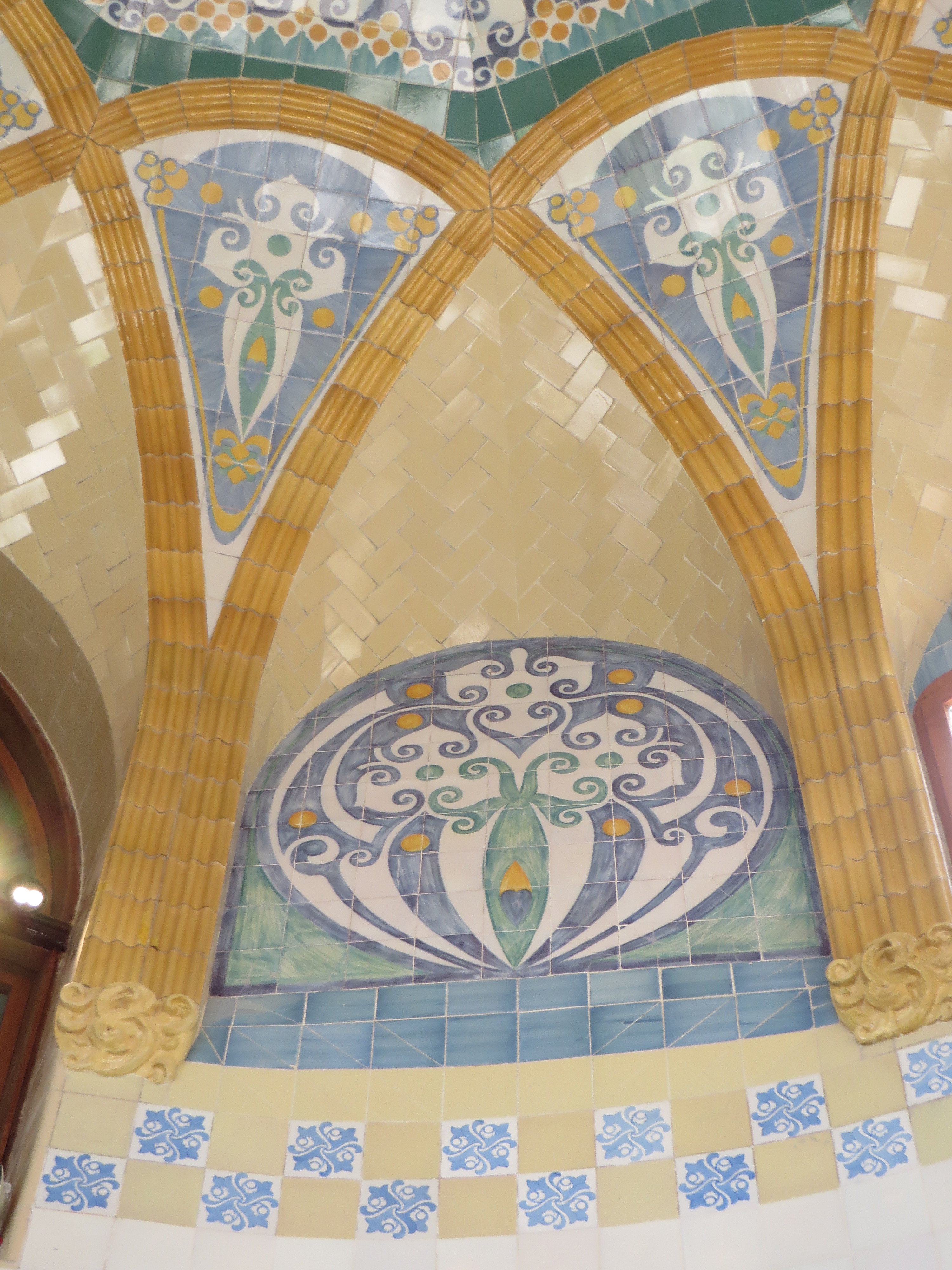
The Casa Lleó Morera, with furniture and joinery by Gaspar Homar and Josep Pey, as well as sculptures by Eusebi Arnau and stained glass by Antoni Rigalt, is a tour de force, a perfect expression of the gesamtkunstwerk that draws on the talents of several leading artists. Nevertheless, his most stunning contribution to Modernista is the Palau de la Musica Catalana (1905-08), another collaboration drawing on the talents of Lluis Bru i Salelles for the exterior mosaics and Dídac Masana i Majó and Pablo Emilio Gargallo Catalán for the mind-blowing monumental sculptures of the proscenium arch.
Palau de la Musica Catalana (1905-08)
Modernisme: Catalan Painters from Marià Fortuny to Pablo Picasso
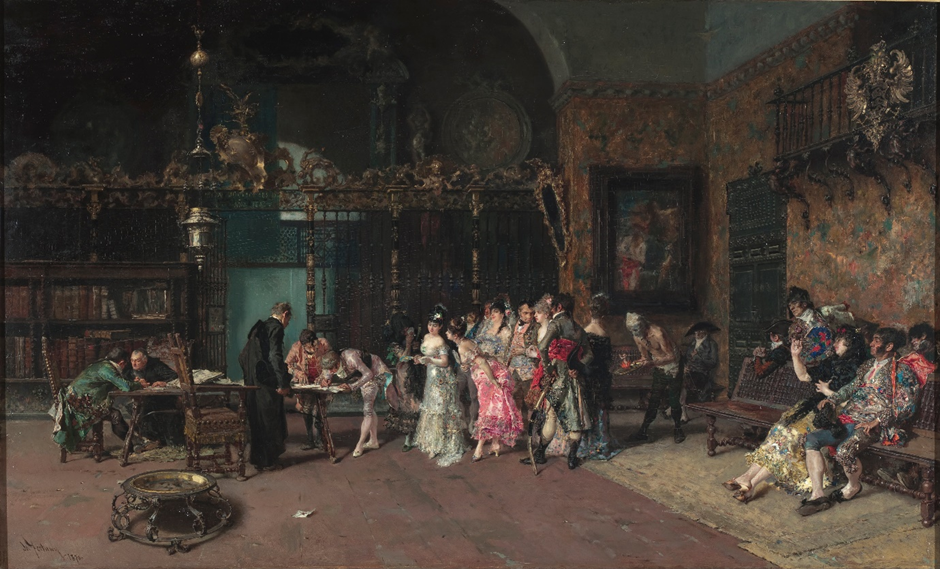
Many are under the misapprehension that Marià Fortuny was Italian. This mistake arises from the famous fashion House of Fortuny, based in Venice, which was founded by his son Mariano Fortuny. Sadly, Mariano never knew his father, the leading Spanish painter of his day, as he died when his son was only three. Fortuny, who shares the same birthplace as Gaudi and Domènech, Reus, near Tarragona, is credited with developing Costumbrismo, thepictorial interpretation of local everyday Hispanic life, customs (costumbres) and traditions. Although costumbrist painters focused on the precise representation of people and places, allying them to realism, the emphasis on colourful historic dress and events such as fiestas, bull fights and religious festivals, also ties them to romanticism. Fortuny’s vivacious iridescent brushstroke brought new life to Costumbrismo and established Hispanic life as a worthy subject. He paved the way for the next generation, the Modernisme painters.
Marià Fortuny, The Spanish Wedding, 1870
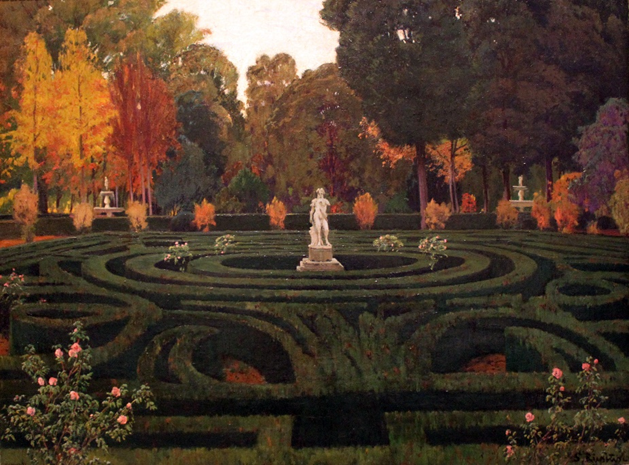
Through his posters and other graphic works, Ramon Casas (1866-1932) helped to define Catalan Modernisme. He was one of the founders of the café Els Quatre Gats (Four Cats), so named as in Catalan this expression means ‘weird’ people, namely artists, writers, and outsiders. The café was opened in 1897 by four artists- Miguel Utrillo, Pere Romeu, Santiago Rusiñol (1861-1931) and Casas. It soon became a meeting place for the avant-garde. The same circle of artists founded the art magazine of the same name, illustrated by themselves, in which they also voiced their ideas and opinions.
Santiago Rusiñol i Prats, Gardens of Aranjuez, 1911
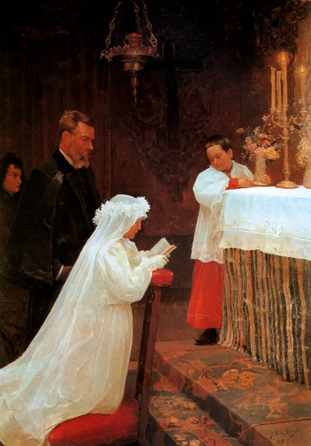
Exhibitions and concerts were held at the café, providing opportunities for younger artists: Pablo Picasso (1871-1973) had his first exhibition at the Els Quatre Gats. Although born in Malaga, Picasso’s family moved to Barcelona in 1895. He thought of the city as his home, even learning Catalan. In his early works he often depicted Catalan life.
First Communion (1896), Picasso’s first painting, aged fifteen.
Please join me to explore Catalonia Modernisme: the architecture of Gaudi and Domènech and Catalan Modernist painting.
In the Art world, there is plenty to look forward to in 2023!
Two centenary’s that have caught my eye are Sorolla, ‘Spain’s master of light’ and the ‘Divine Sarah’, the greatest tragic actress of her age. Both died in 1923. Both centenaries will be marked with exhibitions in Madrid, Valencia and Paris. I have three lectures on Sorolla on open access…go to Anne Anderson Art and Design History Channel.
To mark Sarah Bernhardt’s centenary, the Petit Palais, Paris will be holding an exceptional exhibition from 14th April to 27th August 2023. With over 400 hundred exhibits ranging from costumes to paintings and photographs the exhibition will cover her amazing career as an actress and artist. To whet your appetite, I will be offering a one-hour lecture on the ‘Divine Sarah’ which will cover not only her stage career but also her complicated love life (she was bisexual) and success as a sculptor. It will pay special attention to the intersection of her career with that of Oscar Wilde. The two had much in common!
Please join me on Wednesday 25th January, at either 11am or 7pm BST to learn more about the ‘Divine Sarah’. For details of how to join go to the end of this blog.
‘The Divine Sarah’: Sarah Bernhardt (1844-1923), a modern celebrity
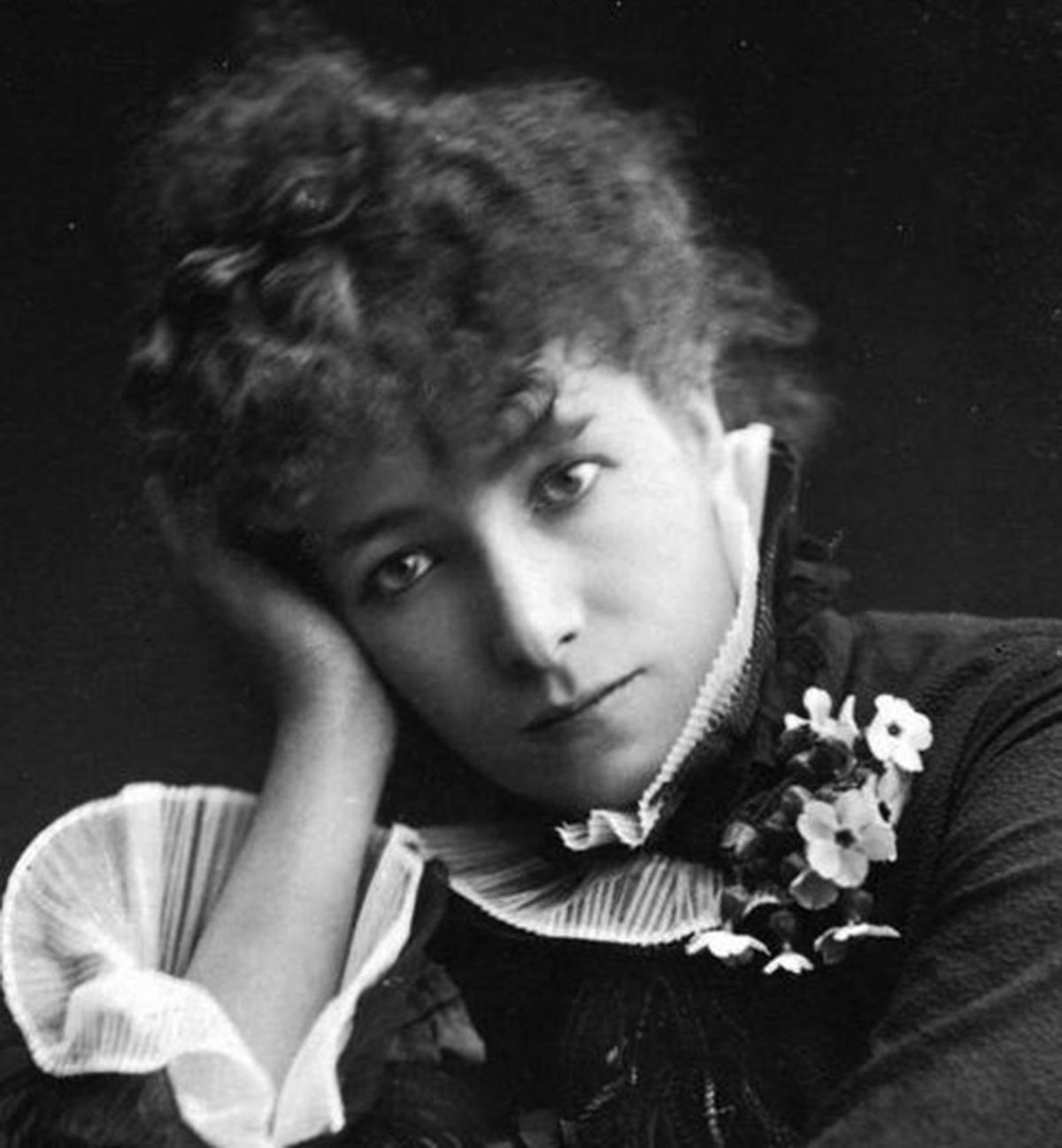
With her lyrical ‘golden voice’ and stage presence the ‘Divine Sarah’ held her audiences in thrall. As Mark Twain put it, ‘there are five kinds of actresses: bad actresses, fair actresses, good actresses, great actresses—and then there is Sarah Bernhardt.’ Artists hoped to paint her. Playwrights created roles for her.
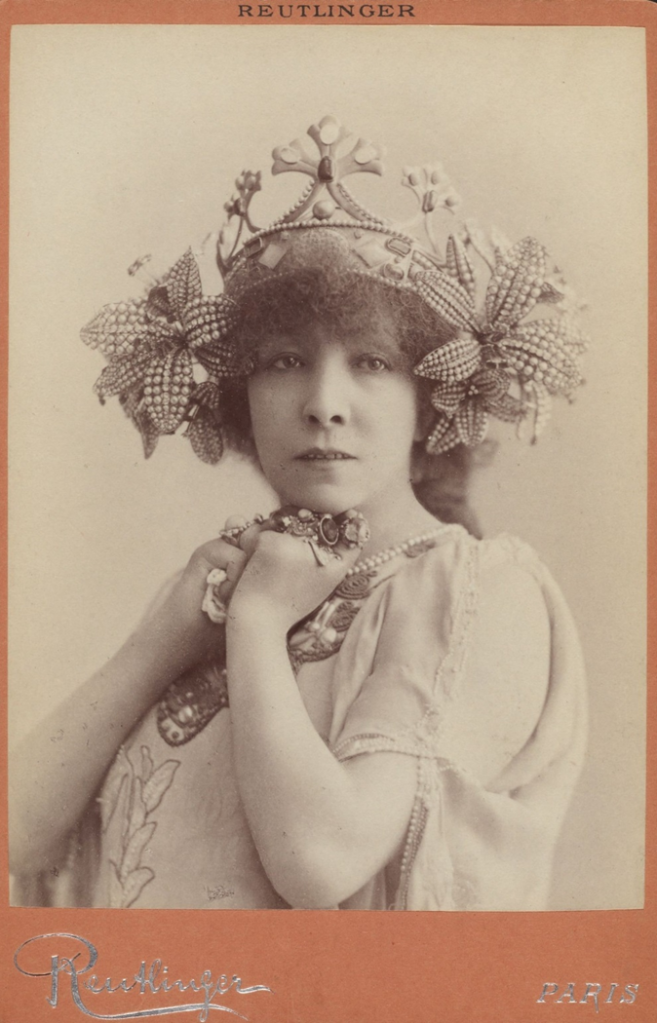
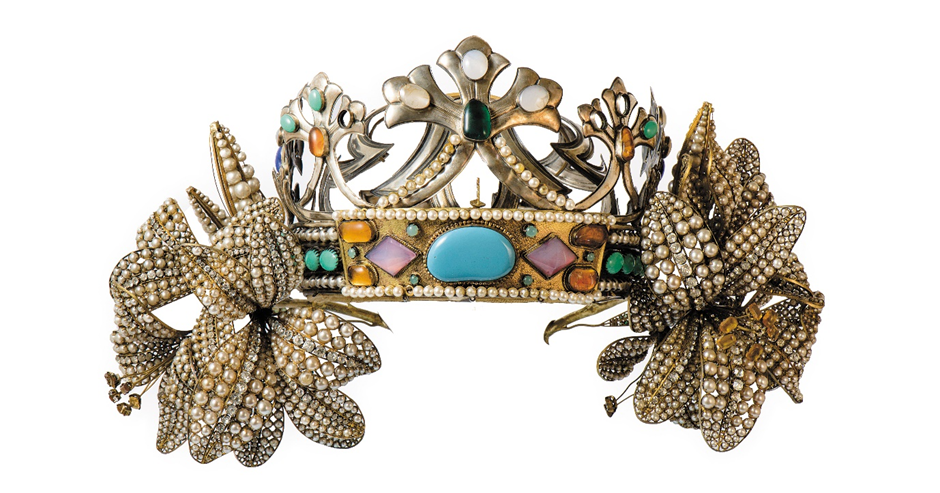
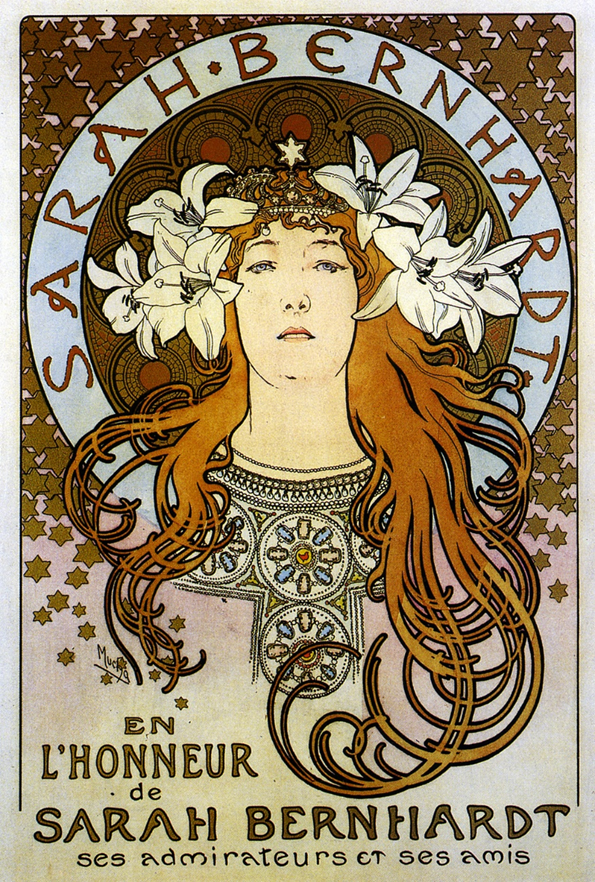
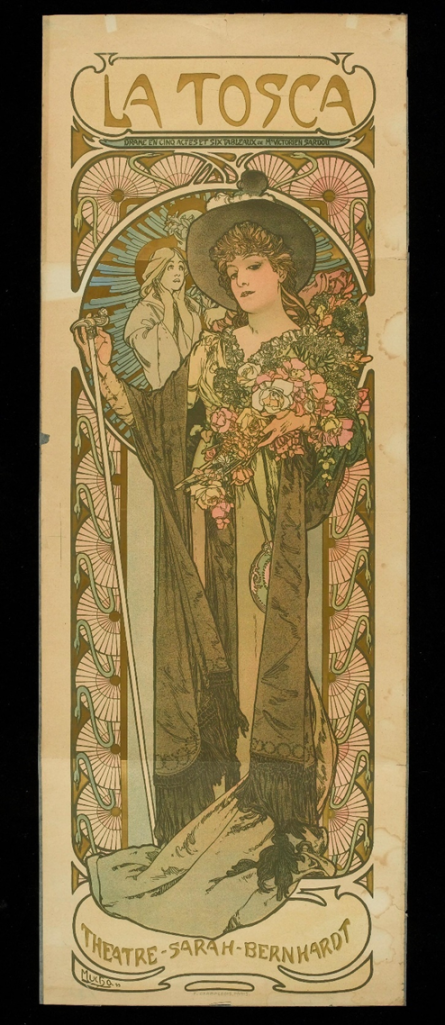
Edmond Rostand, who described her as ‘the queen of the pose and the princess of the gesture,’ wrote La Princesse Lointaine/The Unattainable Princess (1895) to display her talents. Rene Lalique designed her dramatic head-dress of bejewelled lilies, while Alphonse Mucha’s Art Nouveau posters immortalised the role.
Sarah Bernhardt as Mélisande in La Princesse Lointaine wearing the headdress designed by Alphonse Mucha and created by Rene Lalique (1895).
Alphonse Mucha’s posterin honour of Sarah Bernhardt
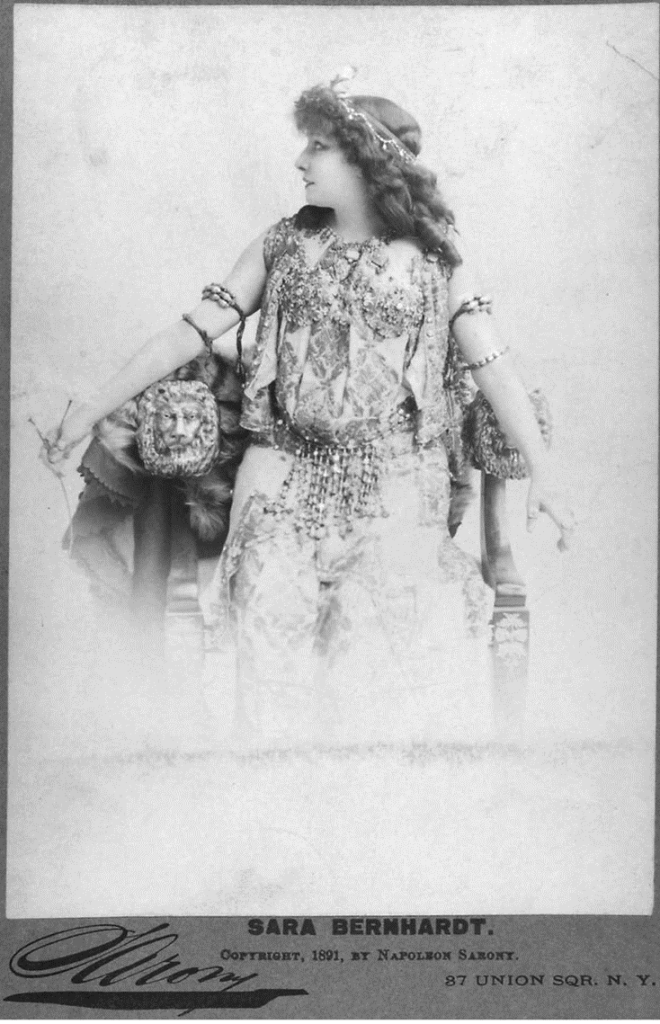
Victorien Sardou offered Bernhardt many melodramatic roles, writing Fédora (1882), Théodora (1884), La Tosca (1887) and Cléopâtre (1890) for her. Playing variously a vicious queen, a prostitute, and a lady of dubious morality, Bernhardt embodied the ‘femme-fatale’.
Sarah Bernhardt in the role of La Tosca. Colour lithograph by Mucha, 1899.
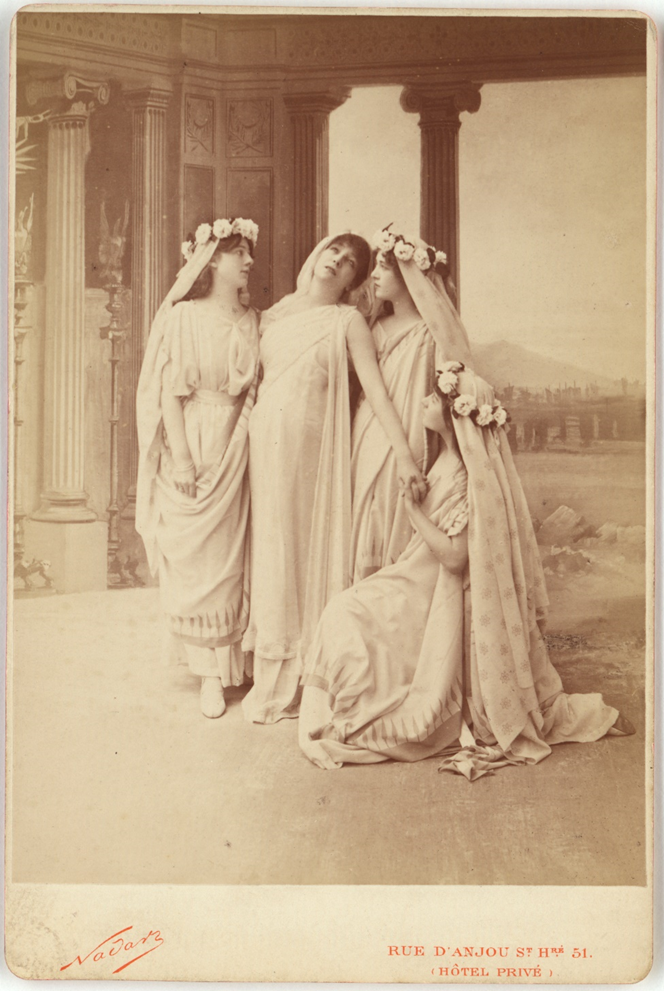
When Bernhardt arrived in England in May 1879, Oscar Wilde, accompanied by the actor Johnston Forbes-Robertson went down to Folkestone to greet her. Forbes-Robertson presented her with a gardenia, while Wilde, overhearing the cry ‘they’ll make a carpet of flowers for you soon’, is said to have flung down an armful of lilies. As she rather reluctantly walked over the blooms, Wilde cried out ‘Hip, hip hurrah! A cheer for Sarah Bernhardt!’ After attending her opening night at the Gaiety Theatre, Wilde heaped rapturous praise on Sarah’s performance of Racine’s Phedre.
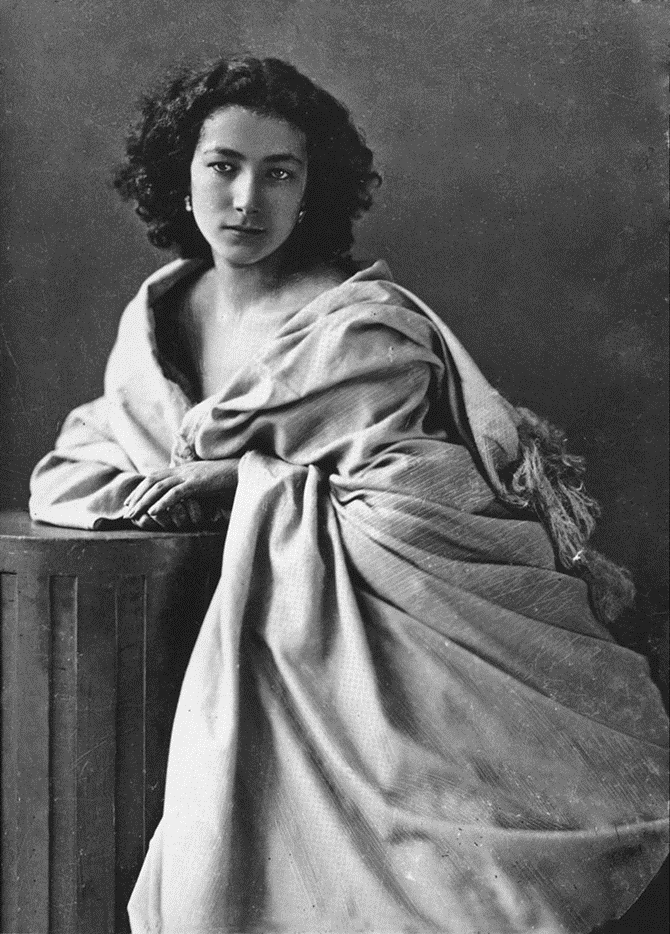
Sarah Bernhardt in Racine’s Phèdre, Nadar, c. 1874
He declared her performance to be ‘the most splendid creation’ he had ever witnessed. Oscar ‘poured out his soul’ in a sonnet, ‘How vain and dull our common world must seem/To such a one as Thou’. He had already learnt the lesson of hitching his star to an international celebrity; his sonnet appeared in the well-read Society weekly paper TheWorld. During Sarah’s sojourn in London, Wilde remained her ‘devoted attendant’. The actress even graced his rooms in Salisbury Street, off the Strand. After one jolly supper party, she scrawled her signature on the whitewashed panelling.
Bernhardt returned to London in 1892, the same year Oscar achieved his first West End hit with Lady Windermere’s Fan. Impressed by this achievement, Sarah asked him to write a play for her. In jest he replied he had already done so, with Salomé. A reading of the play apparently whetted her imagination. It was not ‘religious’ but rather dealt with desire- ‘love, passion, nature, the stars.’ She wanted to play the title role immediately, as part of her current London season. For Wilde this would have been an amazing coup, an artistic triumph to match the commercial success of his Society comedy.
Graham Robertson designed the costumes for the original production of Salomé at the request of Bernhardt. Wilde expressed a desire that they should be in varying shades of yellow, from pale lemon to almost orange. The choice was deliberate, echoing the racy French ‘yellow- backed’ novels.
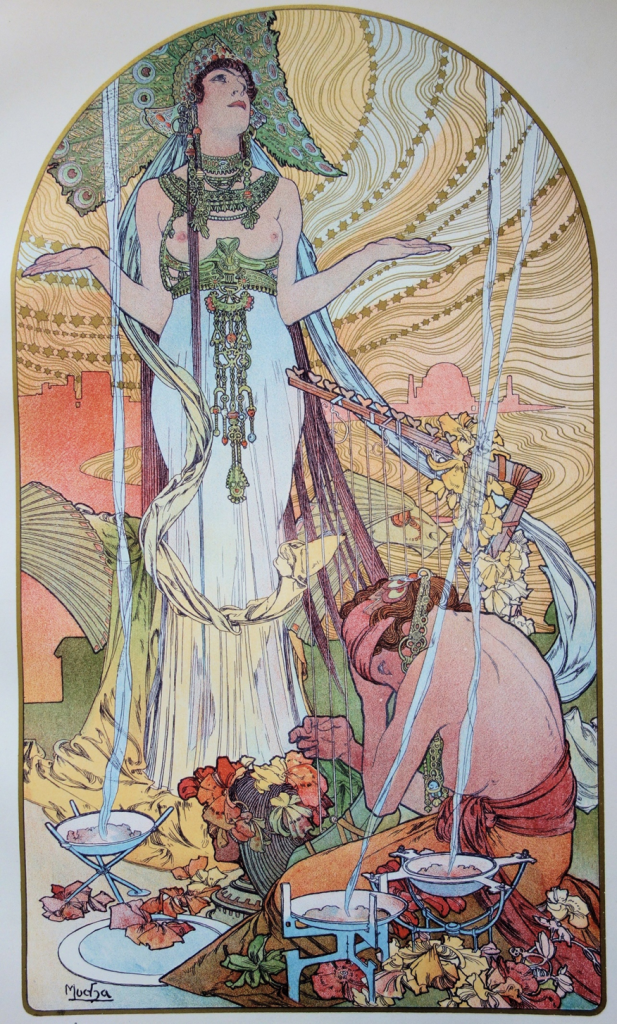
Rehearsals began at once. If Wilde harboured any doubts about a 47-year-old woman playing a young girl, they were soon dispelled. To hear his words ‘spoken by the most beautiful voice in the world’ was ‘the greatest joy that is possible to experience’. Although Wilde had grandiose plans for the stage setting and costumes, to save money the scenery and costumes for Cleopatra were to be used. However, Wilde’s ambitions were dashed when the Lord Chamberlain refused to grant a license for the play. Sarah was unwilling to give up the part, declaring ‘the role is mine, Mr Oscar Wilde has given it to me, and nobody else can perform it. No, no, no.’ But it was not to be, Wilde never saw his play produced. However, Mucha gives us a taste of what might have been!
Like Oscar, Sarah was a shrewd self-promoter. According to Hannah Manktelow, she ‘cultivated her image as a mysterious, exotic outsider. She claimed to sleep in a coffin and encouraged the circulation of outlandish rumours about her eccentric behaviour.’
Like Wilde she has left us some wonderful ‘bon mot’….
Oscar Wilde: ‘Do you mind if I smoke?’ Sarah Bernhardt: ‘I don’t care if you burn.’
‘It is by spending oneself that one becomes rich’
‘Slow down? Rest? With all eternity before me?’
[When asked aged 79 why her Paris apartment was on the top floor, up many flights of stairs she declared:
It’s the only way I can still make the hearts of men beat faster.
Please join me on Wednesday 25th January, at either 11am or 7pm BST to learn more about the ‘Divine Sarah’. I will be repeating the morning lecture in the evening of the same day for those people unable to make the morning slot.
The lecture will be delivered live by Zoom. It will be uploaded afterwards to my YouTube channel, and you will be provided with a private link to view it again at your leisure. The lecture lasts for around an hour.
As the lectures will be delivered live by Zoom, you will be able to ask your questions in person at the end. You can also use the ‘Chat’ function. The lecture costs £10. To book a place
Or you can pay by cheque or BACS (details will be supplied). Cheques should be made payable to Anne Anderson.
Or you can pay by PayPal
One lecture
‘Divine Sarah’
£10.00
Once you register and pay, you will be sent a separate email with your link. You will need this link to access the lecture on the day so please do not delete it. After the lecture you will be sent another private link so you can access the lecture on my YouTube Channel.
Please join me on Wednesday 25th January, at either 11am or 7pm BST
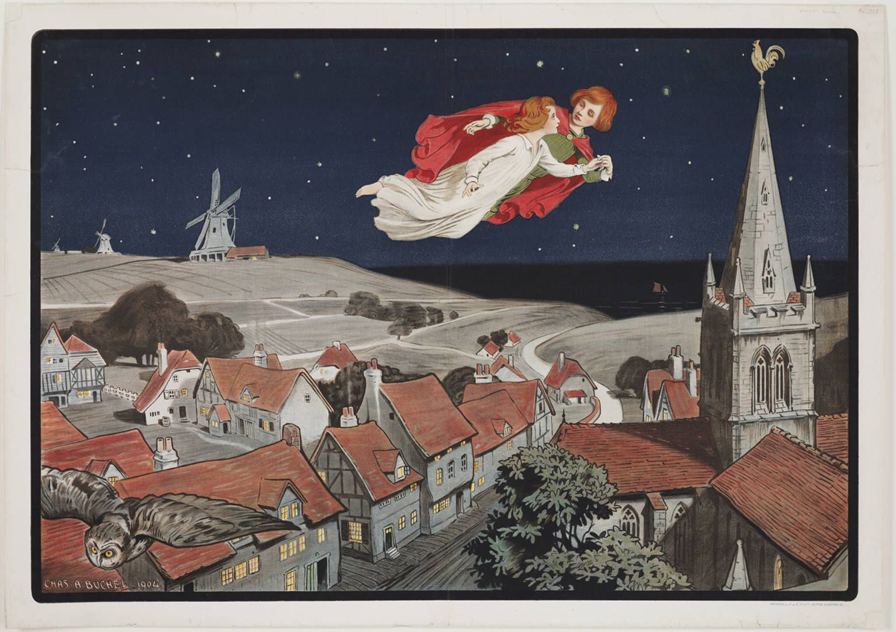
Is Peter Pan a pantomime? Well, if you want to adhere strictly to the Victorian rules, probably not. But as the ‘fairy play’ was first performed on 27 December 1904, Peter Pan or the Boy Who Wouldn’t Grow Up has inevitably been thought of as a ‘holiday entertainment for children’.
Poster for Peter Pan or the Boy Who Wouldn’t Grow Up, Charles Buchel, 1904
Peter Pan has been performed continually as a play and musical for over a hundred years, more recently entering the panto repertoire. This year it will be played in Stoke-on-Trent, Malvern, and Manchester. The show borrows from panto’s gender-crossing convention: Peter Pan has always been played by the ‘principal boy’ the role being first taken by Nina Boucicault. The reason for this was the difficulty of using a child actor in the main role; children were not allowed to perform after 9pm. Also, a ‘breeches role’ allowed women to defy convention by showing their legs. This drew the attention of many fathers, guaranteeing a big audience!
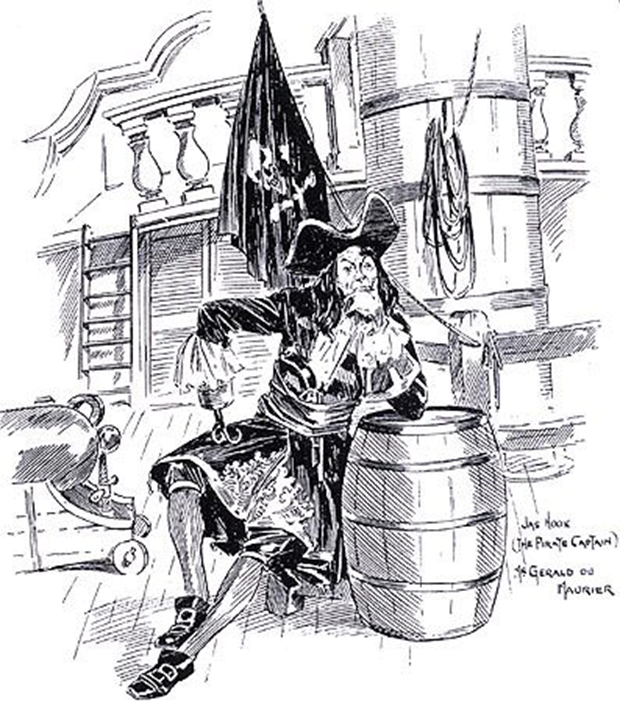
Peter Pan also has a great villain, Captain Hook. He certainly needs to keep an eye over his shoulder, as he is stalked by a crocodile who has already acquired a taste for him. The dual role of Hook and the children’s father Mr. Darling was first played by Gerald du Maurier. That name will be familiar to many, as Gerald was the son of the famous cartoonist and author of Trilby George du Maurier and in turn the father of novelist Daphne du Maurier. Gerald had already made a name for himself playing Ernest in Barrie’s comedy The Admirable Crichton. By one of those strange coincidences Gerald was also the brother of Sylvia Llewelyn Davies, the mother of the boys who inspired J M Barrie to write Peter Pan.
James Hook (The Pirate Captain) Gerald du Maurier
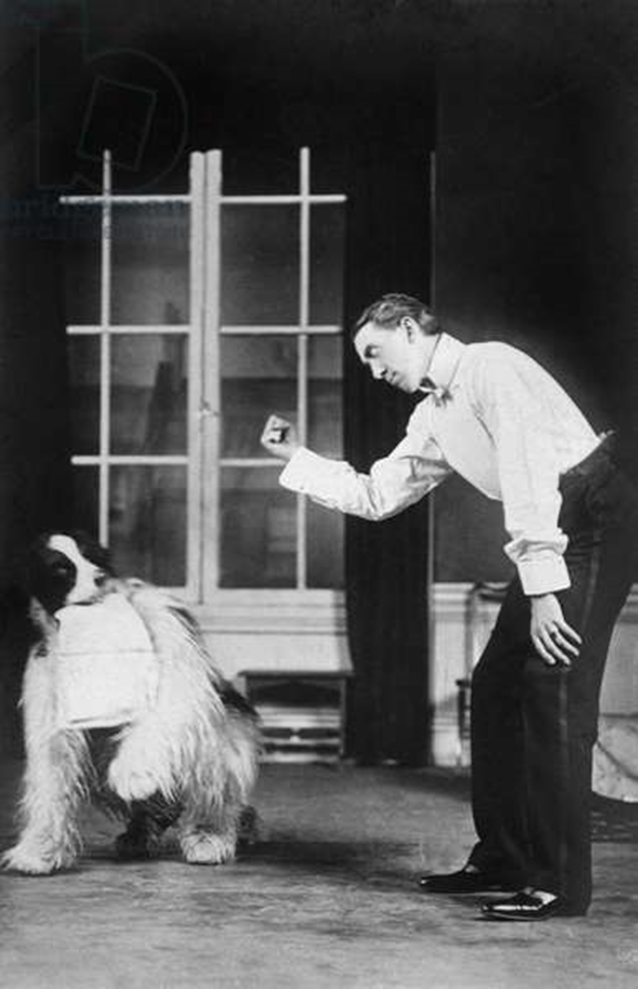
Barrie first encountered George (5), Jack (3) and baby Peter Llewelyn Davies with their nanny whilst walking his dog, Porthos, a St. Bernard, in Kensington Gardens. However, it was his dog Luath, a Newfoundland, who appears to have inspired ‘Nana’ the dog nursemaid. In the first stage production Nana was played by actor Arthur Lupino dressed as a dog! Apparently Lupino studied Luath first hand, at the writer’s home. Many of Nana’s stage movements, such as banging a paw on the floor, were derived from the dog’s behaviour. The tradition of an actor dressed in a dog costume continues. Impersonator George Ali gave an impressive performance as Nana in the 1924 silent film adaptation. However, Christopher Walken as Mr Darling/Hook, in NBC’s 2014 live televised production, was up staged by a real dog, Bowdie a rescued poodle cross!
Arthur Lupino (1864-1908) as Nana and Sir Gerald Du Maurier
Soon a friend of the family, which grew to five boys, Barrie, whose marriage was childless, enjoyed entertaining them with tall tales of adventure. While he claimed all five boys inspired him, Barrie was also haunted by the tragic death of his older brother, David, who died in a freak ice-skating accident before his 14th birthday. His mother thought of David as ‘forever a boy’. Today the story’s appeal rests on the hope that we remain ‘forever a child’ in spirit.
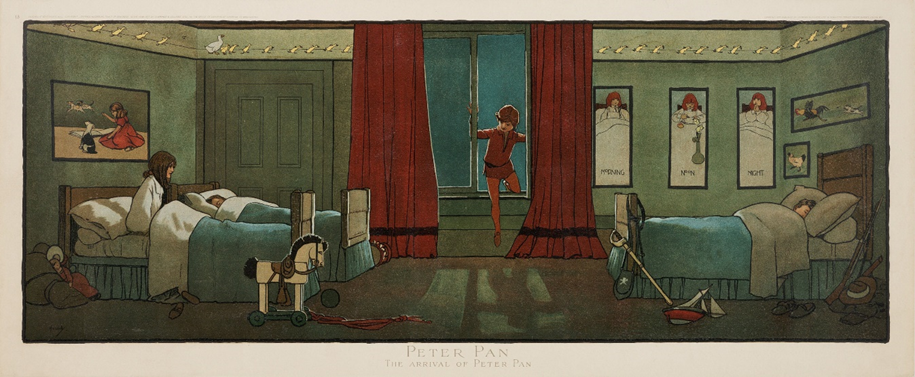
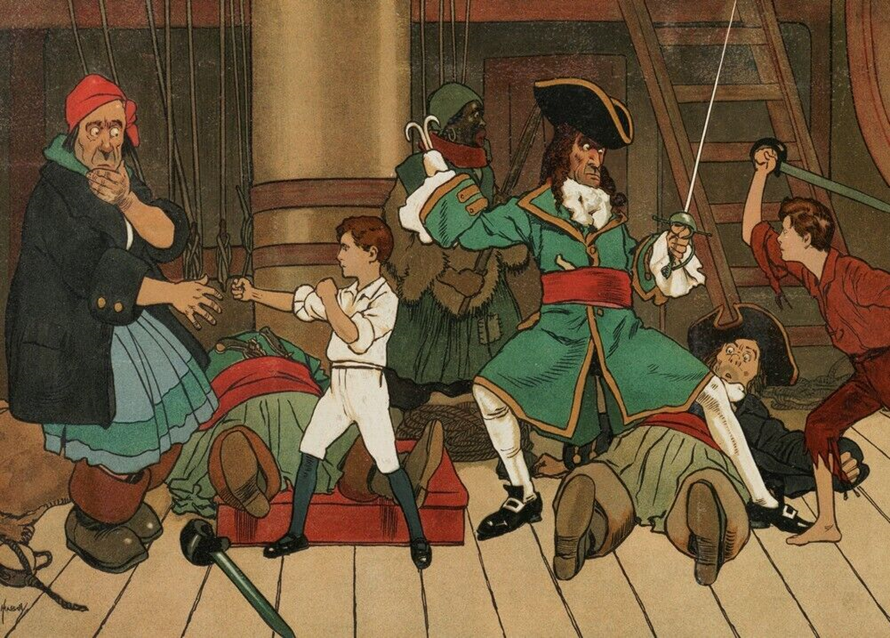
As Barrie never fully described Peter’s appearance, leaving it to the imagination of the reader, our image of Peter Pan has been shaped by later illustrators. John Hassall designed a set of six prints for Liberty & Co as nursery pictures in 1905.
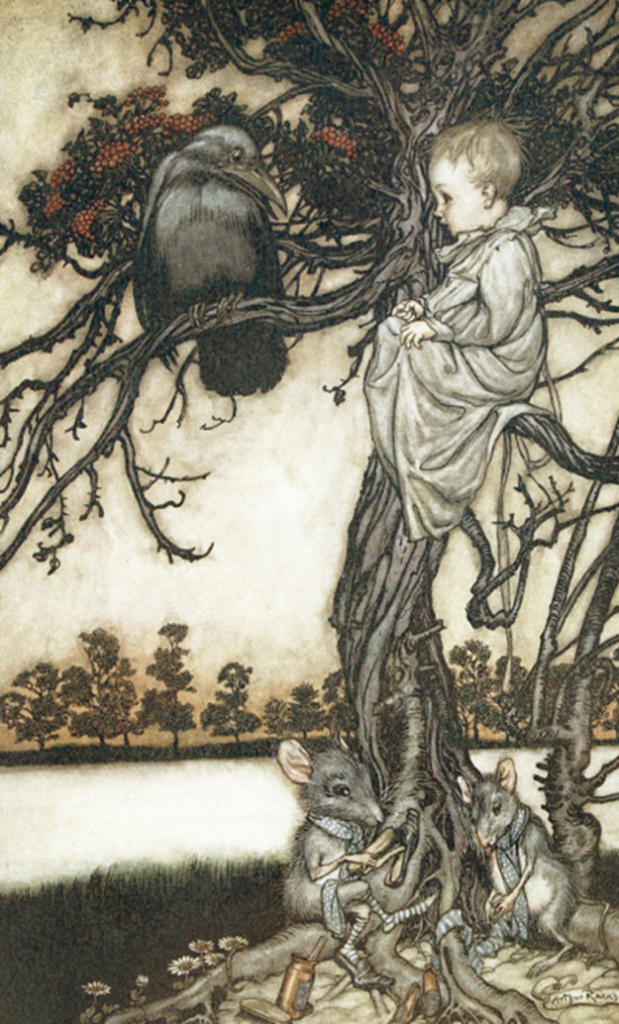
Prior to the play, Peter Pan made his first appearance in the adult novel The Little White Bird (1902) featuring in chapters 13-18. Over hearing his parents talking about what it means to be an adult, Baby Peter flies from his nursery to Kensington Gardens. Living among the fairies and elves, he is described as ‘betwixt-and-between’ a boy and a bird.
Following the stage success of Peter Pan, these chapters were reissued as Peter Pan in Kensington Gardens with illustrations by Arthur Rackham.
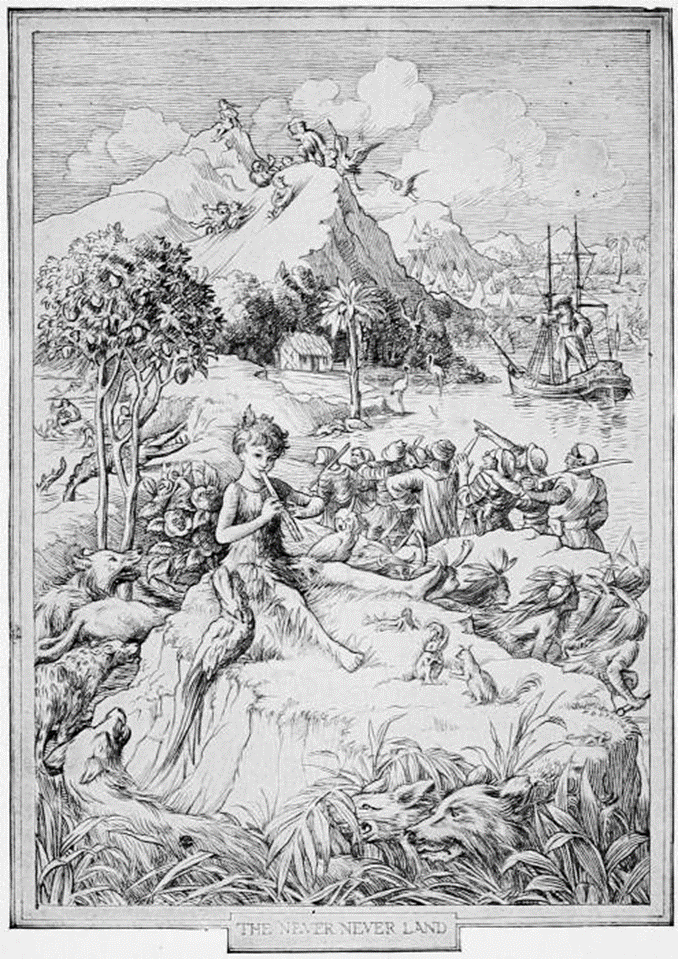
Barrie then adapted and expanded the storyline of his play, publishing the novel Peter and Wendy with illustrations by Francis Donkin Bedford in 1911.
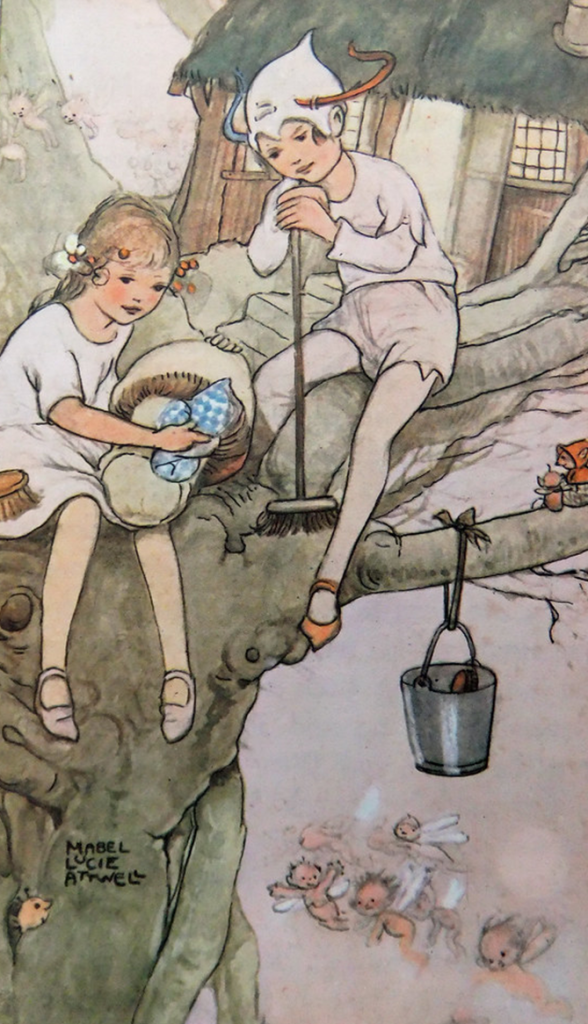
However, my own cherished volume has charming illustrations by Lucy Mabel Atwell (1921)
If you would like to discover more about Barrie and his ‘Lost Boys’, who were orphaned in 1910, go to my You Tube Channel, Anne Anderson Art and Design History Channel, where you will find an open access lecture.
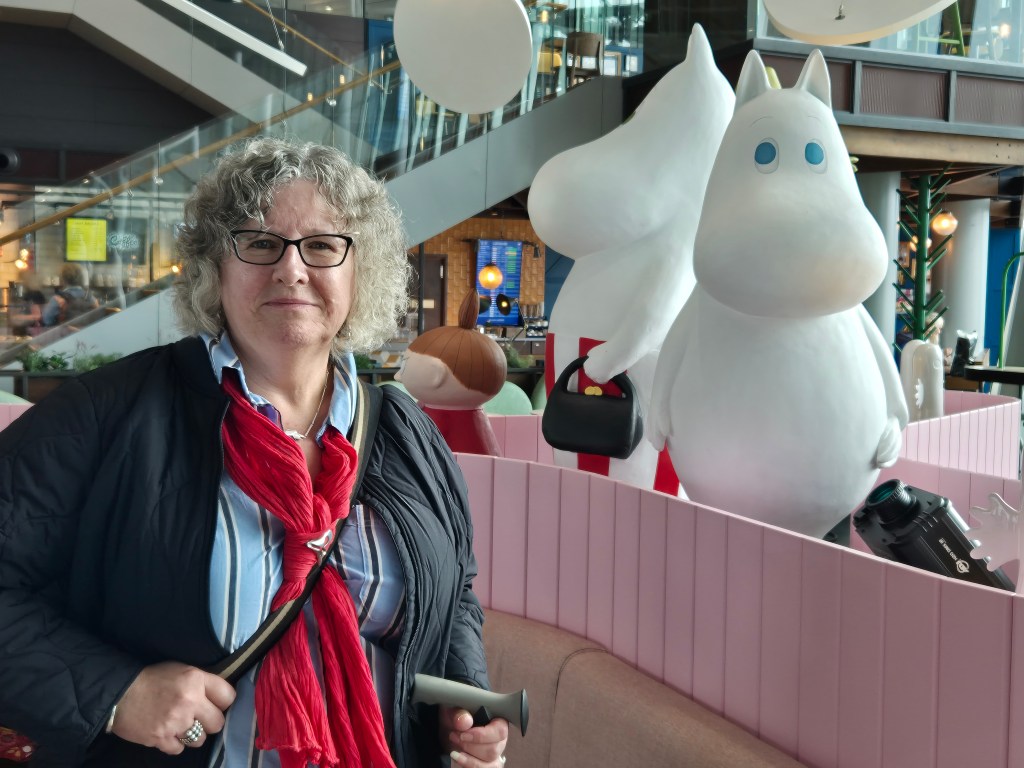
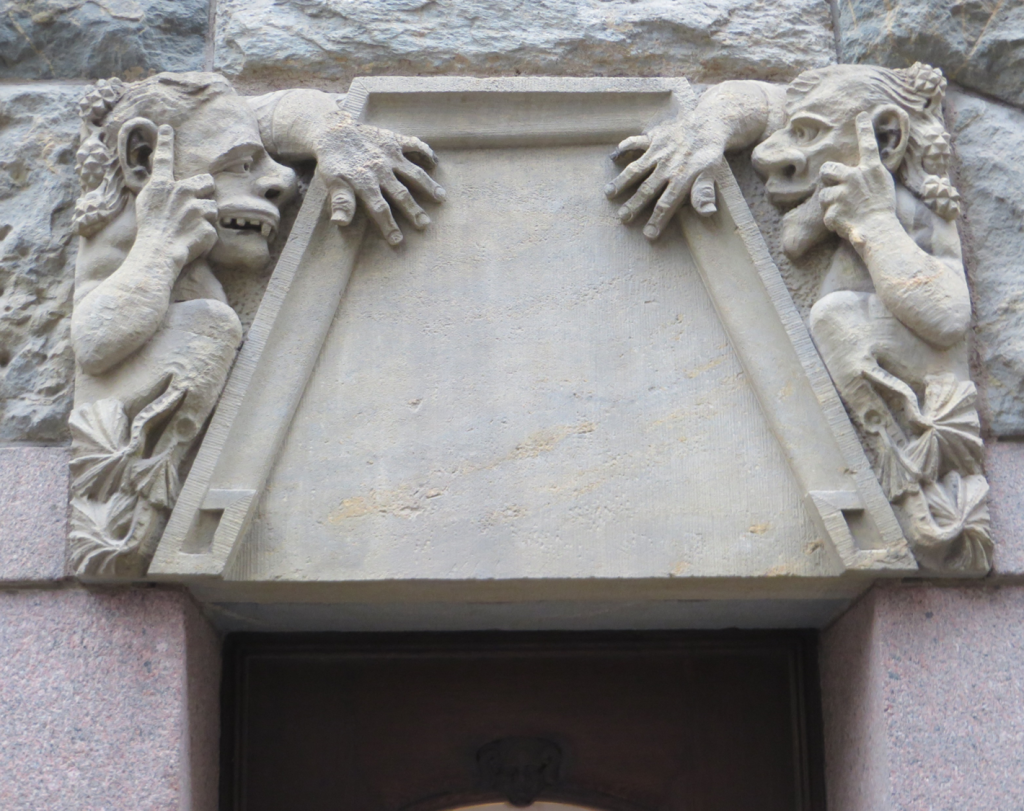
When thinking about Baltic Art Nouveau, the grandiose buildings of Riga usually spring to mind. However, Helsinki boasts over 500 ‘National Romantic’ and ‘Jugend’ buildings from the turn of the 20th century. The German term ‘Jugendstil’ or ‘Youth style’ has been adopted, taken from the avant-garde magazine Jugend published from 1896, to designate these buildings. You will look in vain for the curvi-linear fluid forms associated with the French and Belgian ‘whiplash’ or ‘’coup de fouet’ style. Finnish architects and designers developed their own nationalistic style, one based on native architecture and folk traditions. Finnish traditions were now deemed to be modern, and local individualism reflected international expressions of independence as seen in Barcelona and Glasgow. On a walk through the Jugend districts of Helsinki you will discover a fairyland of castles decorated with all manner of wild beasts, from bears and wolves to frogs and trolls. One can see where Tove Marika Jansson found her inspiration for the Momintroll books!
‘Swedes we are not, We do not want to become Russians, So let’s be Finns’.
Johan Vilhelm Snellman (1806-1881)
‘The poems of the Kalevala are truly so sacred to me that, for instance, when singing them it feels as if you were resting your weary head upon some strong steadfast support.’
Akseli Gallen-Kallela (1865-1931)
Karelia: ‘ancient Finnishness could still be found, frozen in time-in a state that could be revived.’
Ville Lukkarinen (1957-)
Helsinki: Jugendstil capital
Replacing the old capital of Turku, Helsinki had become the economic and cultural centre of Finland by the mid-19th century. With an exodus of rural workers to the urban factories, the population grew quickly from around 32,000 in 1870 to 43,000 by 1880. In 1902 the population officially passed 100,000. New housing was desperately needed for both the affluent middle-classes and the working classes. Housing for the wealthy was built around Kasarmitor Square and Bulevardi. Kallio was traditionally a working-class area. The traditional wooden houses were swept aside by a new type of accommodation, apartment blocks rising five or six storeys. These large apartment blocks were largely bult by housing associations and housing companies spurred on by State loans.
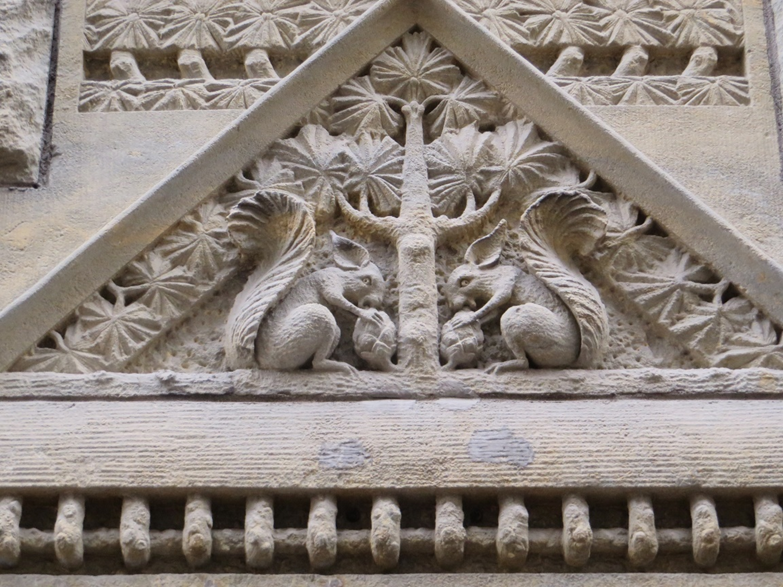
There were lots of opportunities for ‘home-grown’ architects and master builders who had graduated from the Helsinki Polytechnic Institute. Although studying at home, rather than in Sweden or Germany, they were still aware in international trends especially the emergence of the Arts and Crafts movement and Art Nouveau. However, the move towards a modern architecture, underpinned by the latest technologies, was coupled with a growing desire to create a Finnish style. Finnish nationalism was growing, with demands for independence from Russia. The Finnish spirit grew stronger after the 1899 February Manifesto, when Russification began in earnest under Czar Nicholas II. Russian became the official language; the press was censored, and notable Finnish leaders were deported. Architects responded by incorporating motifs that drew on the flora, ferns, pines and acorns, and fauna of Finland, notably bears.
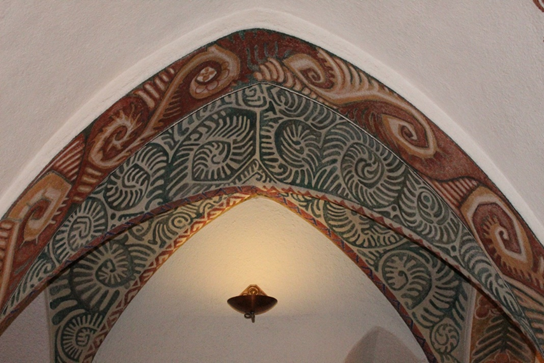
Vanha Poli bears and ferns
Tales from the Kalevala
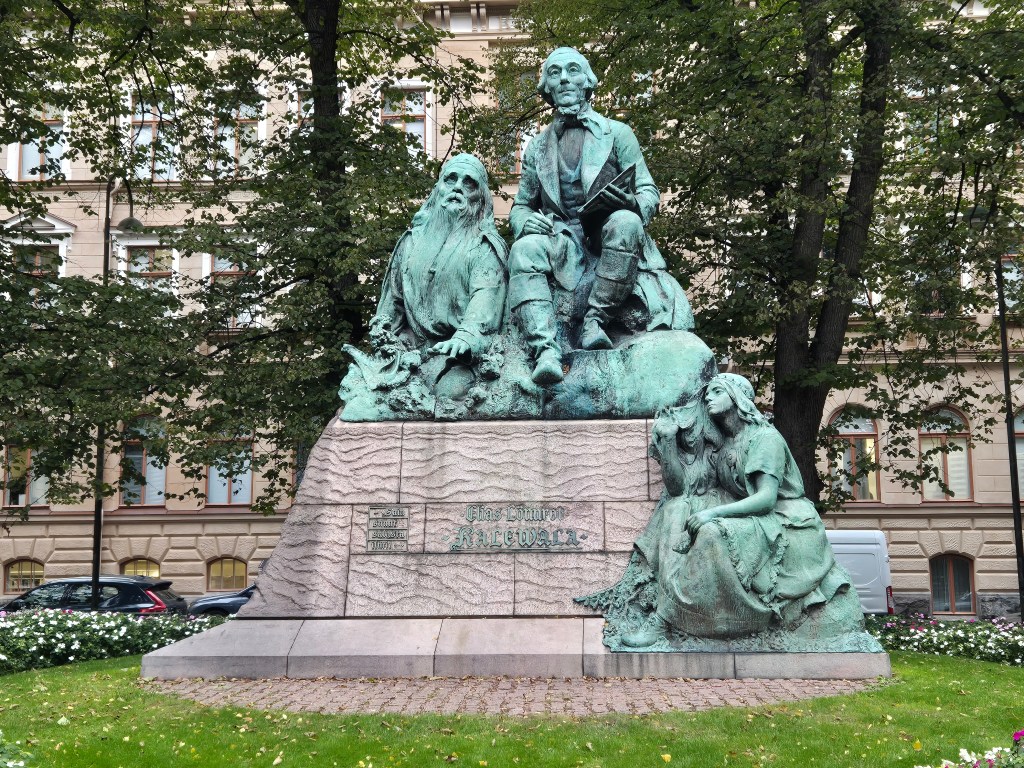
Artists and architects also looked to the Kalevala, a compilation of epic poetry, ballades, and incantations published by Elias Lönnrot in 1835. Lönnrot drew on Karelian and Finnish oral folklore and mythology to create a national epic.
A tribute to the Finnish philologist, physician, and collector of the Finnish national epic, the Kalevala. Created by sculptor Emil Wikström, the bronze monument was unveiled in 1902 and depicts Lönnrot on a folklore-collecting journey, with figures of Väinämöinen (the symbol of the Kalevala’s magic verses) and Impi (symbolizing the Kalevala’s songs and lyric poems) on either side.A relief depicting Antero Vipunen, a wise old man from the Kalevala, is hidden on the pedestal. In the Elias Lönnrot Park in Helsinki.
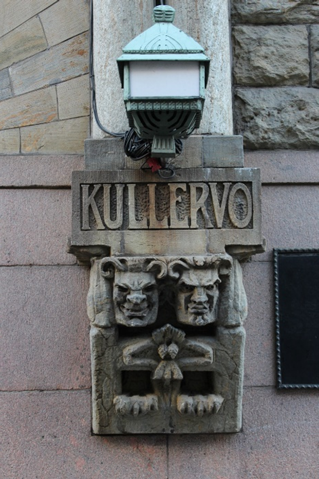
The Kalevala captured the imagination of the artist Akseli Gallen-Kallela (1865-1931), who sought to represent the spirit of ‘Finnishness’ in his paintings; the tale of Anio who escapes marriage to Väinämöinen by drowning; Lemminkäinen who is brought back to life by his mother and the ill-fated Kullervo who mistakenly seduces his sister and eventually commits suicide. Characters from the Kalevala appear on Helsinki’s Jugend buildings. Jean Sibellius (1865-1957) was similarly inspired by the Kalevala. Both painter and composer were involved in the cultural-nationalist group Nuori Suomi or ‘Young Finland’.
Architects also studied Finnish vernacular structures, churches, castles, and domestic buildings, notably the ancient wooden houses of Karelia, an area which straddles Finland and Russia, where it was claimed, true Finnish traditions had survived. The Finnish Antiquarian Society organised field trips for students to discover medieval churches and agricultural buildings. Karelianism underpinned the National Romanticism that flourished at the turn of the century. Tradition was now deemed to be modern.
Paris 1900: a watershed
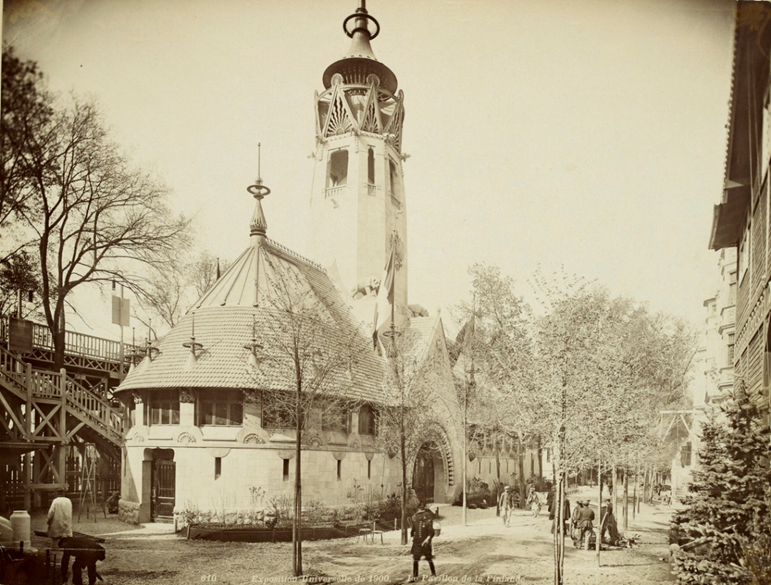
The prize-winning Finnish Pavilion for the 1900 Paris Universal Exhibition marks a watershed in the evolution of Jugend Suomessa. It was created by a young threesome:
Herman Gesellius (1874-1916), Armas Lindgren (1872-1929),andGottlieb Eliel Saarinen (1873-1950) They founded their architectural practice in 1896, while all three were still undergraduates. Drawing on Finnish medieval churches, they created a uniquely nationalistic building. The tall spire represented a maypole or ‘midsummer pole’, denoting one of the nation’s most important festivities. Gallen-Kalela painted the central dome with tales from the Kalevala. It should be remembered Finland was exhibiting as a Grand Duchy of Imperial Russia.
Gallen-Kalela, Ilmarinen ploughing the Viper-field
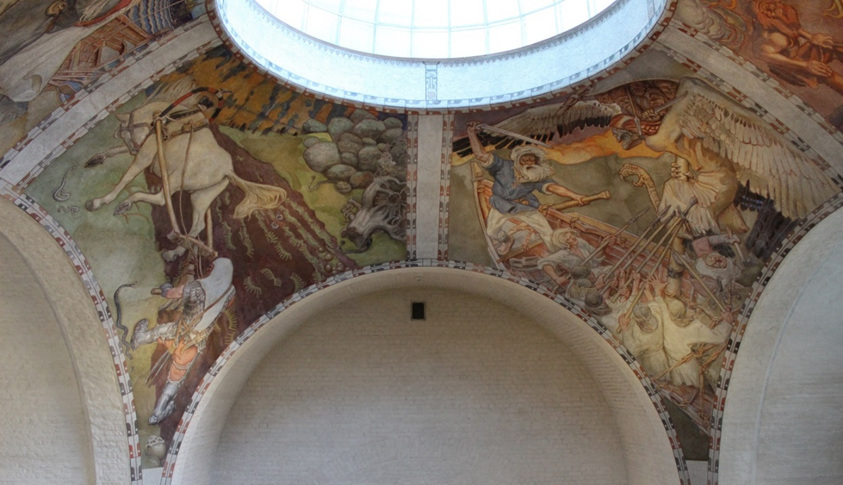
The Defence of the Sampo: Lemminkäinen joins forces with Väinämoinen and Ilmarinen, two of the other main heroes in the Kalevala, to steal the Sampo from Louhi, metamorphosed into an eagle. 1926-28.
National Romanticism
The district around the railway station became the heart of Helsinki’s cultural and commercial centre. It was here the first “rugged granite” buildings appeared. Ironically the Finnish National Theatre, designed by architect Onni Tarjanne in the National Romantic style, was influenced by the American architect Henry Hobson Richardson (1838-1886). ‘Richardsonian Romanesque’ freely blended 11th and 12th century French, Spanish, and Italian Romanesque characteristics to create an American style!
In addition to round-headed Romanesque arches, often springing from short squat columns, the style incorporated cylindrical towers with conical caps embedded in the walling and rich rustication. Lars Sonck’s Headquarters of the Helsinki Telephone Association (1903-07) echoes these features. Rough-hewn granite was seen to embody the tough Finnish character.
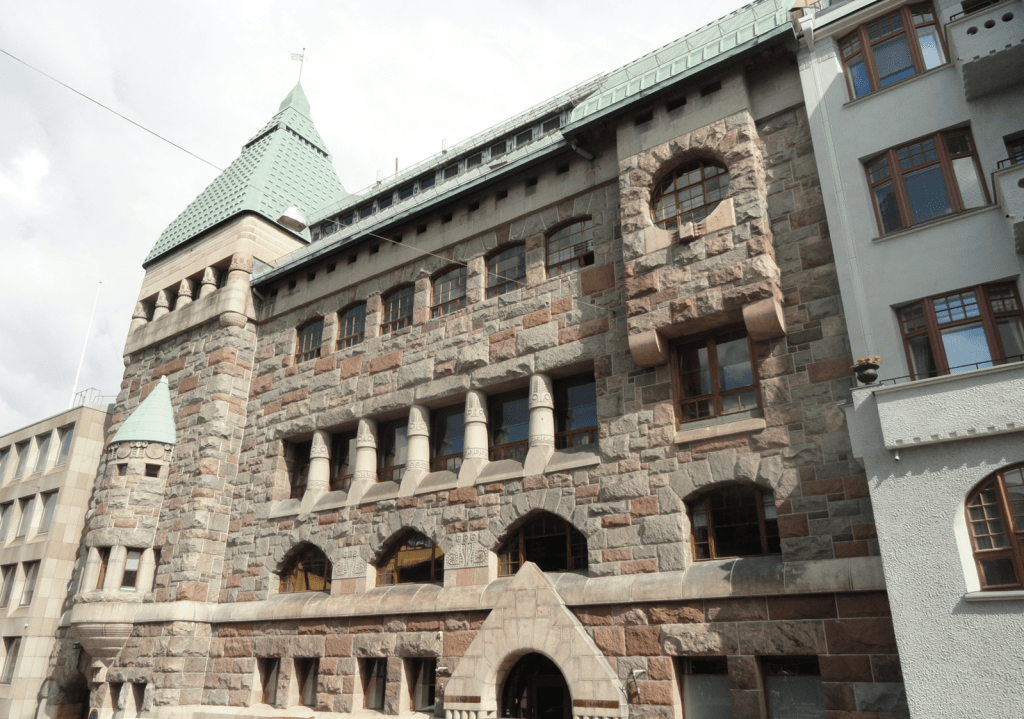
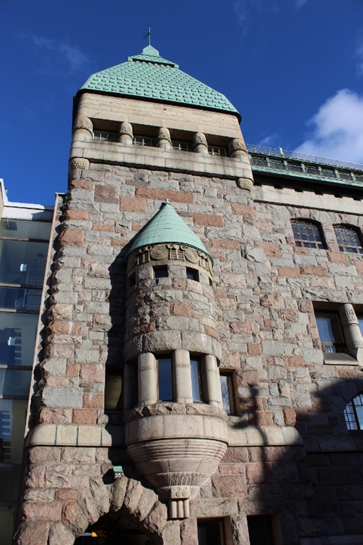
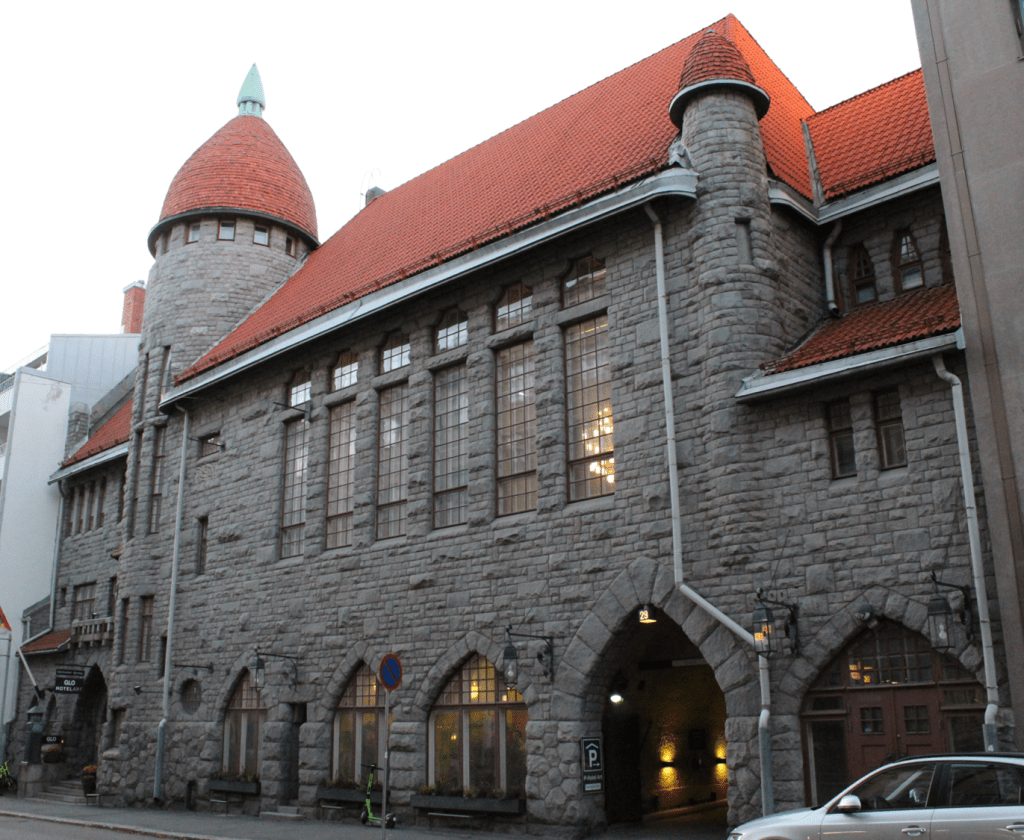
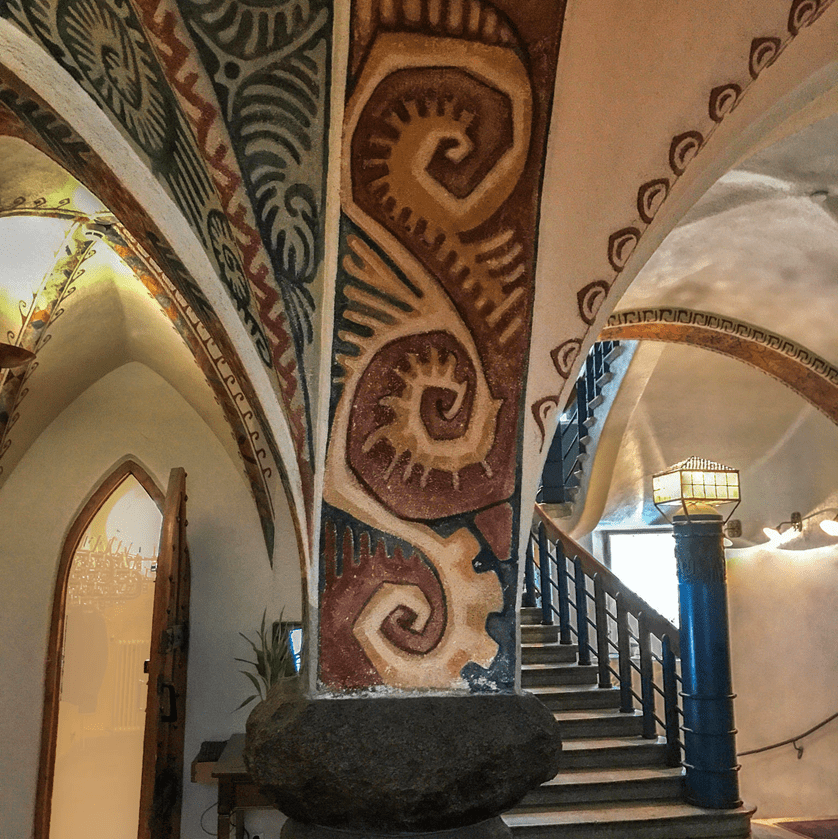
Vanha Poli now Jugend Hotel Lönnrotinkatu 29, 1903, Karl Lindahl and Valter Thomé, the former Polytechnic Students’ Union.
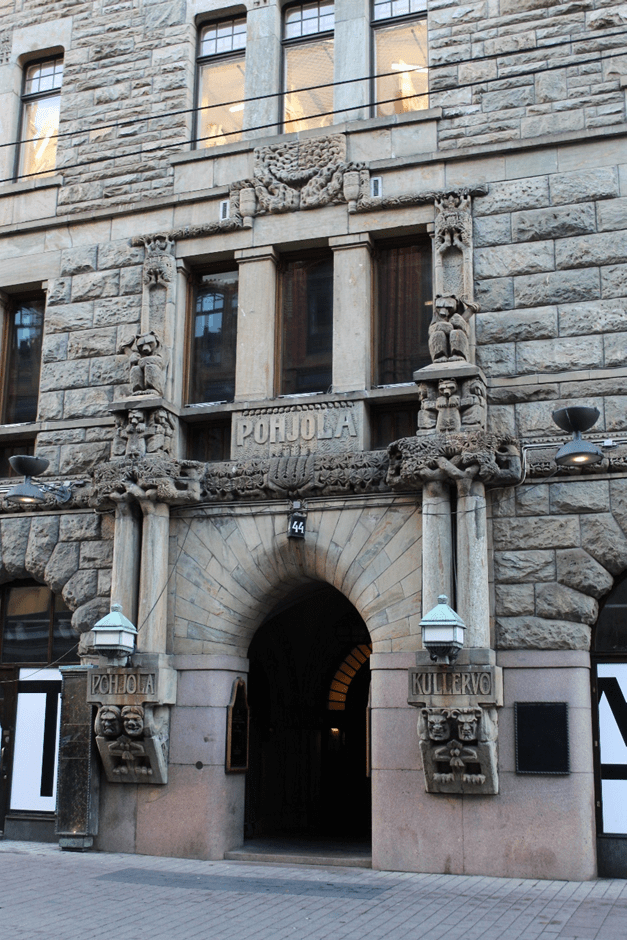
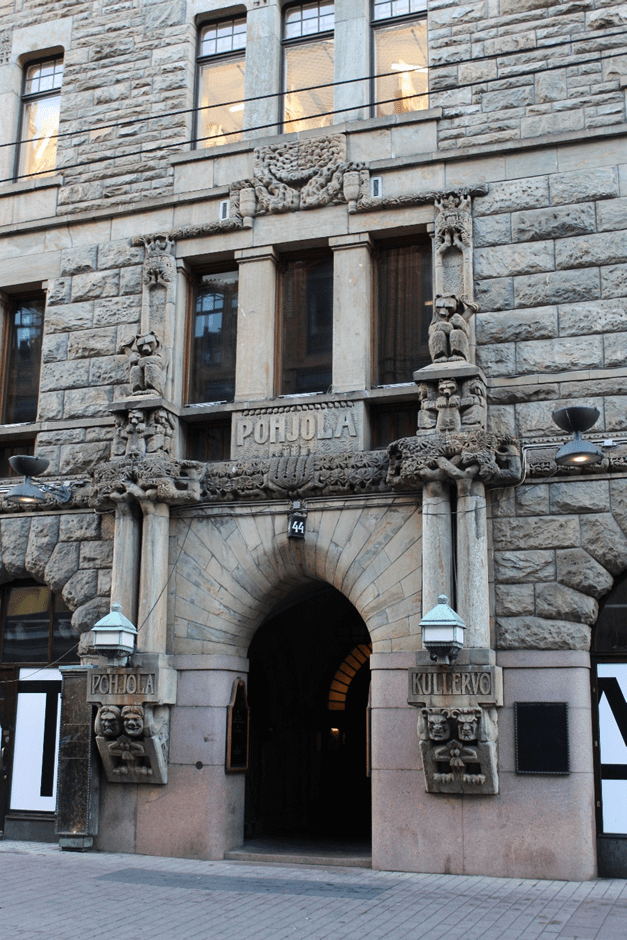
The fantastic Pohjola Insurance Building, on Aleksanterinkatu, dating to 1901, designed by Herman Gesellius, Armas Lindgren, and Eliel Saarinen, exemplifies National Romanticism. Resembling a gigantic castle, the building is amusingly covered with dangerous beasts- wolves, bears and trolls- that it would be wise to insure against!
In the famous Finnish epic, the Kalevala, Pohjola is the evil land of the North. The fantastic entrance was designed by Hilda Flodin.
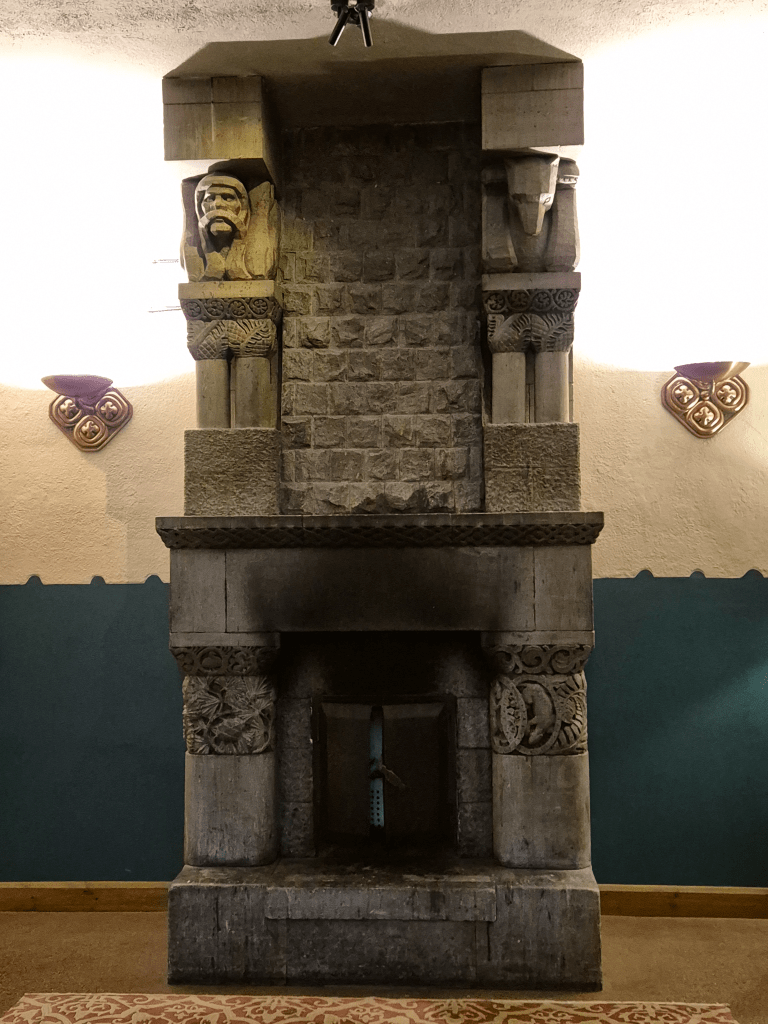
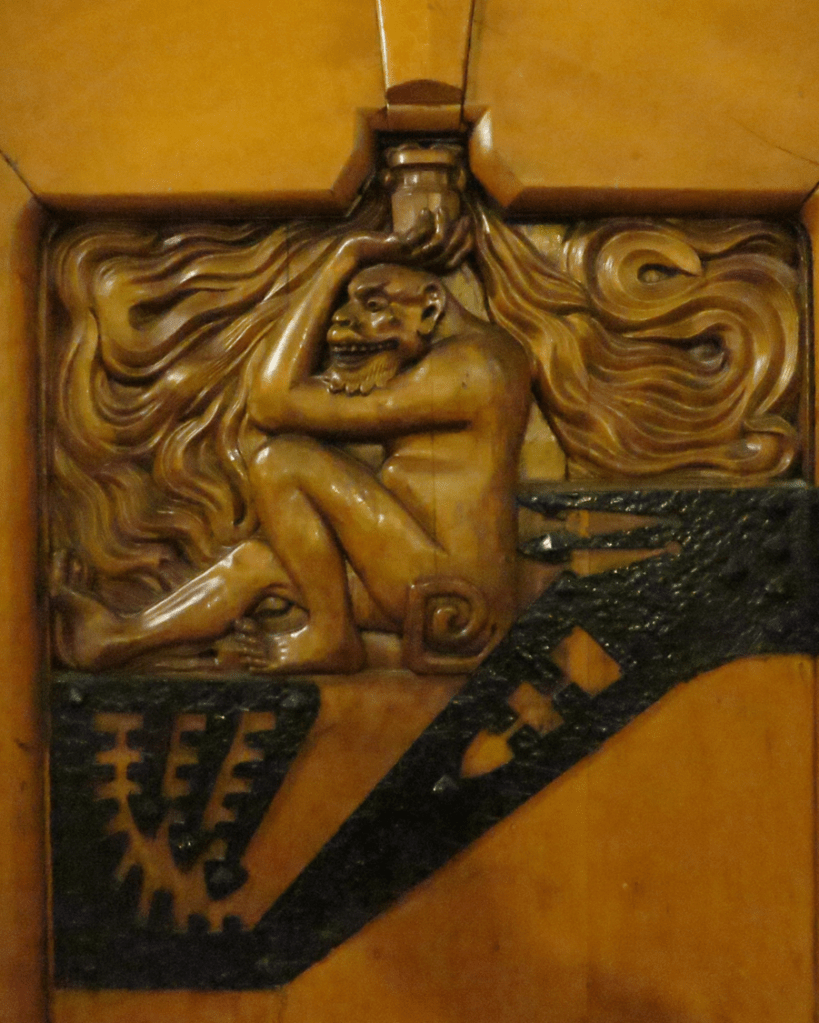
Ascend the staircase to a magical world of beasts and trolls.
Apartment Blocks
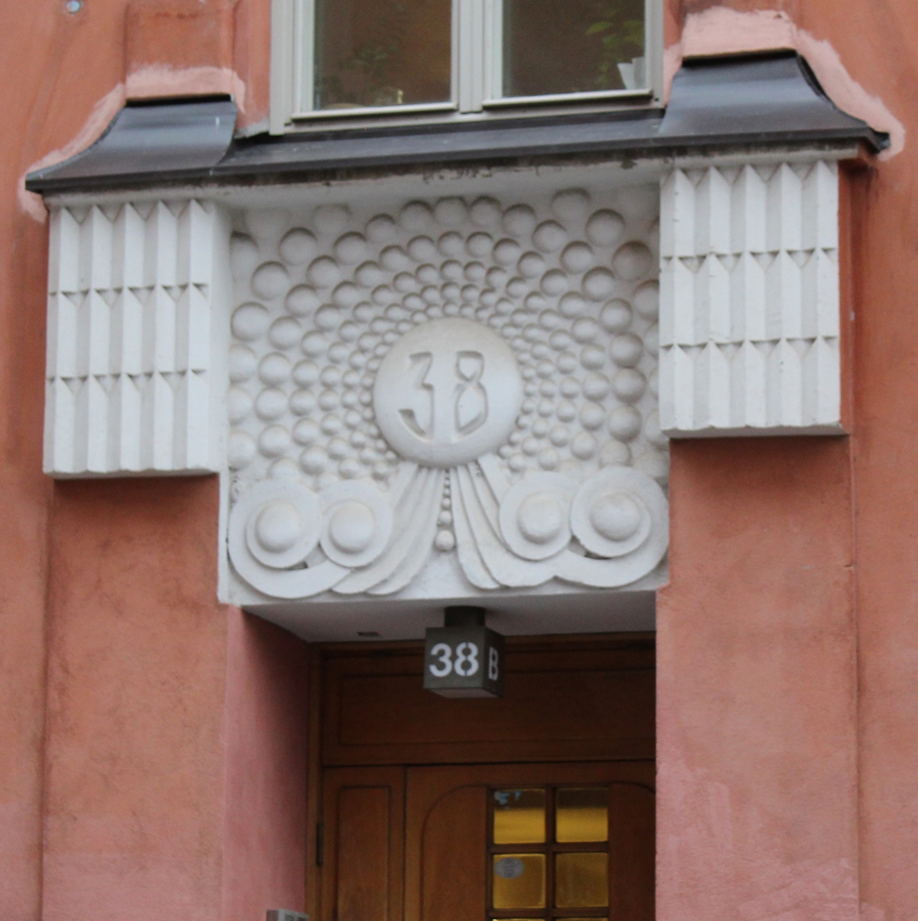
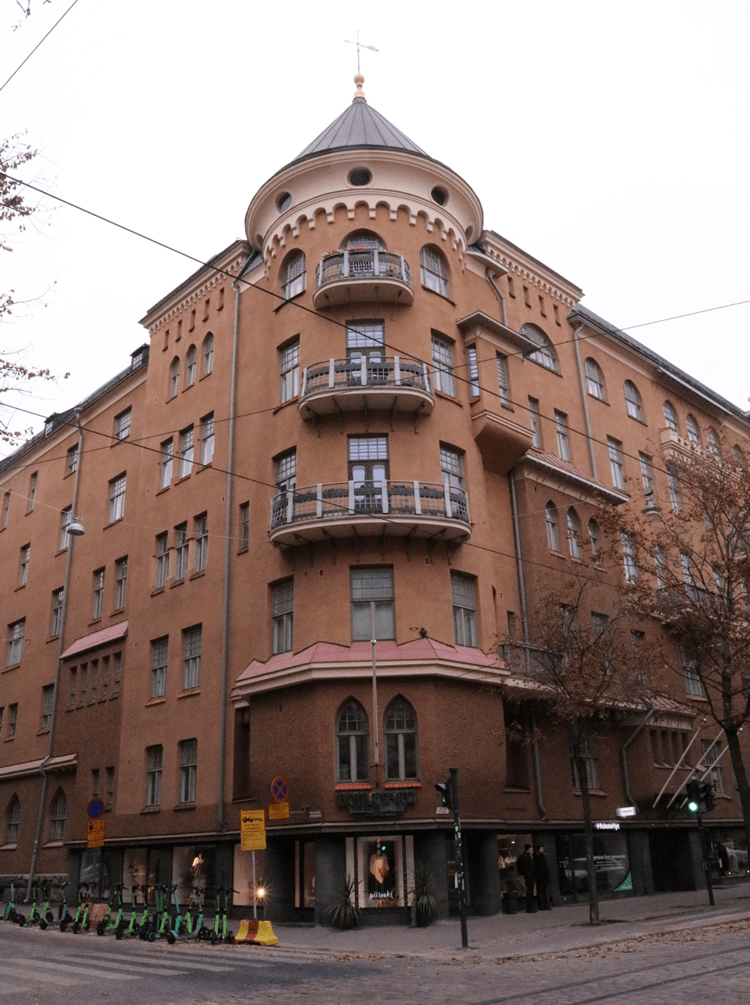
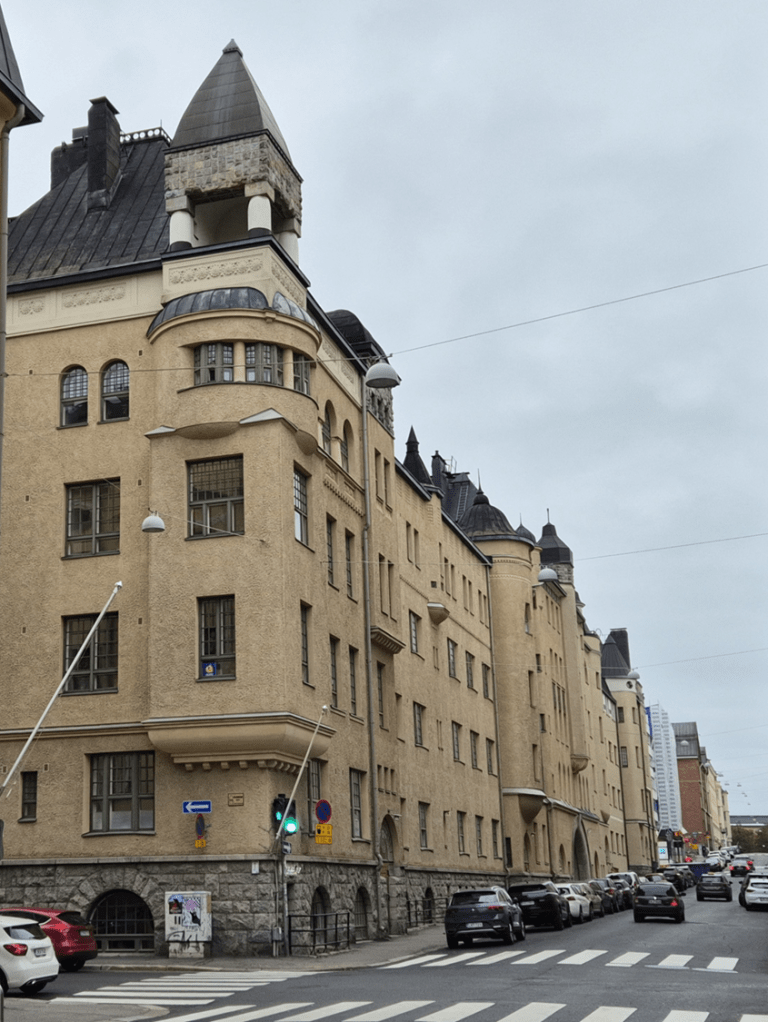
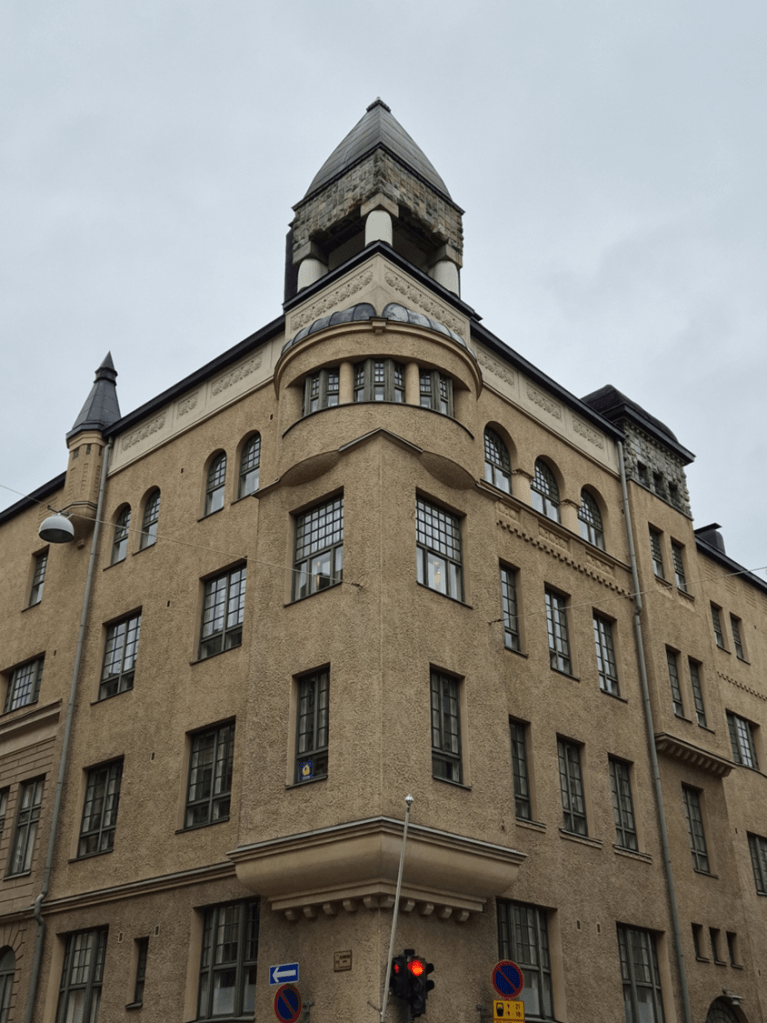
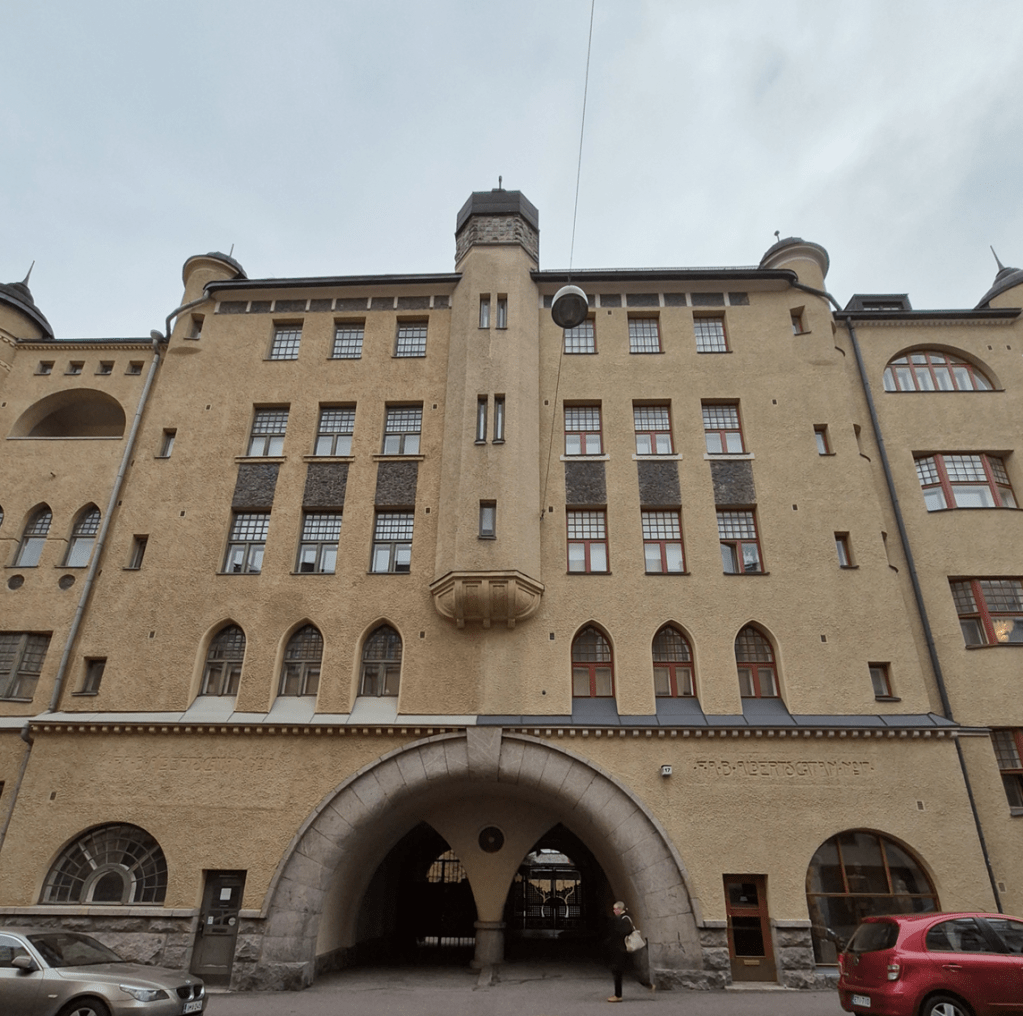
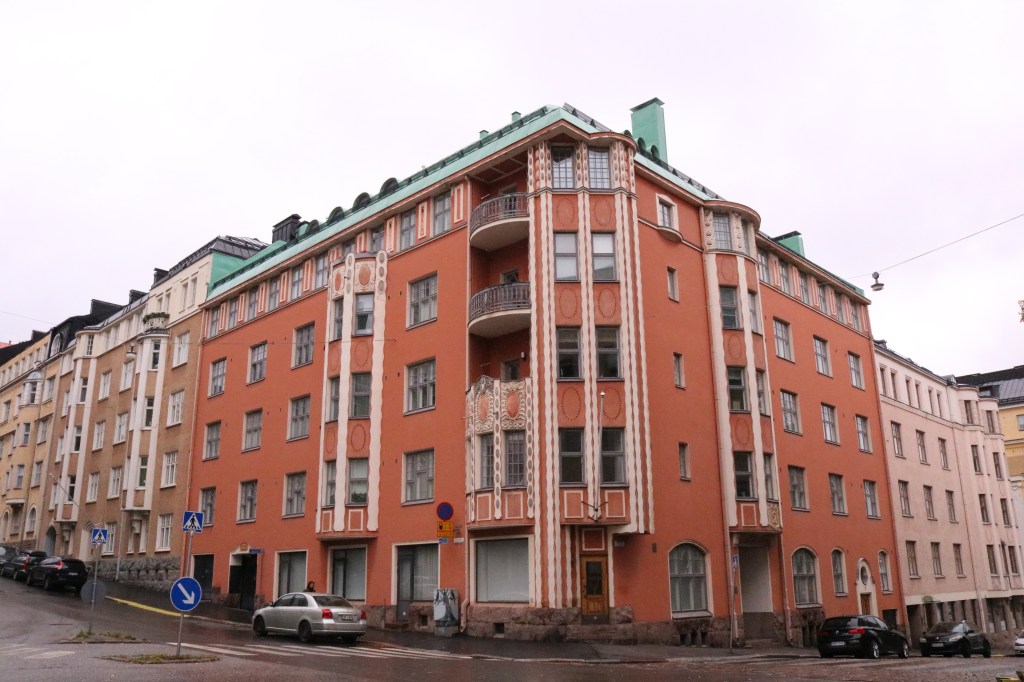
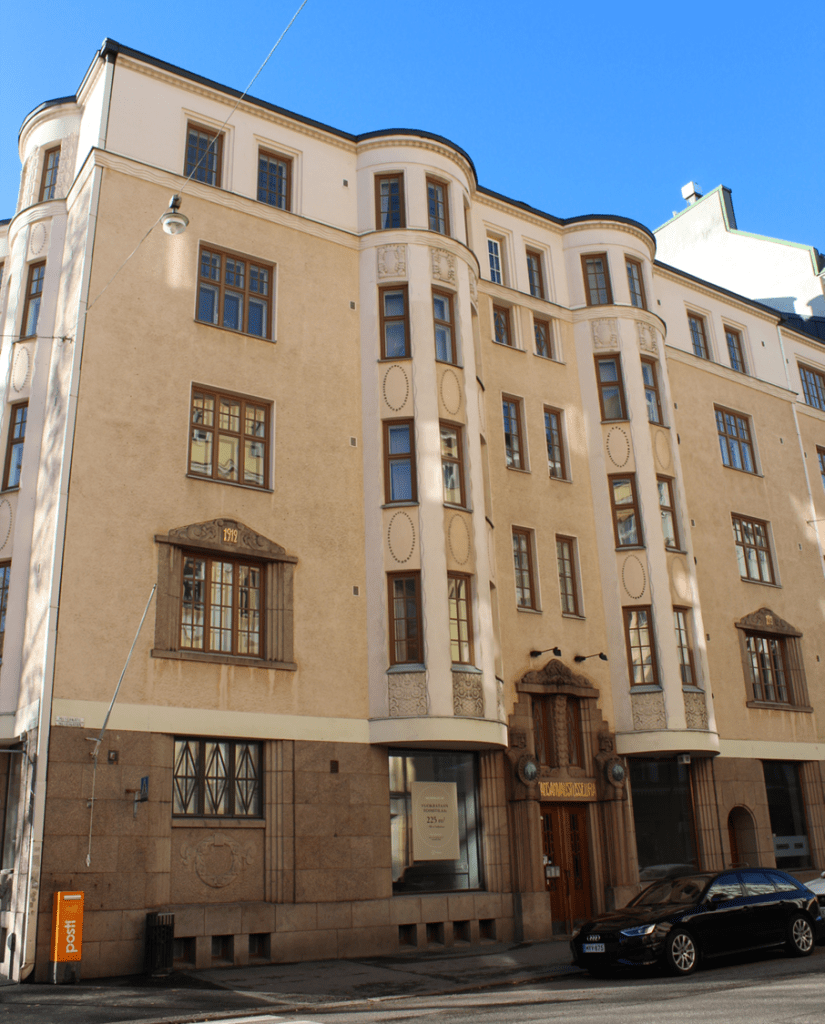
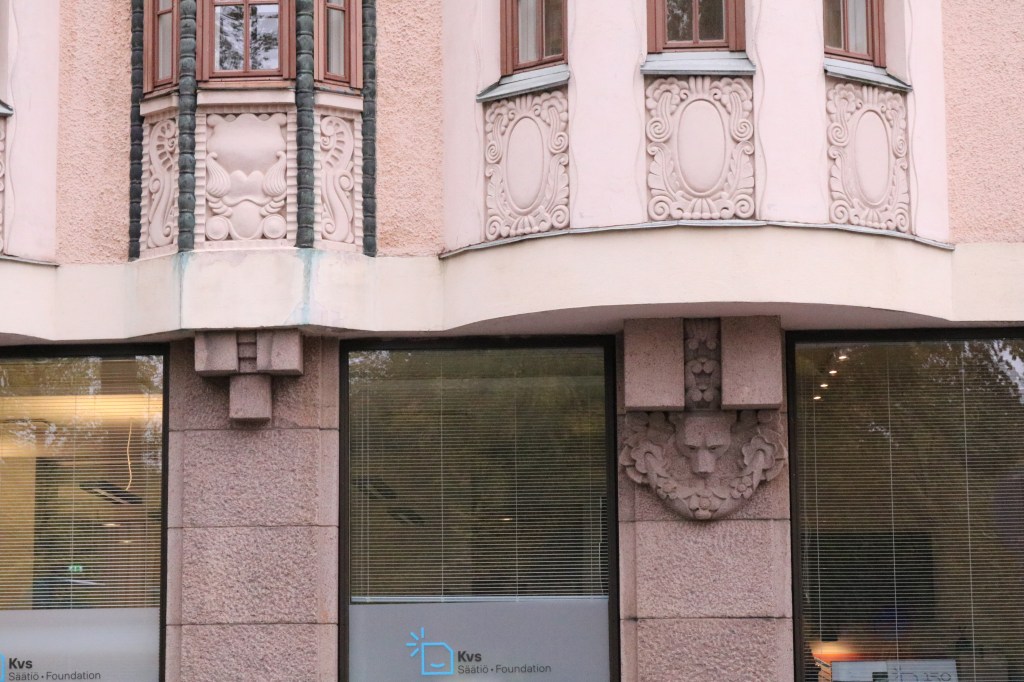
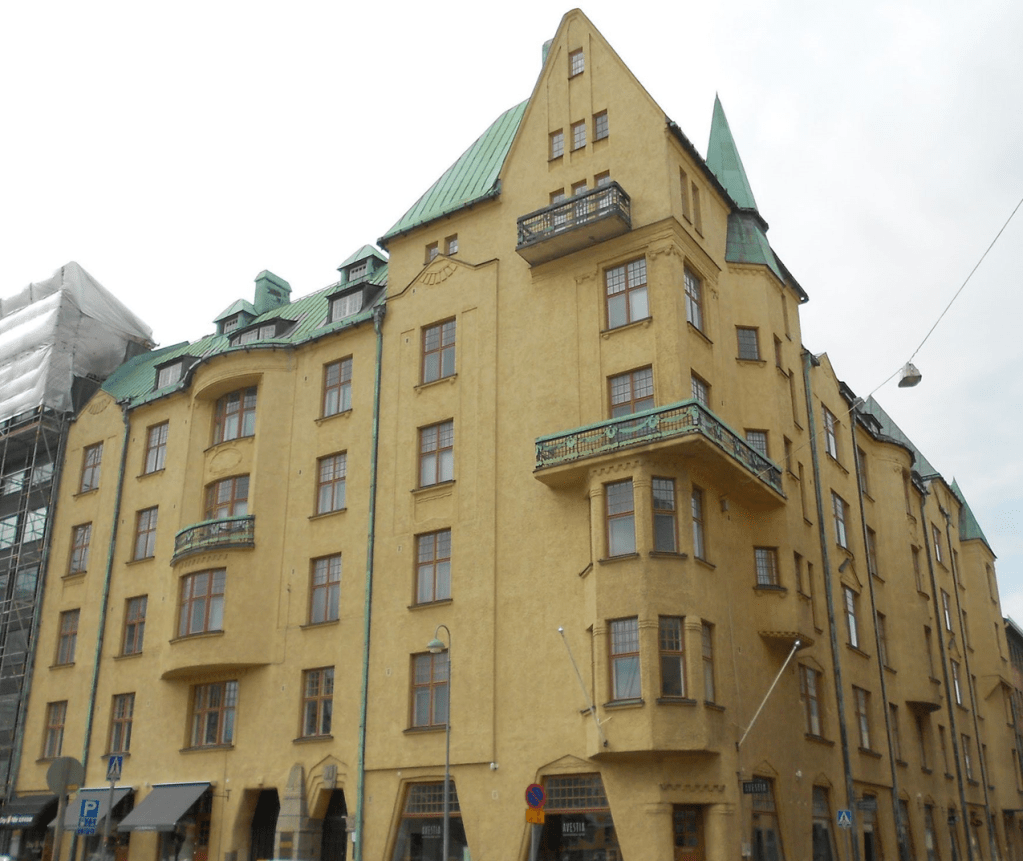
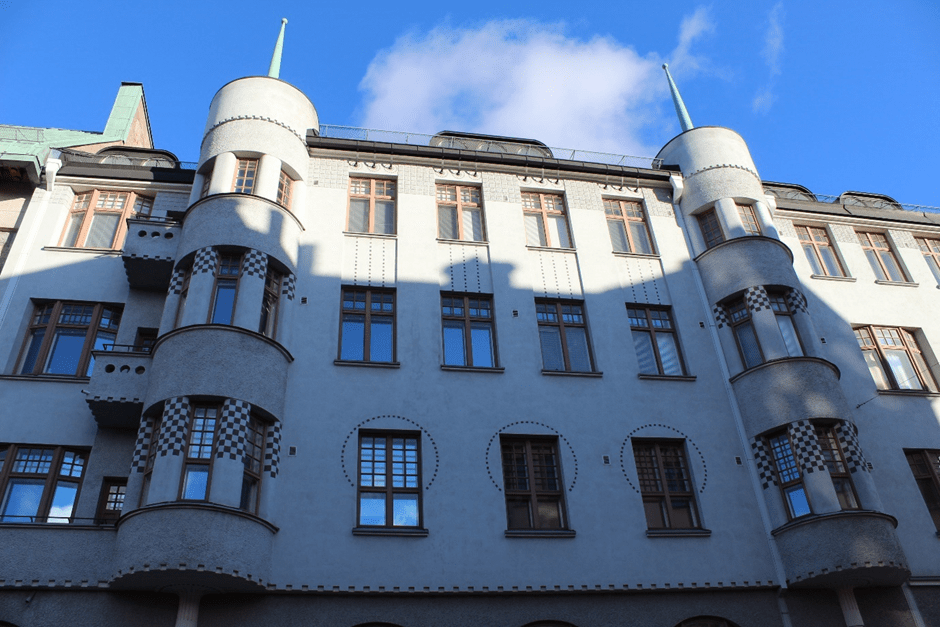
The apartment blocks that sprung up across Helsinki certainly took their cue from castles, being massive bastions with sheer walls and monumental corner towers. Their severity is broken by decorative motifs around doorways and windows or under the eaves. Finnish identity was expressed through motifs adapted from woodcarvings, metalwork, and textiles. The angularity of some motifs, especially the ancient swastika (both facing right and left), stars and lozenges, creates a visual language very different to the curvilinear forms of Belgian and French Art Nouveau.
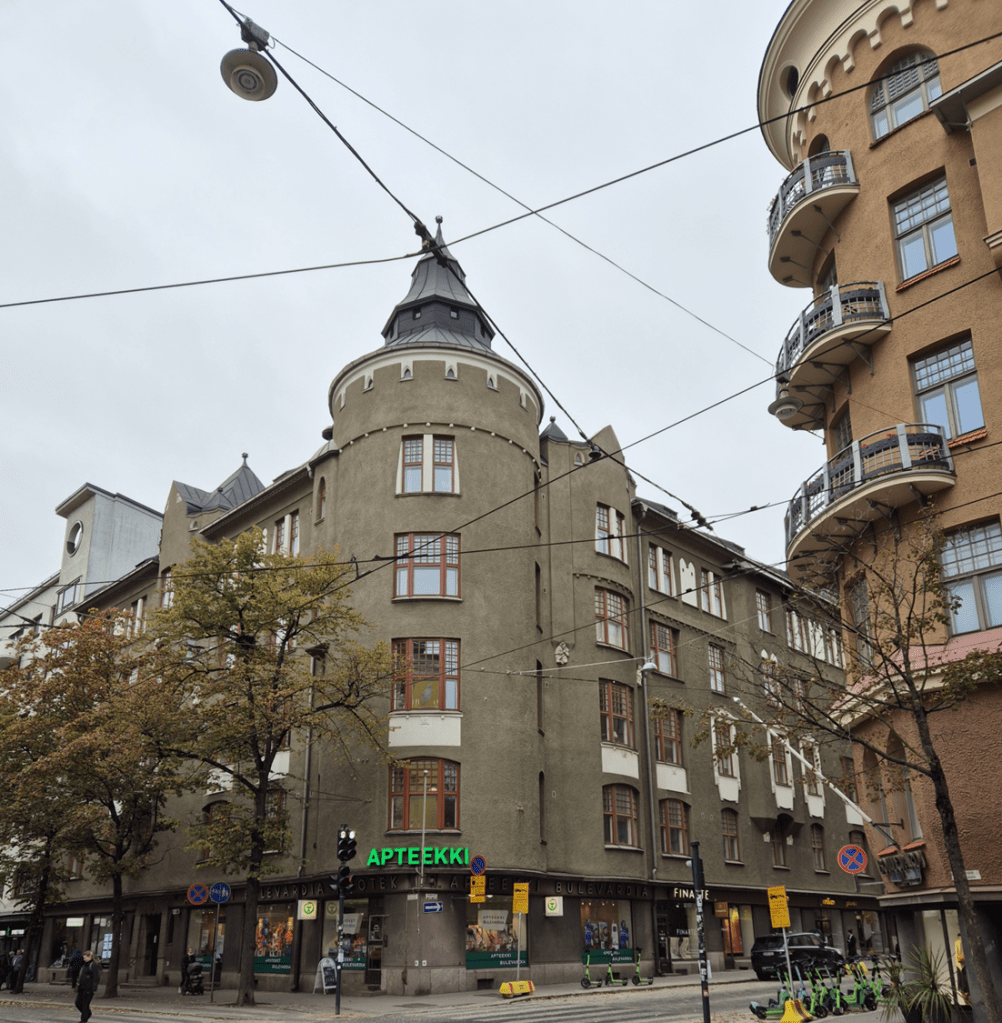
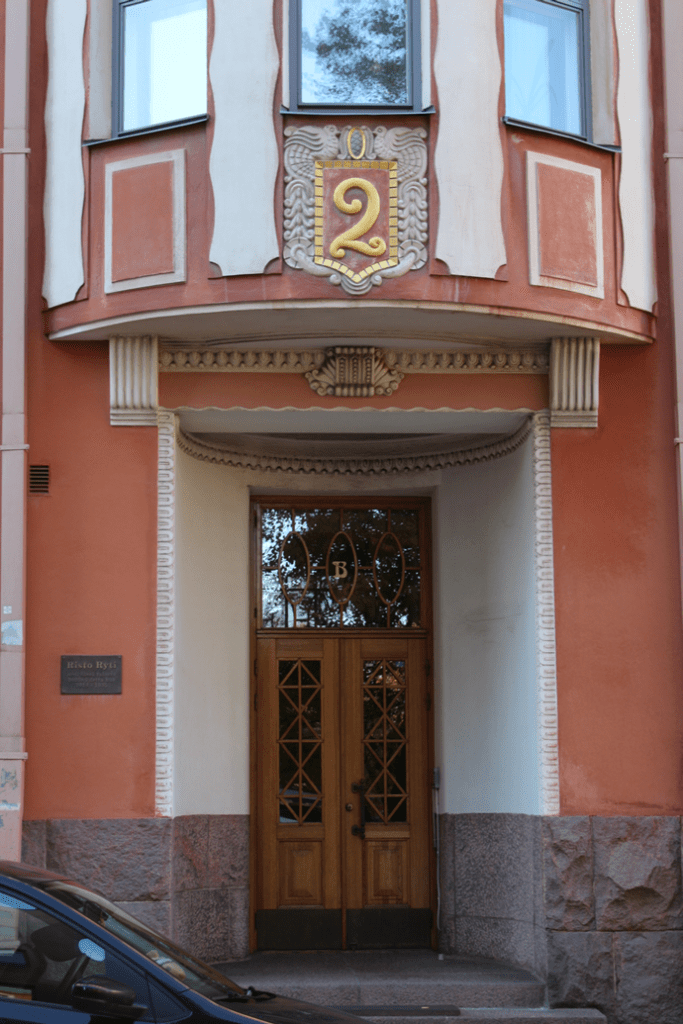
You will often find a base course of granite underpinning an apartment block. Above the rendered walls were invariably painted in earthy yellow or reddish tones. Other elements to look for include spires, lancet windows, projecting bay and oriel windows, monumental arches, and steep gables. Decorative elements cluster around doorways, windows and under the eaves, as seen on the apartment block at Bulevardi 24.
Sirius buildingFabianinkatu 4, 1905,Knut Wasastjerna and Gustaf Lindberg
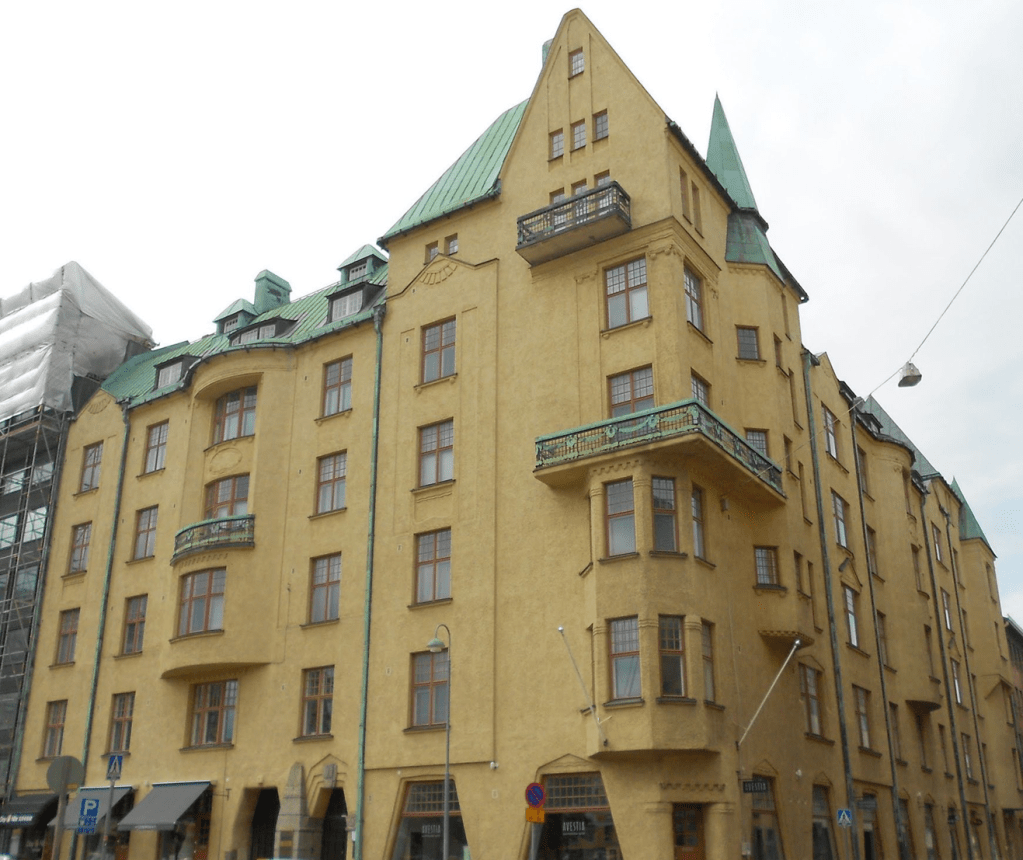
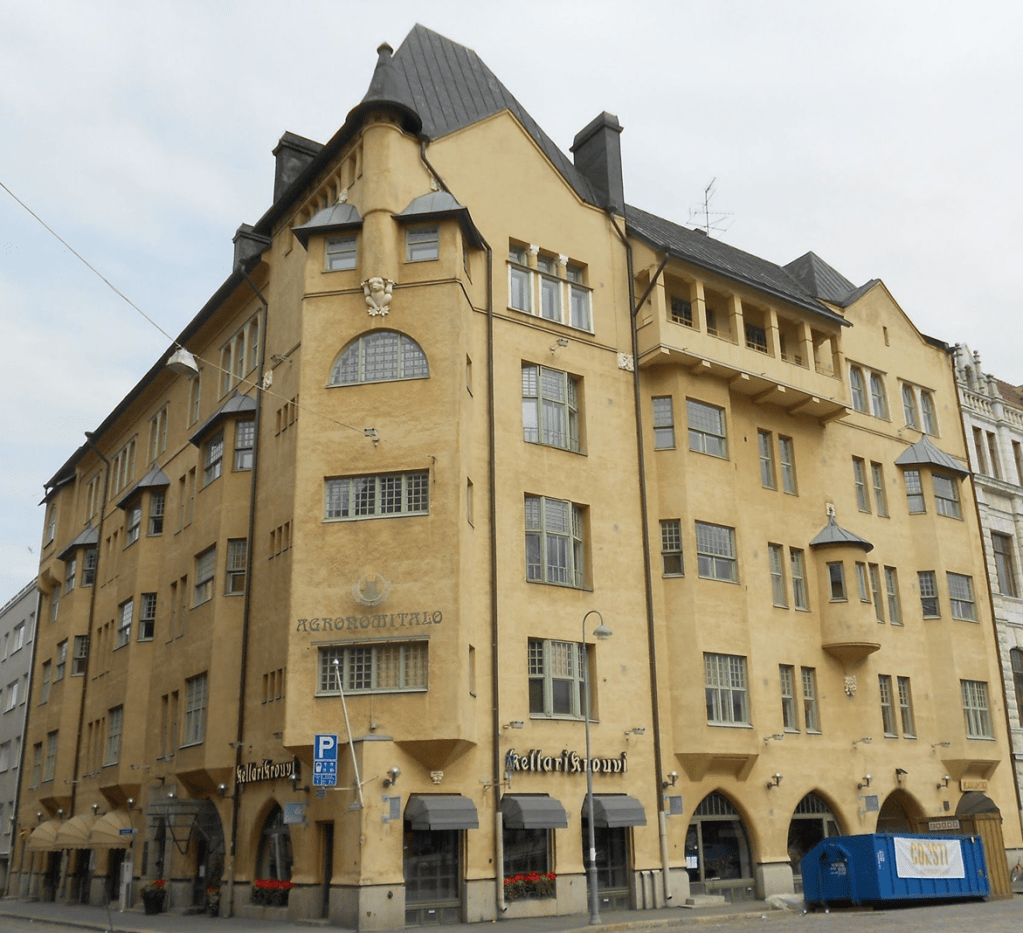
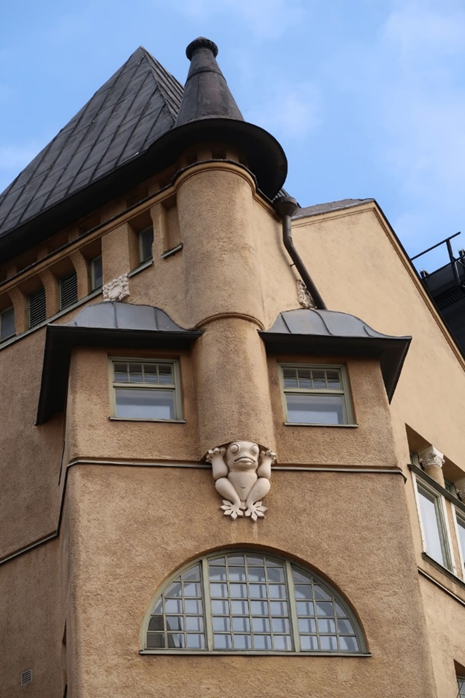
The Doctors House/ Lääkäreiden building (1901), now known as the Agronomitalo, Fabianinkatu 17/ Kasarmitori, designed by Gesellius, Lindgren, and Saarinen set a standard. Five storeys high, clad with rough yellow render, its sheer walls were relieved by projecting oriel windows. The main decorative element is quirky frog appearing to support a corner turret. The frog might reference the ‘Little Frog’ dance, ‘Små grodorna’ in Swedish, performed by children around the Maypole. Midsummer festivities are important across all the Nordic countries. Built on Kasarmitori (Barracks Square), a rather impressive area, these apartments were for the upper-middle classes: the spacious accommodation had professional areas, as it was envisaged that doctors would take up residence. Hence, its local name. Some of the interiors were furnished by Louis Sparre with custom furniture and fittings.
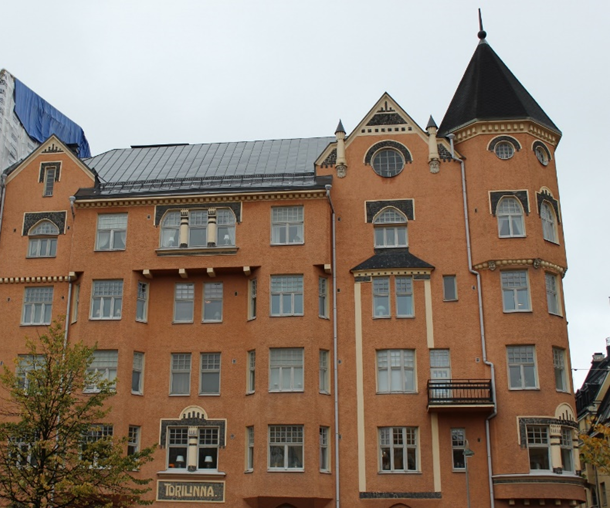
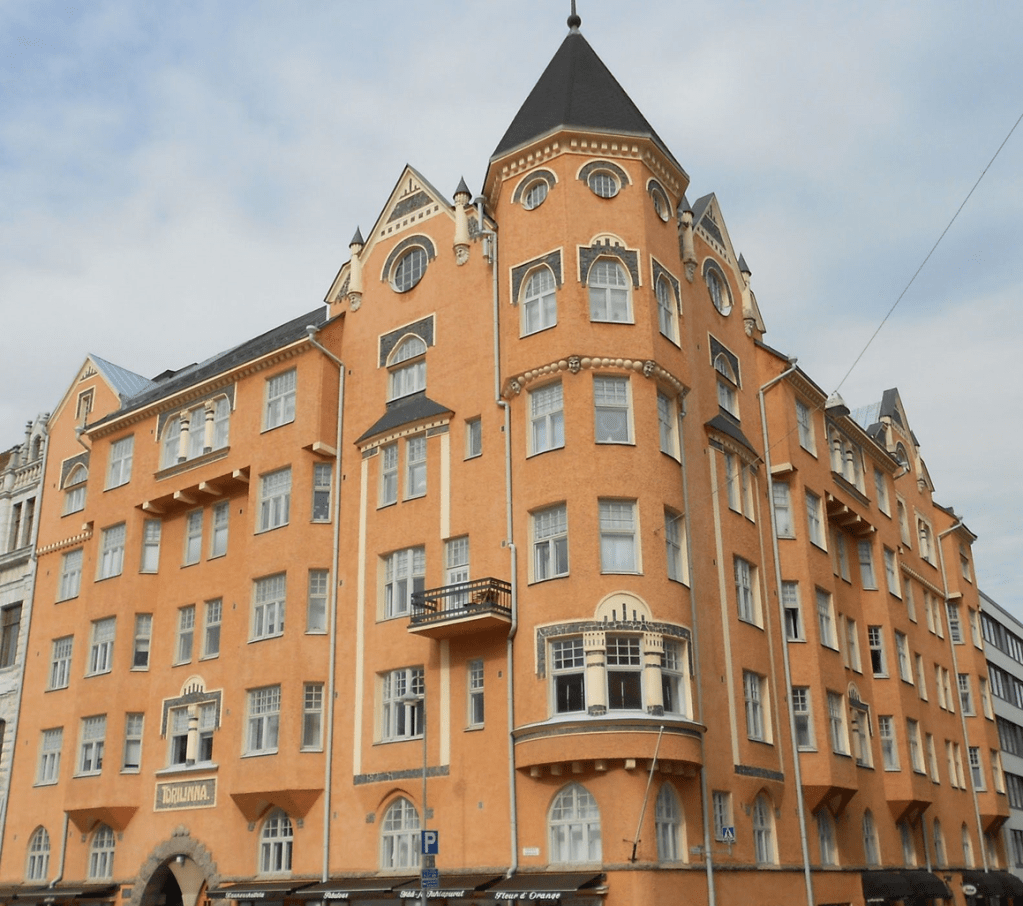
Nearby the Torilinna building (1906), Eteläinen Makasiinikatu 5/Fabianinkatu 13, takes its name from the location, meaning Tori (Square) Linna (Castle). It was built by G.W. Nyberg and Edv. Löppönen.
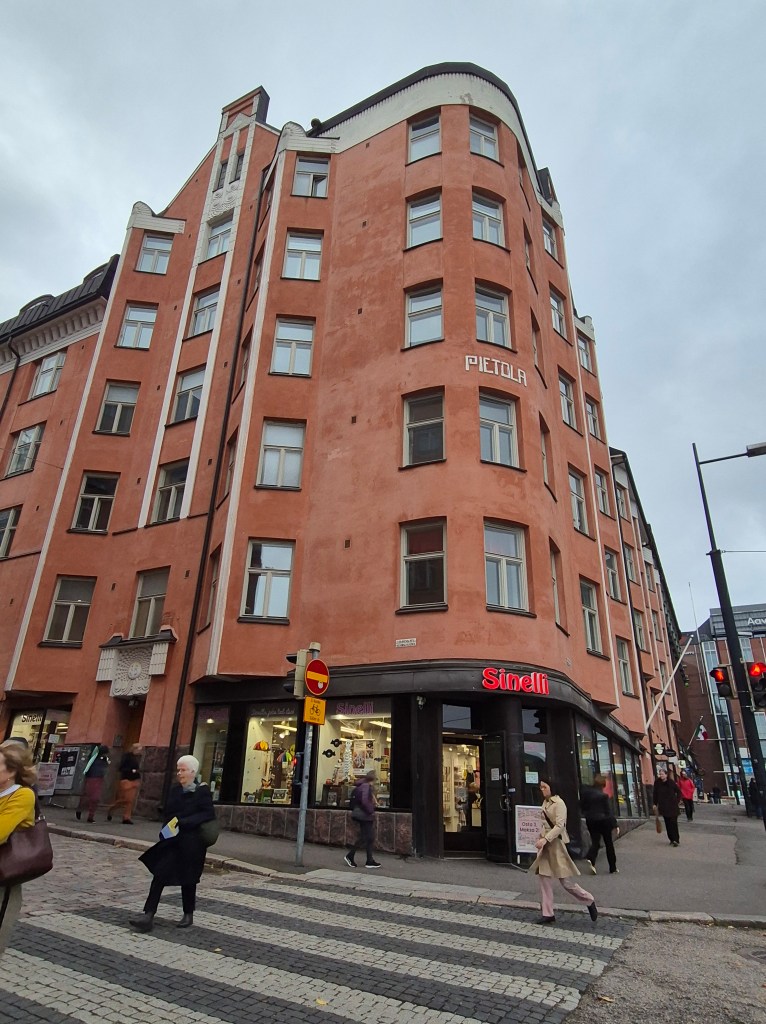
In the KAMPPI district, Yrjonkatu is lined with Jugend apartment blocks. The run starts with Koitto House [Dawning] (1907), Yrjonkatu 31/ Simonkatu 8, by Vilho Penttila, which has been mauled by later editions, and Pietola, Yrjonkatu 38/Simonkatu 10 (1908) by Heikki Kaartinen. Many of the apartments are named. Koitto, meaning ‘dawning’, could be a reference to a new start at the opening of the 20th century. However, it was also the headquarters of a temperance society founded by Doctor Aksel August Granfelt. As secretary of the Finnish Lifelong Learning Foundation and advocate of total abstinence, Granfelt was an influential ‘Fennophile’. The building housed rental apartment, shops, a restaurant, café, gym and even a banquet hall with a stage. According to the society’s centenary publication, ‘Koitto was simultaneously a temperance society, worker’s institute, study group, club for women and young people, library and sports club, part of the cooperative movement and savings bank institute, and even functioned, in a way, as a trade union and a political party.’
Pietola, Yrjonkatu 38/Simonkatu 10 (1908) by Heikki Kaartinen, can be a personal/surname name, but it is also a small hamlet in western Finland.
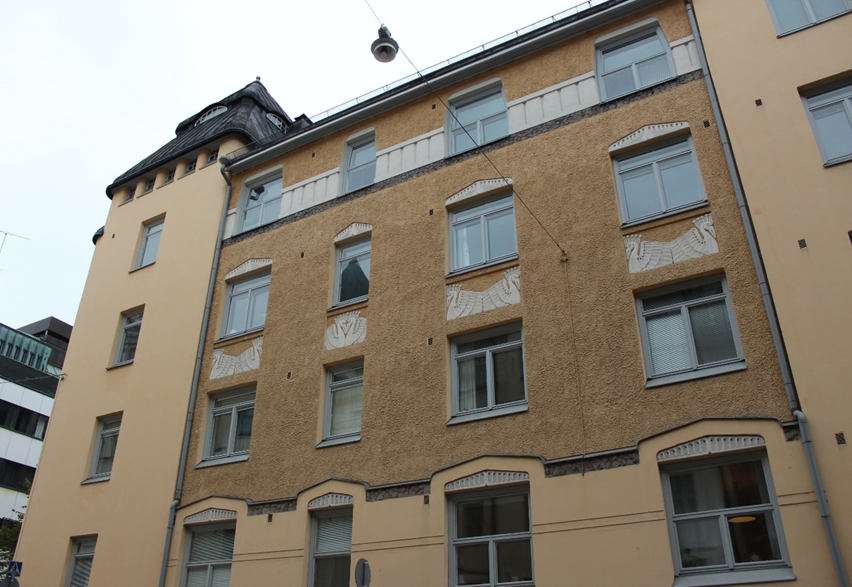
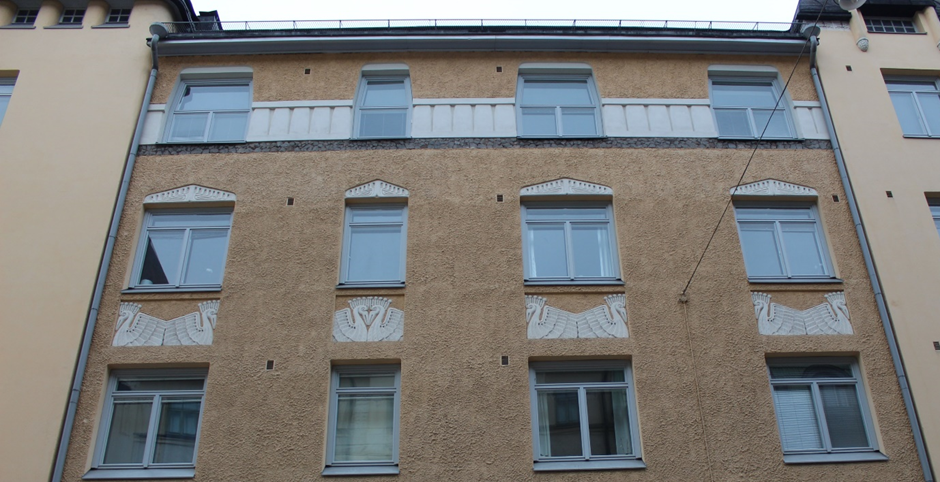
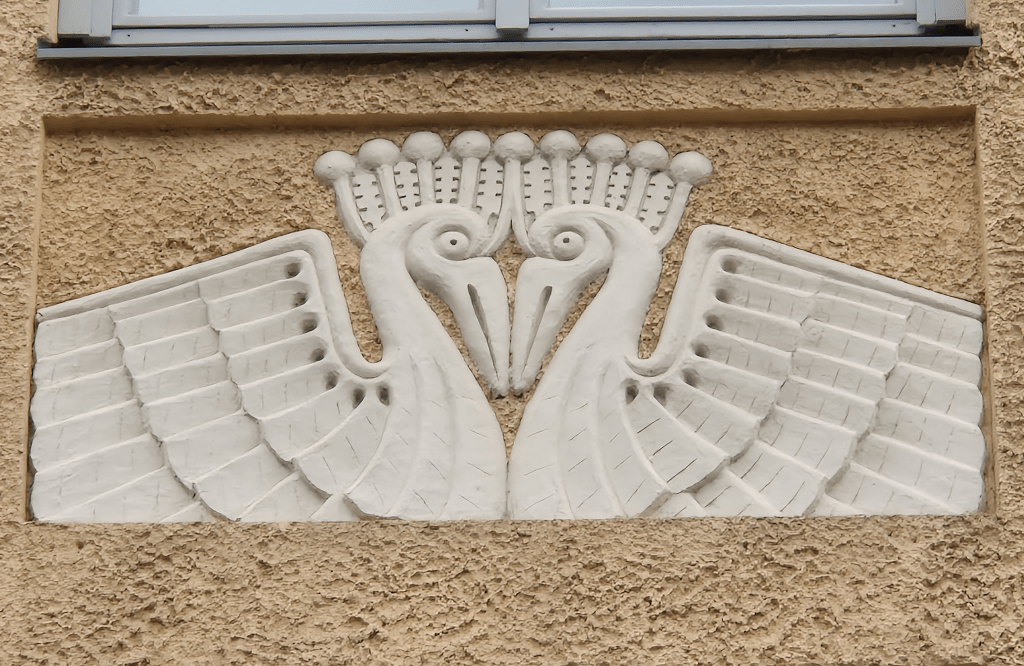
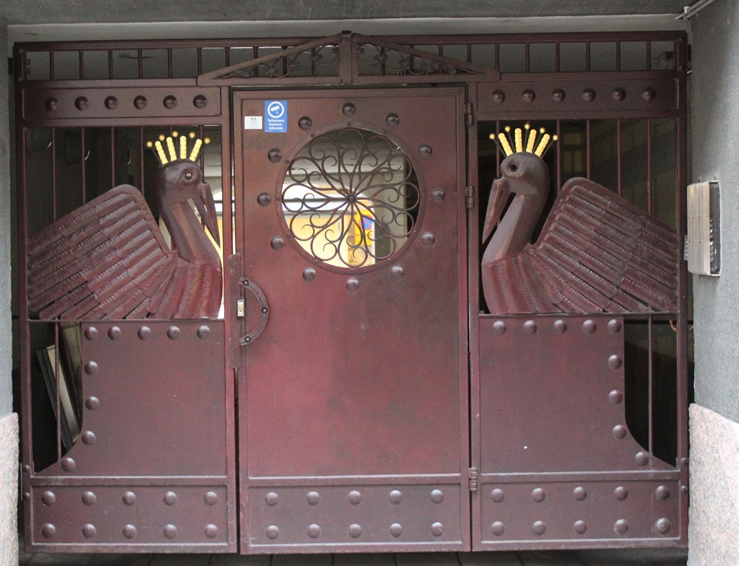
Harjula by Heikki Kaartinen, constructed by Asunto Osakeyhtio, housing company, (1905), Yrjonkatu 32/ Eerikinkatu 1, also appears to have been named after a country town in southern Finland. Like Pietola it can also be a surname. This apartment block is distinguished by panels of stylised birds. The same motif is transformed into the entrance gate to the courtyard.
Jukola, Yrjonkatu 25 (1906) by Heikki Kaartinen, stands opposite, named for a literary masterpiece. Aleksis Kivi (1834-72), who died aged only 38, is said to have written the first significant novel in Finnish, Seitsemän veljestä/ Seven Brothers. Translated into 33 languages and still a mandatory text in Finnish schools, it is said to depict ‘ordinary Finns in a realistic way’ or a ‘not-so-virtuous rural life’. As Jukola was the farm where the brothers grew up, they were known as ‘the Jukola brothers’. The building is decorated with bear heads and acorns.
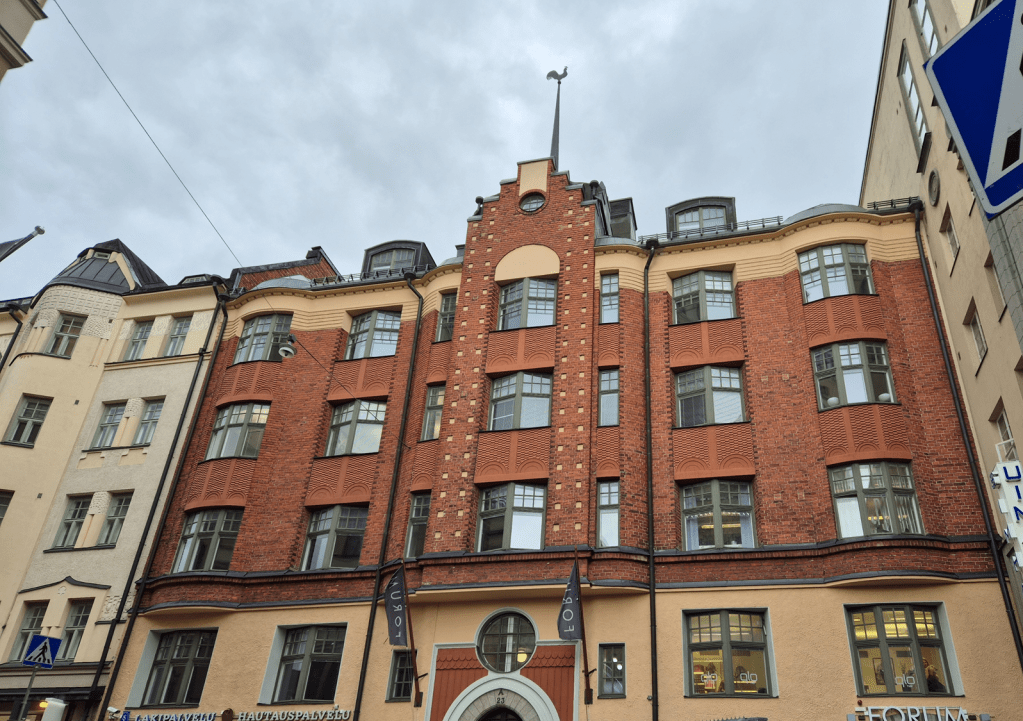
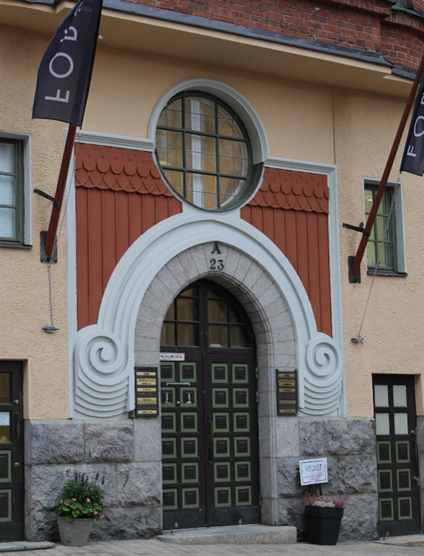
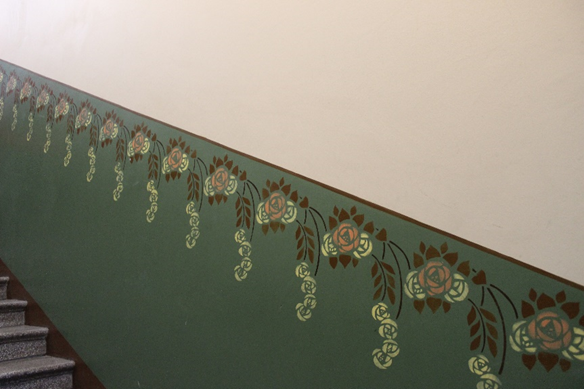
Adjacent, Yrjönkatu 23 (1907-08) by Gunnar Stenius, a partner in Lindgren & Stenius, is architecturally quite different being clad in patterned brickwork. Stenius may have been influenced by Danish, Swedish, or German buildings of a similar date. It also had the novelty of a central kitchen. Apparently ‘they made living easier for families, as middle-class mothers began to work outside the home and many households no longer employed domestic help.’ An elaborate doorway leads to a beautiful staircase painted with Mackintosh style roses. The building is crowned by a tall weathervane, which stands out on the skyline.
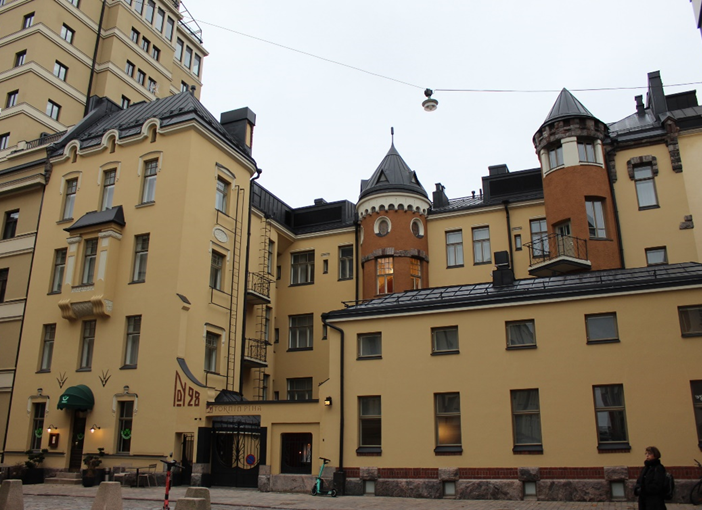
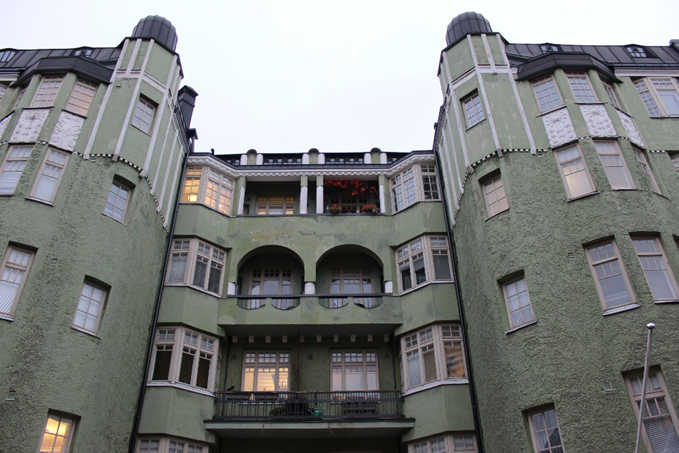
Facing Jukola, Yrjönkatu28, is the courtyard of the Kyllikki (1904) apartment block; the romantic towers evoke a medieval skyline.
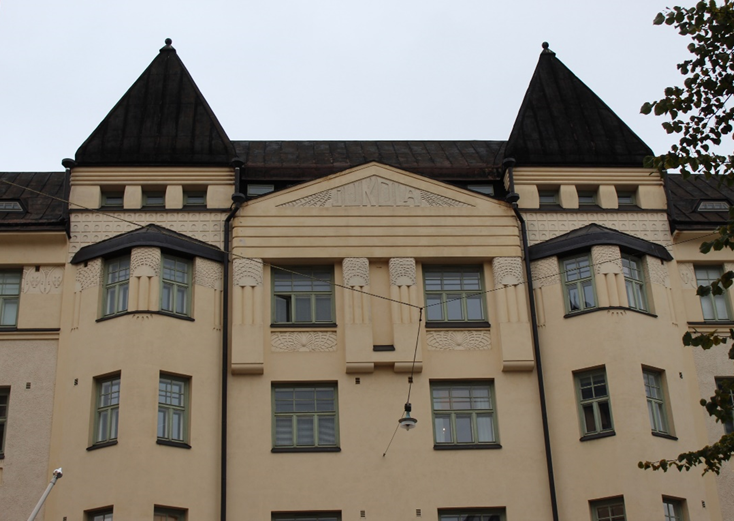
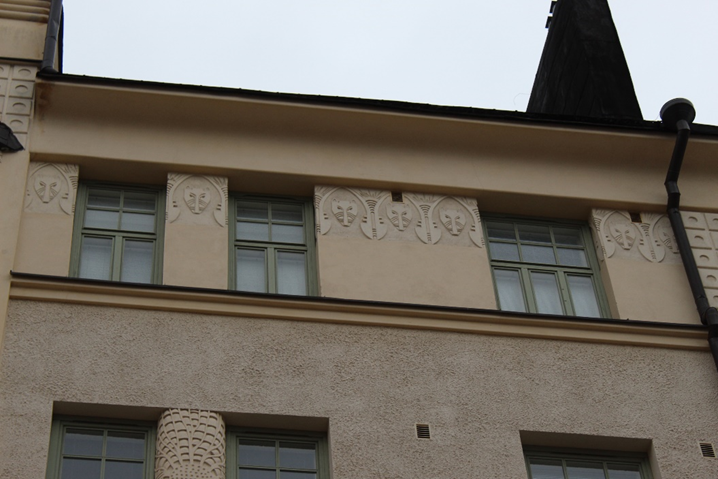
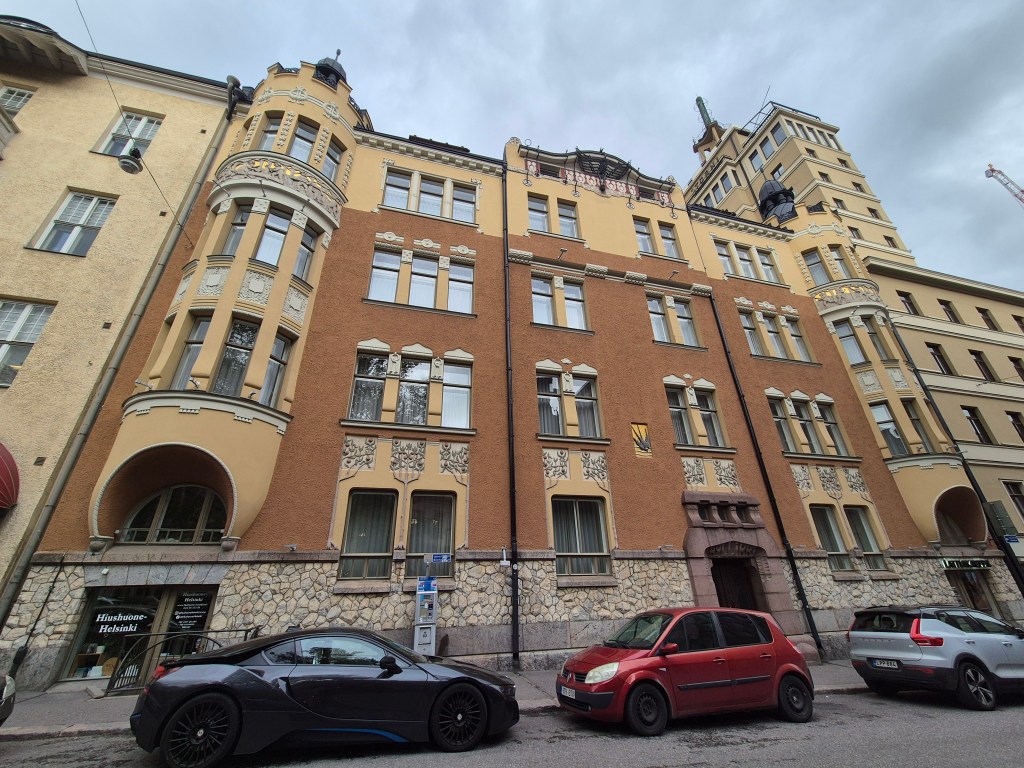
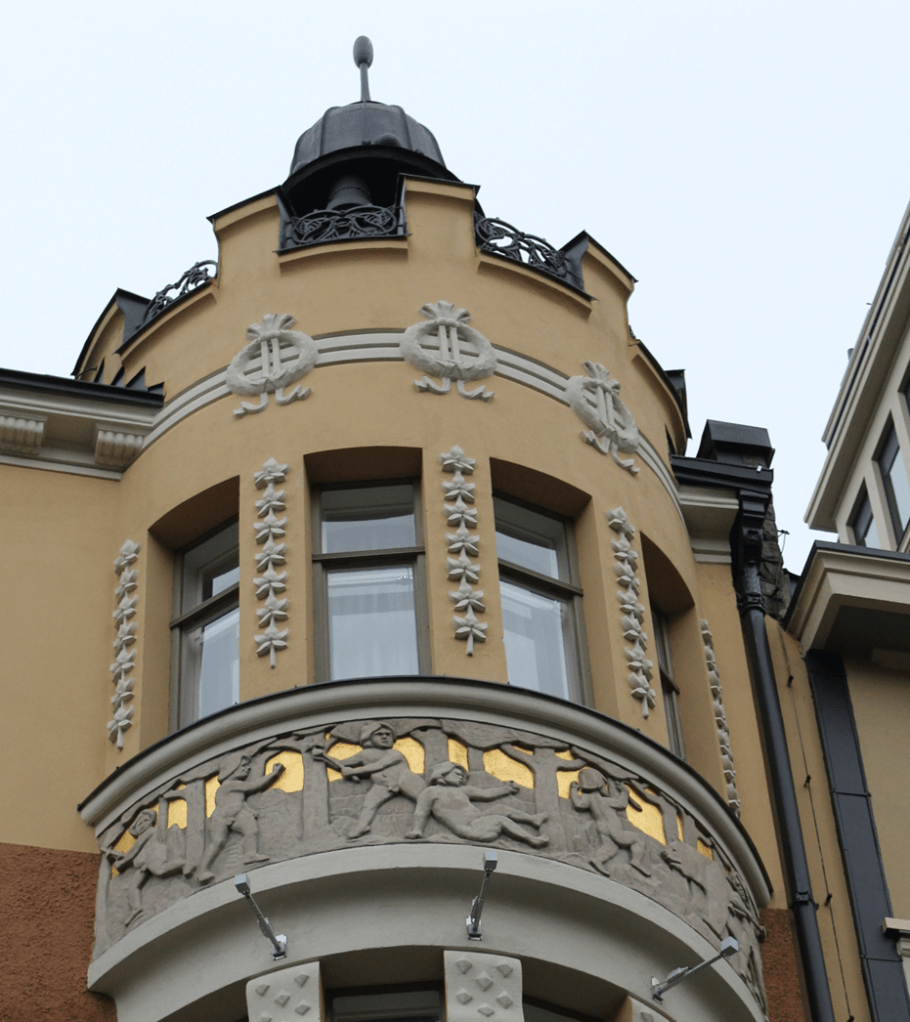
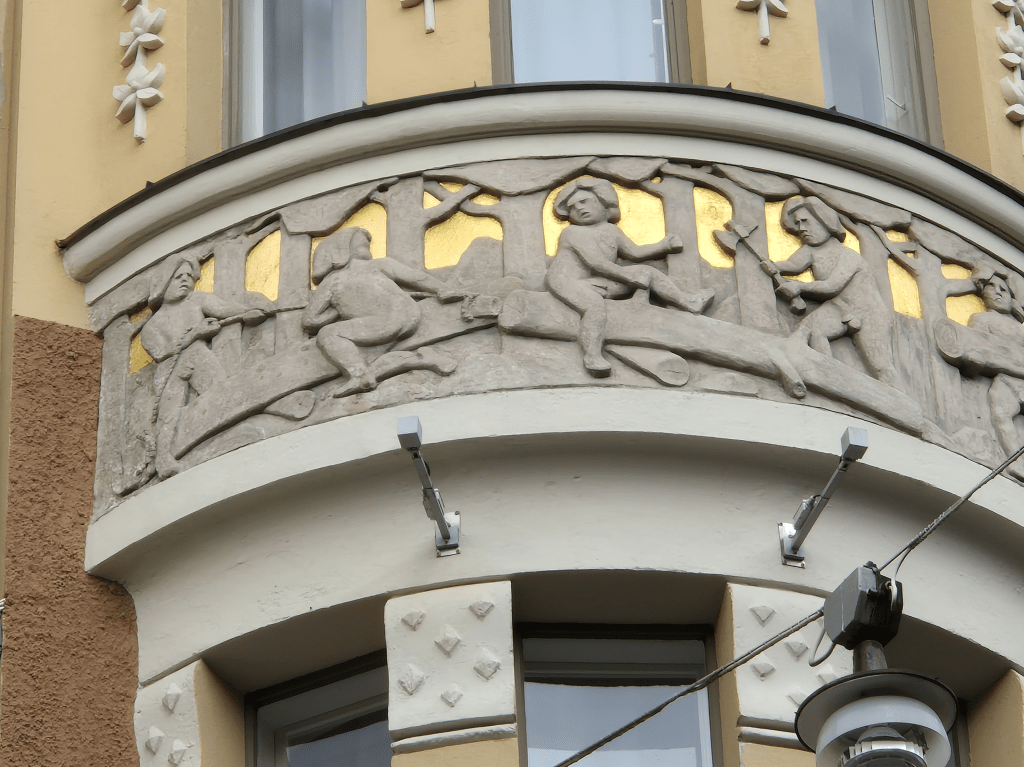
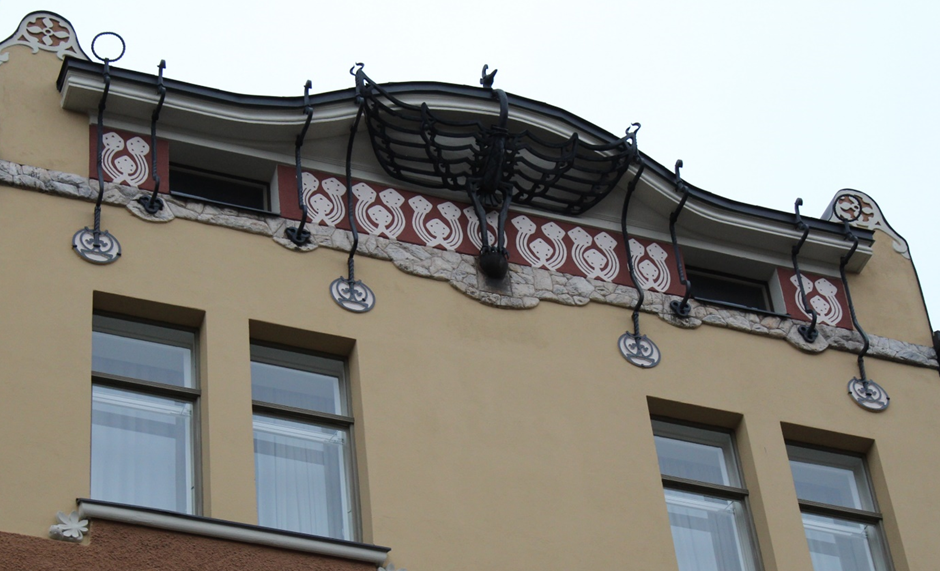
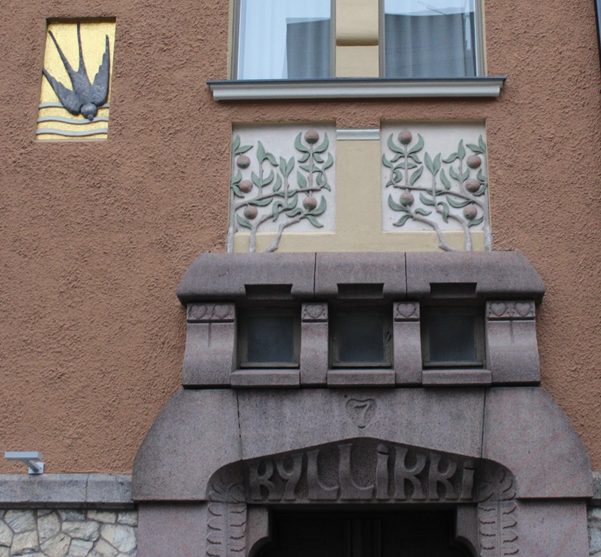
Kyllikki (1904), by Georg Wasastjerna and Karl V. Polon, Kalevankatu 7 and Yrjonkatu 28, is now part of Hotel Torni. Kyllikki is Lemminkainen’s happy wife in the epic Kalevala. It has the prettiest façade you will encounter. Its two round oriel towers are decorated with friezes of children. On the right the children are fighting or more sensibly running away from a bear. On the left they appear to be felling trees. The stylised bird under the eave, apparently a Blue-bill Duck, is quite unique. Stylised fruit trees surround the windows. A swallow completes the delightful naturalistic ornamentation.
Spot the bear!
Cutting down trees
Blue-bill Duck, made of metal.
Kyllikki is Lemminkainen’s happy wife
The last interesting building is this sequence is Yksitoista[Eleven] (1908), Kalevankau 11, by Vilho Penttila. Rather than a sheer face, it has a recessed façade with varied balconies above. Commercial spaces take up the ground floor.
Punavuori Area
A walk along Bulevardi takes you passed Huvilinna, Sanmark House, and Bulevardi 11.
Huvilinna, 17-19, Bulevardi, 1905-1906 Gustaf Estlander architect. Commercial spaces on the ground floor. Note the massive granite arches.
Albertinkatu 17-19,Built 1906-1907 Gustaf Estlander architect
Etu-Toolo area
Tunturinkulma, Cygnaeuksenkatu 2/ Tunturikatu 1 12, built 1911-12.Emil Svensson architect.
Kansanvalistusseura/ People’s Education Society, Cygnaeuksenkatu/Museokatu, 1913, Emil Svensson
See
Areas to explore:
In Kaartinkaupunki, you will find the Doctor’s House, Sirius, Torillinna and the Helsinki Telephone Company by Lars Sonck.
The Katajanokka area, the other side of the Market Square, has many impressive apartment blocks, notably Olofsbourg with its monumental tower by Gesellius, Lindgren and Saarinen.
An example of Nordic- Classicism, the Suomi-Salaman building (1909-11, 1927) an insurance company, can be found at Lönnrotinkatu 5. Designed by Onni Tarjanne and Armas Lindgren with sculptures by Eemil Halonen (1875-1950). Architect Karl Lindahl made additions in 1927.
Reading
Architectural Guide Art Nouveau Helsinki, Helsinki: Helsinki City Museum, 2020.
Becker, Ingeborg and Sigrid Melchior, Now the Light Comes from the North-Art Nouveau in Finland. Berlin: Brohan Museum, 2002.
Korvenmaa, Pekka, Innovation Versus Tradition: The Architect Lar Sonck Works and Projects 1900-1910, Helsinki: Finnish Antiquarian Society, 1991.
Moorhouse, Jonathan, Michael Carapetian, and Leena Ahtola-Moorhouse, Helsinki Jugendstil Architecture 1895-1915, Helsinki: Otava, 1987.
Nikula, Riitta, Armas Lingren 1874-1929, Helsinki: Museum of Finnish Architecture, 1988.
Finlandia: Jugendstil to Modernism in the far North
Like many visitors my first glimpse of Helsinki was from the sea, sailing into the port while enjoying a Baltic cruise. Standing out on the horizon are the white silhouette of the Lutheran Cathedral, built as a tribute to the Grand Duke of Finland, TsarNicholas I of Russia, and the green dome of the Eastern Orthodox Uspenski Cathedral inaugurated in 1868. Both remind us that Finland was a grand duchy of the Russian Empire until December 1917. Once landed, tourists usually head for the market in search of souvenirs or Senate Square to admire a unified ensemble of early 19th century Neoclassical buildings created by Carl Ludvig Engel: Helsinki Cathedral, the Government Palace, the University of Helsinki, and the National Library of Finland. The centre of Senate Square is dominated by a statue to Alexander II who envisioned a stylish modern capital along the lines of St. Petersburg.
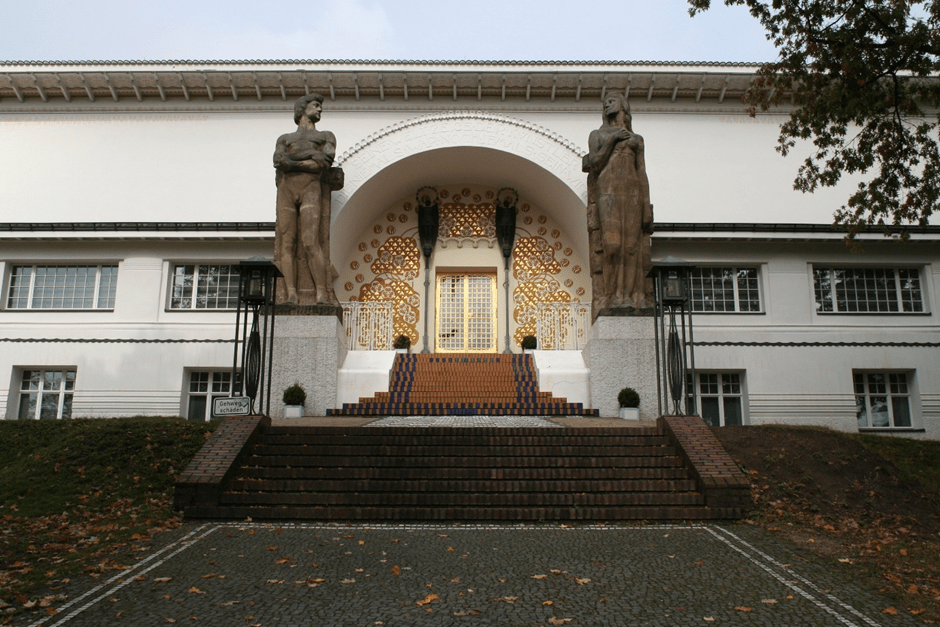
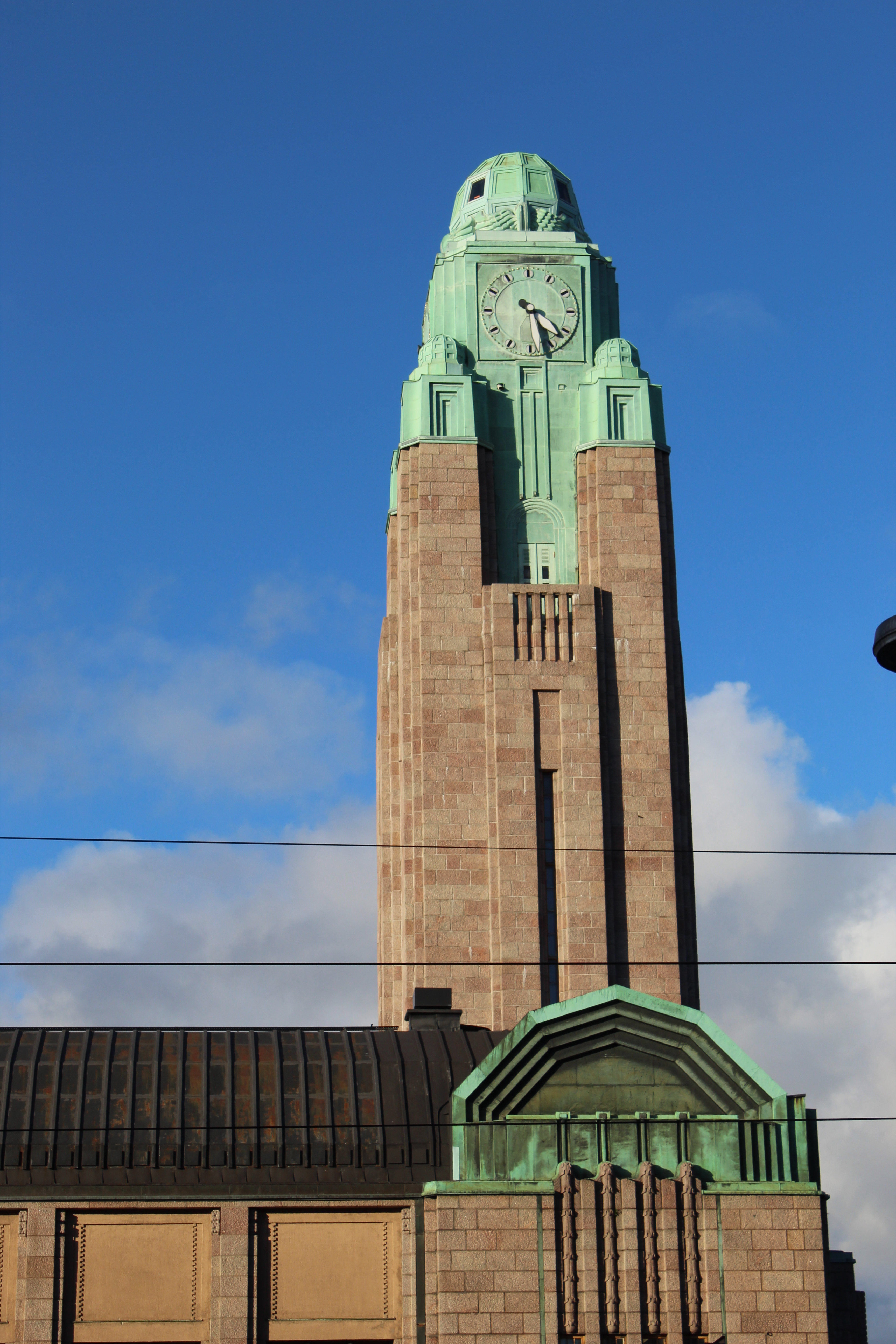
However, as a dedicated seeker of Jugendstil architecture, the German term for Art Nouveau also used in northern climes, I headed for the city centre in search of the Central Railway Station designed by Eliel Saarinen in 1904 and finally inaugurated in 1919. Initially conceived in a National Romantic style, Saarinen modified his plans in 1909, after a European study tour. The famous Ernst Ludwig Haus, at the centre of Darmstadt’s Jugendstil colony (1901), certainly influenced the final conception dominated by Emil Wikström’s iconic Lantern Carriers.
However, as I soon discovered, the Central Station represents the tip of an iceberg as Helsinki boasts some 500 National Romantic/ Jugendstil buildings. My favourite remains the fantastic Pohjola Insurance Building, on Aleksanterinkatu, dating to 1901, designed by Herman Gesellius, Armas Lindgren, and Saarinen. Resembling a gigantic castle, the building is amusingly covered with dangerous beasts- wolves, bears and trolls- that it would be wise to insure against! In the famous Finnish epic, the Kalevala, Pohjola is the evil land of the North. It was Kalevala and Karelianism that shaped the art of Akseli Gallen-Kallela, Finland’s great symbolist painter.
Over a series of three lectures, I will explore the fantastic art and architecture of Helsinki encompassing not only the city’s Jugendstil buildings but also the paintings of Akseli Gallen-Kallela and the furniture and glass designs of Alvar and Anio Aalto.
Akseli Gallen-Kallela and Karelianism
Finland’s remarkable Jugendstil pavilion took centre stage at the 1900 Paris World Fair. Created by Herman Gesellius, Armas Lindgren, and Eliel Saarinen the pavilion was an expression of Finnish nationalism in the face of Russification.
A committed patriot, who changed his name from Swedish to Finnish, Gallen-Kallela decorated the central dome with scenes from the Kalevala, Finland’s national epic published in 1835. Compiled from Finnish and Karelian folk lore, the Kalevala was central to Karelianism. This romantic nationalistic movement saw Karelia, an area which straddles Finland and Russia, as a refuge for ‘Finnishness’, where the true spirit of the people had maintained its authencity across centuries. Many artists, writers and musicians supported Karelianism; Gallen-Kallela was joined by Louis Sparre, sculptor Emil Wikström and Jean Sibelius. Gallen-Kallela drew on the Kalevala for his themes as seen in the Aino Myth, Triptych (1891), Lemminkäinen’s Mother (1897) and Joukahainen’s Revenge (1897). From 1926-8 Gallen-Kallela recreated his Kalevala frescoes, originally painted for the 1900 Finnish Pavilion, for the entrance of National Museum, Finland, as a telling statement of Finnish identity: The Forging of the Sampo, The Defense of the Sampo, Ilmarinen Plowing the Field of Vipers,and Killing the Great Pike.
Clearly the Kalevala held a deeply personal meaning for the artist, his vision becoming darker after the death of his young daughter Impi Marjatta. Yet alongside these ideologically complex works, Gallen-Kallela also perfectly captures the beauty of the wild Finnish landscape- his evocative images of snow laden trees, as seen in The Lair of the Lynx (1906) are beyond compare.
Finnish Jugendstil: National Romanticism blends with Arts and Crafts
There is no doubt that the campaigns of Russification, instigated from1899–1905 and again from 1908–1917, swelled the desire to create a national Finnish architecture. Onni Tarjanne’s Finnish National Theatre (1902), with its rough granite façade and twin towers, exemplifies the National Romanticism of the era. However, its Romanesque arcade betrays an influence from far beyond Europe, so-called ‘Richardsonian Romanesque’. Architect Henry Hobson Richardson freely blended 11th and 12th century French, Spanish, and Italian Romanesque characteristics to create an American style! In addition to round-headed Romanesque arches, often springing from short squat columns, the style incorporated cylindrical towers with conical caps embedded in the walling and rich rustication. Lars Sonck’s Headquarters of the Helsinki Telephone Association (1903-07) echoes these features.
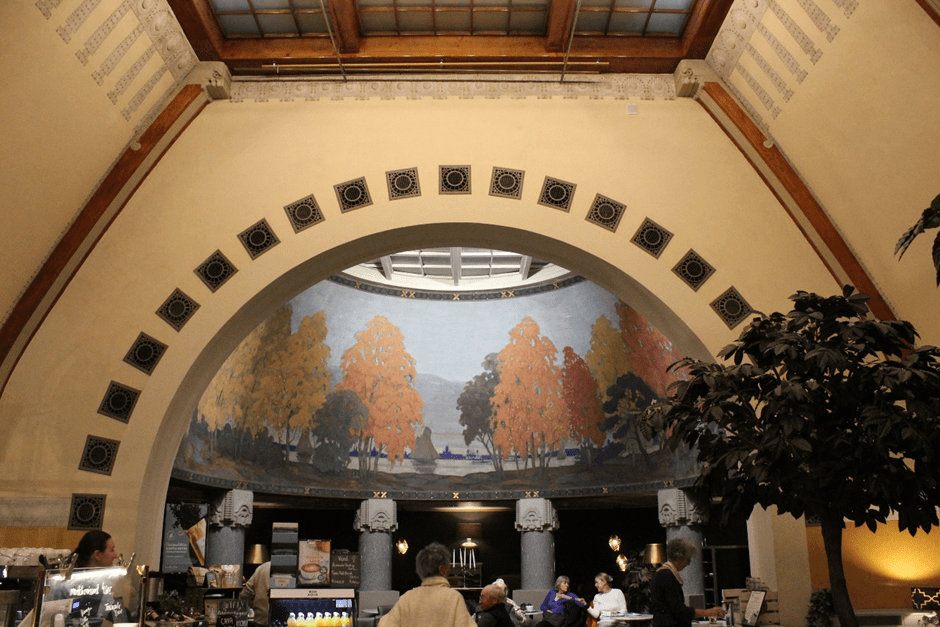
By 1904 Sonck had fully embraced Jugendstil, as seen in his remarkable Jugend Hall (1904), originally a banking hall which now functions as a café.
Coinciding with a massive expansion of the city’s population, large fortress-like apartment blocks sprang up coming to dominate entire streets: Korkeavuorenkatu, Huvilakatu and Kauppiaankatu, the latterfound in a new neighbourhood just east of the city centre, Katajanokka. Although they can appear quite brutal, they are softened by decoration notably around the doors, windows and under the eaves. Alongside apartments by the famous architectural triumvirate of Herman Gesellius, Armas Lindgren, and Eliel Saarinen, other buildings stand out:
Torilinna building Fabianinkatu 13, 1906 by master builder Gustaf Wilhelm Nyberg and Edv. Löppönen
Sirius buildingFabianinkatu 4, 1905, by Knut Wasastjerna and Gustaf Lindberg
Kastén building, Korkeavuorenkatu 31, 1907 by Emil Svensson and Emil Holm.
Now a hotel, Vanha Poli, the former Polytechnic Students’ Union byKarl Lindahl and Valter Thome dating to 1903, makes your stay in Helsinki unique and memorable!
From Jugendstil to Modernism: Saarinen and Aalto
Although Saarinen is best known for the Central Railway Station, many go in search of his rural retreat Hvitträsk, on lake Vitträsk, Kirkkonummi, a few miles outside Helsinki. Originally built as a residence for the three architectural partners and their families, Armas Lindgren soon returned to Helsinki. With the premature death of Herman Gesellius in 1916, Saarinen became sole owner. Although Saarinen moved to America in 1923, he regularly returned to Hvitträsk during the summer months. Although changes were made to Hvitträsk, the central house retains its original Jugendstil spirit.
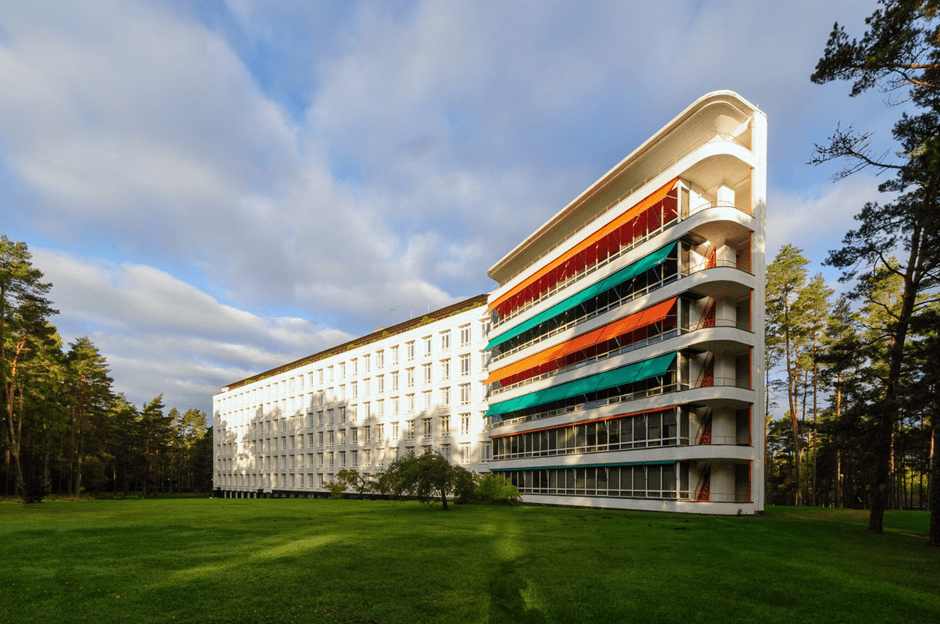
When the property was sold, just before Saarinen’s death in 1950, Hvitträsk was an anomaly. By this time the leading Finnish architect was Alvar Aalto. He was initially influenced by Bauhaus Modernism, as exemplified by his Tuberculosis Sanatorium Paimio, (1928-1933).
Moving away from strictly functional modernist forms, by the 1950s Aalto had developed a personal style based on natural curving lines. The Hall of Culture in Helsinki (1955-58), designed for Finnish Communist cultural organizations, best expresses this phase of his career.
In 1959 work began on a grand new monumental centre for Helsinki around the Töölö Bay area. Aalto’s Finlandia Hall (1962-71) and its Congress wing (1970-75) were the only parts of the plan to be completed. The concert hall’s monolithic tower-like section was intended to create a high empty space that would provide better acoustics. However, cladding the surface in Carrara marble has proved problematic in the harsh Finnish winters. While Aalto claimed he wanted to bring Mediterranean culture to the north, this great white edifice standing on the edge of the lake resembles an iceberg!
Despite these architectural achievements, beyond Finland Aalto is best remembered for founding the design company Artek with his wife and collaborator Aino Maria Marsio-Aalto. As Artek’s first artistic director, Aino’s creative output spanned textiles, lamps, glassware, and interior design. Rather than following a modernist ideology, Aino favoured comfort and homeliness, her ideas perfectly expressed in the Aalto’s own home at Munkkiniemi.
You can pay by PayPalfor a link to these lectures on my YouTube site
Anne Anderson Art and Design History Channel
Lecture 1
Akseli Gallen-Kallela and Karelianism
£7.00
Lecture 2
Finnish Jugendstil: National Romanticism blends with Arts and Crafts
£7.00
Lecture 3
From Jugendstil to Modernism: Saarinen and Aalto
£7.00
Three lectures
Akseli Gallen-Kallela and Karelianism
Finnish Jugendstil: National Romanticism blends with Arts and Crafts
From Jugendstil to Modernism: Saarinen and Aalto
£20.00
Please join me to discover the unique character of Finnish Jugendstil.
Please check out my AMAZON page for my book on Art Nouveau Architecture, published by Crowood.
Processing…
Success! You're on the list.
Whoops! There was an error and we couldn't process your subscription. Please reload the page and try again.
A series of three lectures added to the archive library of lectures
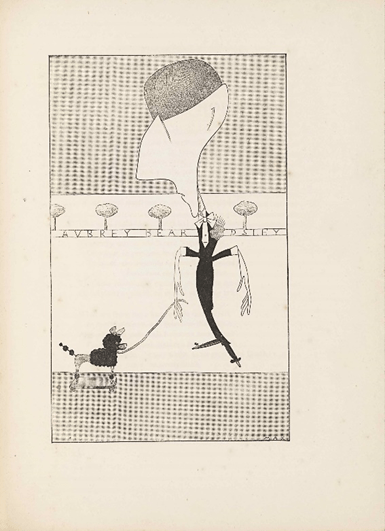
Max Beerbohm, “Caricature of Aubrey Beardsley.” The Savoy, vol. 2, April 1896
On 21st August 2022 academics and enthusiasts, including myself, gathered to wish Aubrey Beardsley Happy Birthday. Celebrating 150 years since his birth, it is sad to recall that Beardsley died aged only twenty-five from tuberculosis. Yet he seemed to pack a whole lifetime into a career that spanned some six years. Inspired by this event, and eagerly anticipating the re-opening of Lord Leighton’s Studio-House, Kensington, in October, I will be offering a series of three lectures on my favourite topic the Aesthetic Movement. Having studied this era for many years, I often joke that I know more about the 1870s and 1880s than my own epoch. For my perfect dinner party, I would invite Oscar Wilde and Jemmy Whistler and allow them to do all the talking!
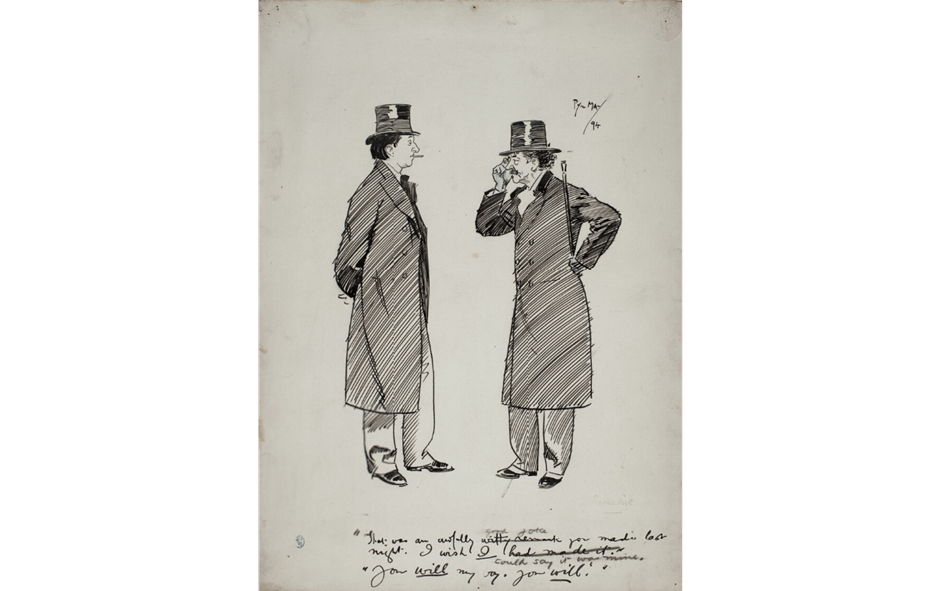
That was an awfully good joke you made last night. I wish I had made it. / ‘You will [underlined] my boy. You will [underlined]. 1894. Art Institute of Chicago. Reproduced in Phil May’s Sketch-book, first issued in 1895.
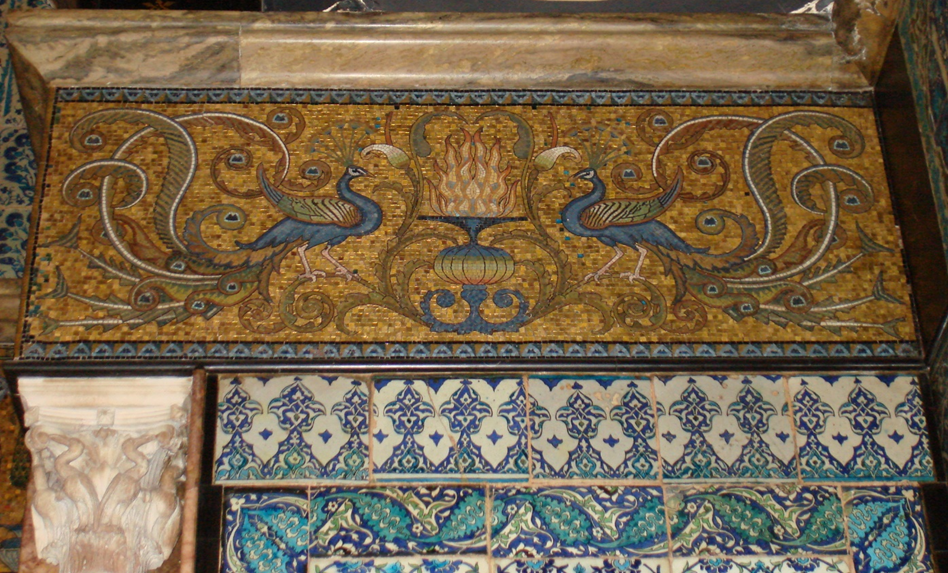
Given my association with Leighton House, its reopening after being closed for some two years will be my highlight this autumn. In 2009-2010, I worked on Closer to Home: The Restoration of Leighton House, an exhibition marking the ambition to return the studio-house to its former glory. With Victorian art and culture out of fashion for many decades, Leighton House had been rather neglected. Much of the original contents, paintings by Leighton and his circle of friends, furniture and ceramics, had been sold after Leighton’s death. While it was impossible to recover all the lost works of art, the auction catalogue provided the basis for a reconstruction. The massive dresser in the dining room, designed by Leighton’s architect George Atchison, has been reconstructed. The glory of the house remains the Arab Hall a unique blend of Western and Eastern art with genuine Islamic tiles, a mosaic by Walter Crane and carvings by Randolph Caldicott. A visit to Leighton’s ‘Palace of Art’ will transport you back to a time when artists lived like princes.
Leighton House, the Arab Hall
I have been a fan of OW for many years publishing several papers in The Wildean, a Journal of Oscar Wilde Studies. So, my trilogy of lectures will begin with Oscar, the High Priest of the Aestheticism!
Oscar Wilde and the Cult of Beauty
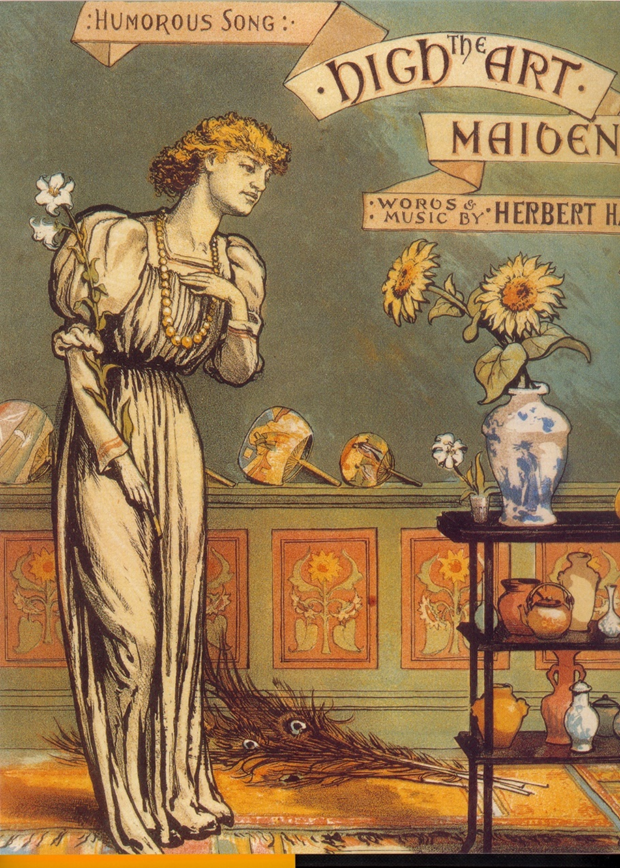
Sheet Music Cover for ‘The High Art Maiden’ c. 1881/82
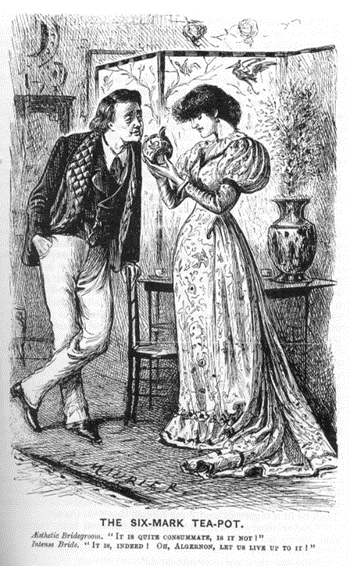
While still a student at Oxford, Oscar declared ‘Somehow or other I’ll be famous, and if not famous, I’ll be notorious.’ How prophetic! As the self-appointed High Priest of Aestheticism, Wilde achieved notoriety early in his career. Oscar made his debut as an art critic with a review of the Grosvenor Gallery, which opened its doors as an alternative exhibition space to the Royal Academy in 1877. He already preferred Burne-Jones to Millais but did not yet appreciate Whistler’s nocturns and symphonies! Posing as an art critic, Oscar’s pretensions and affectations, especially finding it hard to ‘live up’ to his Old Blue china, brought accusations of being a sham. Apparently, Wilde had no real love for art, he merely courted fame. Ridiculing the Aesthetes proved easy and lucrative for George Du Maurier, cartoonist for Punch, and Gilbert and Sullivan, whose comic opera Patience popularised Aestheticism; in 1882 Oscar was despatched to America to bolster the success of Patience and pontificate on how to achieve the ‘House Beautiful’. On his return he made money lecturing on his experiences in America; he married and settled in Tite Street, Chelsea, creating his own ideal home. He had yet to write anything of real significance; the late 1880s saw him editing The Woman’s World. But the 1890s witnessed the publication of his only novel, Dorian Gray, and the stage plays that have secured his posthumous fame as a writer. But just as success was in his grasp, nemesis appeared in the form of the Marquis of Queensbury.
The famous cartoon by George Du Maurier published in Punch (1880)
Patience was first staged in April 1881.
Lord Leighton’s Palace of Art: Artist’s Studio-Houses in London
For some 16 years, until his death in 1896, Lord Leighton ruled the roost as President of the Royal Academy. He headed an elite group of Victorian painters who colonised Holland Park- George Frederick Watts, William Holman Hunt, Luke Fildes, Marcus Stone, William Burges, Hamo Thorneycroft and Valentine Prinsep. On the fringe of this clique lived Linley Sambourne, the Punch cartoonist, who did his best to keep up with the ‘Burne-Joneses’! How was all this finery paid for? Leighton and his rivals were working in a boom period for British art. The newly moneyed wanted contemporary art to hang on their walls- trophies confirming their entrepreneurial and social success. Leighton was ranked among the so-called Olympian painters also numbering G.F. Watts and Alma Tadema. They opted for Classical subjects drawing on both ancient history and mythology. Leighton and Watts were rather high-minded; Alma Tadema less so, opting instead for ‘Victorians in Togas’. They all established their status as ‘gentlemen of the brush’ by creating prestigious studio-houses, veritable Palaces of Art.
Mosaic by Walter Crane in the Arab Hall, Leighton House
Aubrey Beardsley: Enfant Terrible of the 1890s
The Beardsley style is now synonymous with the so-called decadence of the 1890s, when poets and painters appeared to find beauty in morbid, deviant and degenerate subjects. His first major publication, illustrating Sir Thomas Malory‘s Le Morte d’Arthur appeared in 1893. His early style draws very heavily on the Pre-Raphaelite painter Edward Burne-Jones. However, for Oscar Wilde’s Salome (1894) he shifted to emulating Japanese wood block prints as well as paying homage to James Whistler’s infamous ‘Peacock Room’ (1877), the archetypal aesthetic movement interior. The launch of the quarterly magazine the Yellow Book (1894) provided Beardsley with a platform for both his drawings and his literary ambitions. But at the height of this success disaster struck with the conviction of Oscar Wilde for ‘gross indecency’. The decadents were forced ‘underground’, with Leonard Smithers backing the Savoy magazine which ran for only one year, from January to December 1896. The Lysistrata of Aristophanes was also privately printed and issued by Smithers, with Beardsley’s style now aping Greek vase painting. One can only wonder how Beardsley’s style would have evolved had he lived but he was such a child of the Nineties it seems fitting that his flame was extinguished in 1898.
Frontis to Salome, with Oscar the Man in the Moon
‘The Climax’, from Salome
Now available to purchase from the archived library of lectures. You will be sent a direct link to my You Tube Channel Anne Anderson Art and Design History Channel. You can pay by cheque or BACS (details will be supplied). Cheques should be made payable to ‘Anne Anderson’.
Or you can pay by PayPal
One lecture Oscar Wilde
Oscar Wilde and the Cult of Beauty
£7.00
One lecture Leighton House
Lord Leighton’s Palace of Art: Artist’s Studio-Houses in London
£7.00
One lecture Aubrey Beardsley
Aubrey Beardsley: Enfant Terrible of the 1890s.
£7.00
Three lectures
Oscar Wilde and the Cult of Beauty
Lord Leighton’s Palace of Art: Artist’s Studio-Houses in London
Aubrey Beardsley: Enfant Terrible of the 1890s
£20.00
Please join me to discover the mysteries of the Aesthetic Movement!
a conference to celebrate the 150th anniversary of Aubrey Beardsley’s birth.
Saturday 21st August 2022from 10am
I will be giving a paper as this conference:
Beardsley’s Punch Line: the collected works of ‘Weirdsley Daubery’
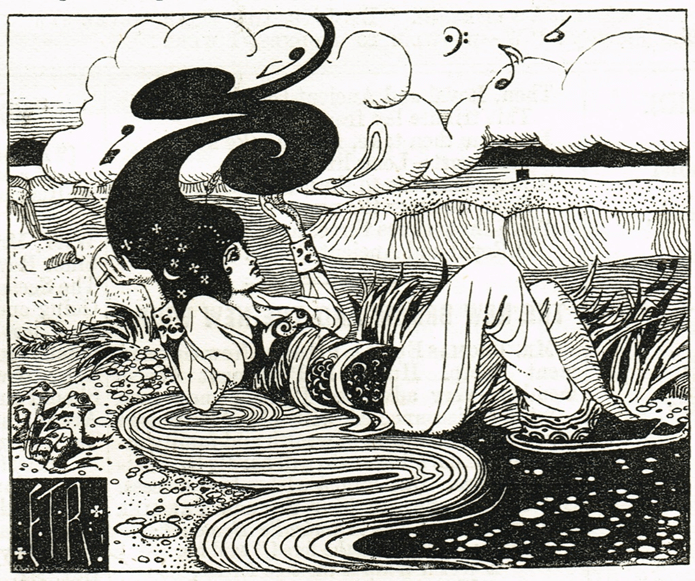
At first glance the reader can be taken in by Punch’s Beardsley parodic cartoons, as they plagiarise his style so perfectly. Mr Punch also had much fun with his name: ‘Weirdsley Daubery’, ’Danby Weirdsley’ and ‘Mortarthurio Whiskerley’, the latter a pun on Beardsley’s Morte d’Arthur illustrations. Throughout 1894 and early 1895 Punch was peppered with Beardsley and Yellow Book parodies, with Edward Tennyson Reed most often responsible. These images are well known, being published in many volumes on Beardsley’s life and work. However, the meaning of some appears obscure, for example ‘Le Yellow Book’ (1895) or ‘Quid Est Pictura’ – Veritas Falsa’ (1895).Reproduced without the accompanying text has weakened the cartoon’s message. As was typical of the editorial policy, Mr Punch followed his own agenda using the Beardsley style to comment more broadly on current issues particularly the inexplicability of contemporary art and the so-called New Woman novel. By uniting image and text, I hope to explain the ‘Punch-line’, thereby gaining greater insight into the Beardsley Years.
‘She-Notes’, Edward Tennyson Reed after Aubrey Beardsley
Arte Nova and Art Deco in Porto and Aveiro, Portugal
To be given on Friday 26th August 2022 at 11.00 am and repeated at 7.00 pm
Looking down on Porto
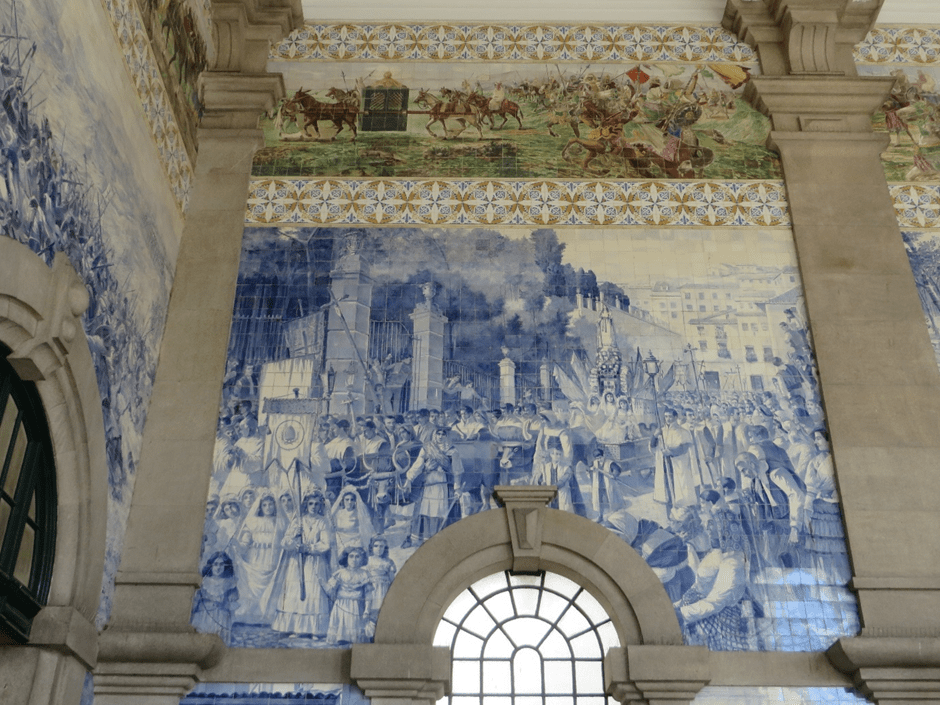
Like many countries enjoying great prosperity at the end of the 19th century, Portuguese architects and designers developed their own variant of Art Nouveau.Arte Nova buildings are invariably distinguished by their Azulejos or hand painted tile panels. Azulejo comes from the Arabic zellige meaning ‘polished stone’ as the original idea was to imitate Roman mosaics. The earliest azulejos dating to the 13th century were alicatados, panels of tile-mosaic. Single colour tin-glazed earthenware tiles were cut into geometric shapes and assembled to form geometric patterns. This technique was introduced into Portugal by Manuel I after a visit to Seville in 1503. Adopting the Moorish tradition of horror vacui (‘fear of empty spaces’), the Portuguese covered walls entirely with azulejos. They were not merely ornamental; they also kept interiors cool. Azulejos are found on the interior and exterior of every type of building from churches to railway stations, the most notably example being the 20,000 or so azulejo tiles used to decorate the vestibule of Porto’s São Bento railway station. Built in 1905-16, by the architect Marques da Silva, this is good place to start our Arte Nova tour of Porto.
Porto’s São Bento railway station
Many of the late 19th century apartments around the Mercado do Bolhão, Porto’s central market dating back to the 1850s, are covered with azulejos creating a rainbow of colours: green, pink and yellow. Another group can be found around the famous Livraria Lello & Irmão bookstore. Thousands visit the bookshop every year, as the quirky staircase, which rather alarmingly hangs in the centre, is said to have inspired the moving staircases of Harry Potter’s Hogwarts. The prettiest Arte Nova house in Porto can be found on RuaCândido dos Rei.
Tiles were also used extensively in Aveiro, where most of the Arte Nova buildings are built in adobe (sun-dried clay bricks). The CasaMário Pessoa (1906-09), the most striking building in Averio, is attributed to Francisco Augusto da Silva Rocha, who headed the local Arte Nova school, and the Swiss born, Ernesto Korrodi. Built for the entrepreneur Mário Belmonte Pessoa, the residence is a riot of colour as well as tiles. Behind a wrought-iron grill of sunflowers, the entrance dramatically stretches its curvilinear forms across the width of the façade. The Vila Africa, in nearby Ílhavo (1907-08), is equally eye-catching.
Returning to Porto our virtual tour ends with the Villa Serralves, the finest Art Deco residence in Portugal. Affectionately known as the ‘Pink House’, this ‘Streamline Modern’ villa reflects the sophisticated taste of its owner, Carlos Alberto Cabral, 2nd Count of Vizela. Visiting the 1925 International Exposition of Modern Industrial and Decorative Arts held in Paris, Cabral became acquainted with the leading architects and designers of the day. His personal vision was realised by architect Charles Siclis, interior designer Émile–Jacques Ruhlmann, and landscape architect Jacques Gréber, who designed the stunning gardens.
Please join me to discover the Arte Nova and Art Deco delights Portugal has to offer!
How to book
To be given on Friday 26th August 2022 at 11.00 am and repeated at 7pm
The cost of the lecture is £10 for this session. You can book this live lecture for either the morning or the evening presentation.
To do so please email Susan Branfield at susanbranfield@waitrose.com
Please note: Susan will not be in the office until 18th August so please do not expect an immediate reply to your booking. She will deal with all bookings upon her return.
Please ask for ‘Morning Lecture’ or ‘Evening Lecture’ when you book your choice as the sessions have different Zoom entry codes
You can pay by cheque or BACS (details will be supplied). Cheques should be made payable to Anne Anderson. or you can pay by PayPal
One lecture August
Arte Nova and Art Deco in Porto and Aveiro, Portugal
£10.00
Once you register and pay, you will be sent a separate email with your link. You will need this link to access the lecture on the day so please do not delete it.
The lecture will be delivered live by Zoom. It will be uploaded afterwards to my YouTube channel for a limited time and you will be provided with a private link to view the lecture again at your leisure.
The lectures last for around an hour. Lecture start times are in BST. There will be a question-and-answer session at the end.
As the lectures will be delivered live by Zoom, you will be able to ask your questions in person at the end. You can also use the ‘Chat’ function.
Join me in this lecture to enjoy some of the historic culture that Portugal has to offer.






























 Anne Anderson