August 2025

With British weather being somewhat better than usual this Spring and Summer, we decided to spend a couple of days visiting London in June. As you can see from the picture above this day was warm and sunny and ideal for a stroll through Green Park on our way to the King’s Gallery, Buckingham Palace, to view the latest exhibition. It was a fascinating experience and we tell you more about it below in our review of The Edwardians: Age of Elegance exhibition.
We have recently returned from our Travel Editions tour: Art Nouveau around York. This is a new tour looking at aspects of the late-Victorian to Edwardian period in fine art, architecture and design in Yorkshire. And to make sure that participants acquired a good grounding in the subject, we based the tour in the magnificent Art Nouveau decorated Elmbank Hotel in York.

The hotel was re-decorated around 1898 by the firm of George Walton. & Co. Following his early career in Glasgow, Walton was expanding his business interests in the late 1890s. In York he was employed to undertake the decorative elements and windows in Elmbank. Fortunately many of his designs still remain in the building, providing a perfect backdrop for the tour.

The Eros mosaic, by George Walton, above the fireplace in the hotel dining room.
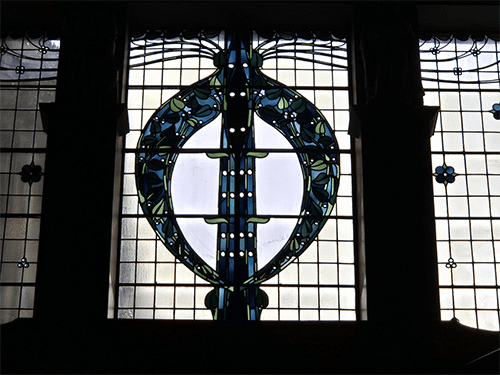
The magnificent George Walton window in the main hall of the hotel.
The tour also took in visits to Whitby, Scarborough to look at Morris and Co. stained glass, the architecture of Leeds and the City Art Gallery and we saw wonderful decorative arts collections at Lotherton Hall just outside Leeds.
There is another Art Nouveau around York tour scheduled for October 2025, so if you feel like a trip to York with us, please contact Travel Editions on 0207 251 0045.
Exhibition Review
The Edwardians: Age of Elegance
The King’s Gallery, Buckingham Palace, London
Open until November. Check days and times of opening on the Royal Collections Trust website.
Although we visit many art galleries during the course of each year, usually viewing paintings and sculptures, we also have a passion for the decorative arts and so this particular exhibition, promising over 300 exhibits including paintings, furniture, jewellery, costume, ceramics, books and much more, attracted our attention.
The exhibition focusses on the glamour of the Edwardian age as seen through the lives and tastes of two royal couples – King Edward VII and Queen Alexandra, and King George V and Queen Mary – including their family lives and their collecting interests as well as spectacular royal events.
Many of the objects have not been displayed in public before, and works by the most renowned contemporary artists of the period, including Carl Fabergé, Frederic Leighton, Edward Burne-Jones, John Singer Sargent and William Morris can be seen.
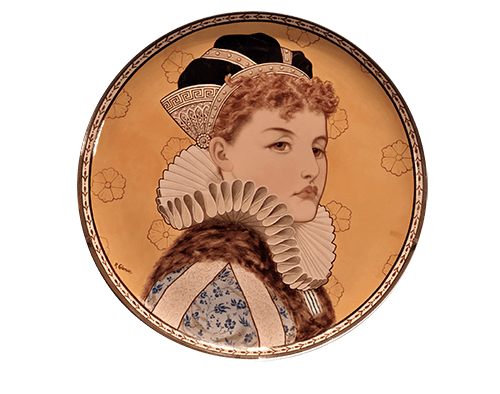
Earthenware charger painted by Rebecca Coleman for the Minton’s Art Pottery Studio c.1873
With so many impressive works of art on view: diamond tiaras, paintings large and small, furniture, metalwork, exquisite examples of book binding and even leatherwork, it was quite difficult to choose an object from the exhibition to illustrate the quality of the collection. Eventually we settled on the magnificent charger shown above as we love Victorian ceramics.
Live Lecture for August
Beauty and Speed:
1935 The launch of SS Normandie, the Art Deco transatlantic liner that inspired the Paquebot style.
The Lecture to be given on Monday 18th August 2025 at 11am and repeated at 7pm BST
Continuing my Art Deco Centenary Year theme, this lecture celebrates ninety years since the SS Normandie, the ultimate transatlantic ocean liner, was launched.
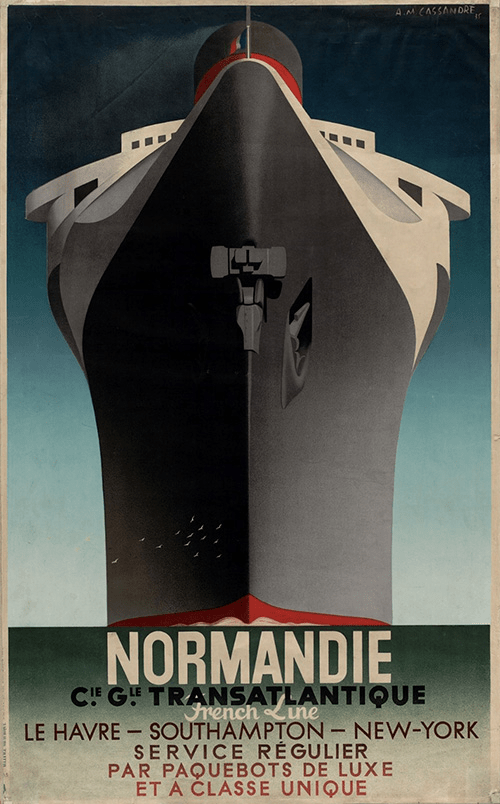
Living in Southampton, I have always taken a special interest in Transatlantic liners. The RMS Queen Mary was the nation’s pride when she was launched in May 1936. In August she took the Blue Ribbon for the fastest crossing of the Atlantic, beating her French rival the superliner SS Normandie. However, while the Queen Mary could match the speed of the Normandie, she could not surpass her striking beauty. Her lavish Art Deco and Streamline Moderne interiors have led many to honour the Normandie as the greatest of all ocean liners.
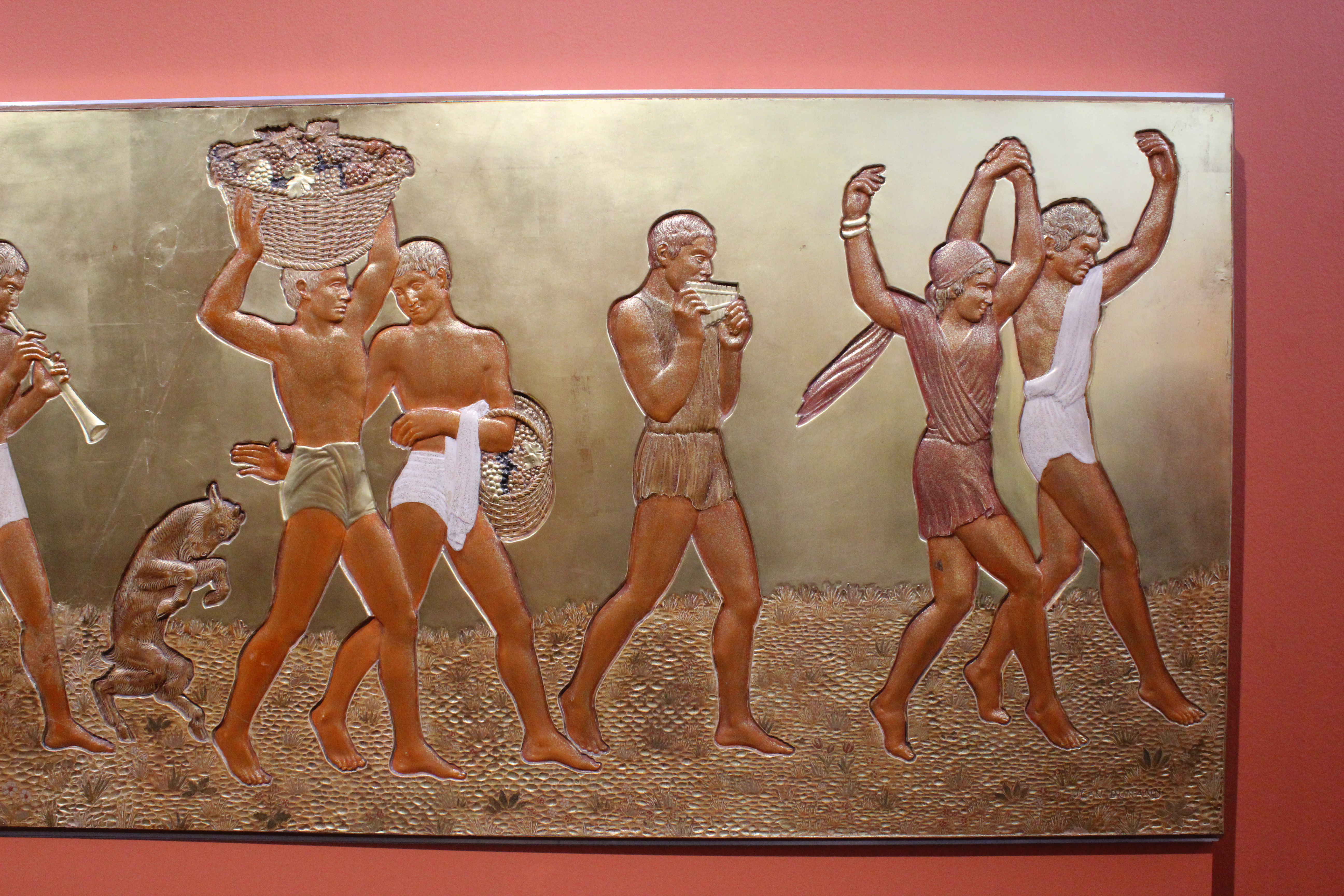
Pierre Patout was entrusted with the overall conception of the Normandie’s interior décor. Following his success at the 1925 Paris Exposition, he had been commissioned to design the interiors of the SS Ile-de-France in 1926. The Normandie was the hight of fashion, with stupendous light fittings supplied by Rene Lalique, magnificent lacquer panels by Jean Dunand, furniture by Emile-Jacques Ruhlmann and tea sets by Christofle.

Jean Dunand, Les Sports 1935, relief for the first-class smoking room of the Normandie. City of Paris Museum of Modern Art, Palais de Tokyo, Paris.
“The unprecedented cost of the construction and lavish decoration were justified in the midst of a worldwide financial crisis because the ship’s mission was to serve as an ambassador, carrying the art and glory of France to foreign lands,” claims the Metropolitan Museum of Art, New York.

For the terrace of the Café-Grill on the Normandie, Carlo Sarrabezolles, Le Genie de la mer, 1935 (not installed, reduced plaster replica). MAT, Paris.
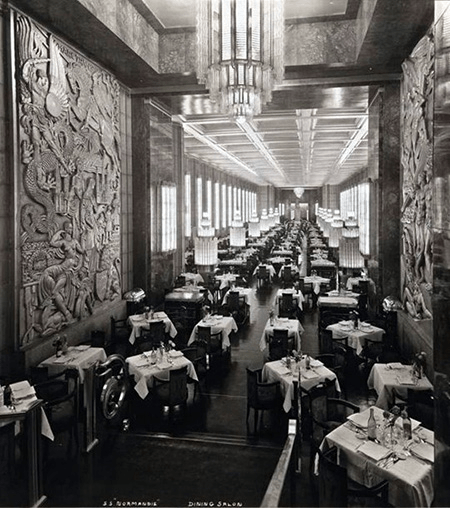
The origins of Normandie can be traced to the 1920s, when the U.S. put restrictions on immigration, greatly reducing the traditional market for steerage-class passengers from Europe, and placing a new emphasis on upper-class tourists, largely Americans, many of them wanting to escape prohibition. Most of the public space was devoted to first-class passengers, including the dining room, lounge, café-grill room, swimming pool, theatre and winter garden. Normandie‘s first-class dining hall was the largest room afloat, being even longer than the Hall of Mirrors at the Palace of Versailles. With twelve imposing illuminated torchères of Lalique glass, flanked by 38 matching columns along the walls, and chandeliers hung at each end, the Normandie was dubbed ‘Ship of Light’.
The glamour of the Normandie naturally attracted the rich and famous, carrying Hollywood royalty like Cary Grant and Marlene Dietrich across the Atlantic alongside cultural luminaries from Salvador Dalí to Ernest Hemingway.
The liner came to an untimely demise in New York harbour; while being fitted as a troop carrier, she was set ablaze and dramatically sank. There was even talk of sabotage. Dredged up, she was finally sold for scrap. However, most of her Art Deco fittings had already been removed and are now spread across private collections, hotels, cruise liners and museums.
I had the good fortune to visit Ocean Liners 1913-1942: A Transatlantic Aesthetic, which is currently running at the Musée d’art moderne André Malraux (MuMa), Le Havre, until September 21, 2025. Despite being in service for only four and half years, the Normandie remains the ultimate icon of the machine age, symbolising speed, glamour and a new era of international travel.
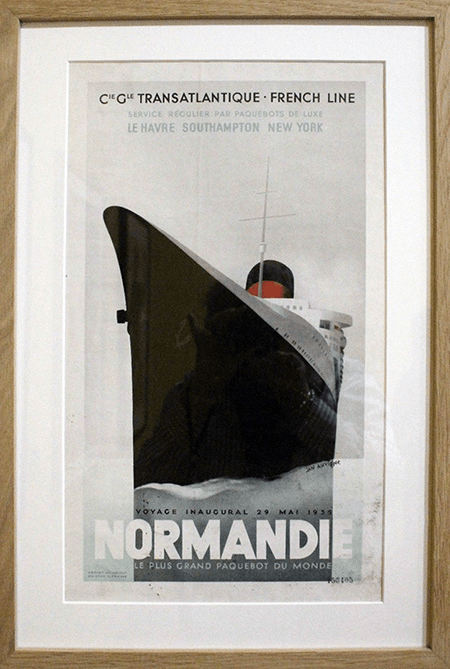
Poster for the inaugural voyage of SS Normandie, Ocean Liners 1913-1942: A Transatlantic Aesthetic, currently running at the Musée d’art moderne André Malraux (MuMa), Le Havre
| Date and Times Beauty and Speed: 1935 the launch of SS Normandie, the Art Deco transatlantic liner that inspired the Paquebot style. |
| The Lecture to be given on Monday 18th August 2025 at 11am and repeated at 7pm BST |
How to Book
| The cost of this lecture is £10. You can book the live lecture for either the morning or the evening presentation. To book your place please email Susan Branfield at susanbranfield77@gmail.com Please state your preferred time, Morning Lecture or Evening Lecture, for the zoom link, as they have different codes .You can pay by cheque or BACS (details will be supplied). Cheques should be made payable to ‘Anne Anderson’. |
| Once you register and pay, you will be sent a separate email with your link. You will need this link to access the lecture on the day so please do not delete it. As the lecture will be delivered live by Zoom, you will be able to ask your questions in person at the end. You can also use the ‘Chat’ function. After the lecture you will be sent another private link so you can access the lecture on my YouTube Channel. |
If you are living outside the UK, for more information and for access to our on-line PayPal Booking facilities press the Pay Here button below to be transferred to Anne’s website at anne-anderson.com and our Information and Payment Page. This service is also available to UK residents.
1935 Normandie
1935 Normandie Ocean Liner
£10.00
Anne Anderson Art and Design History Channel
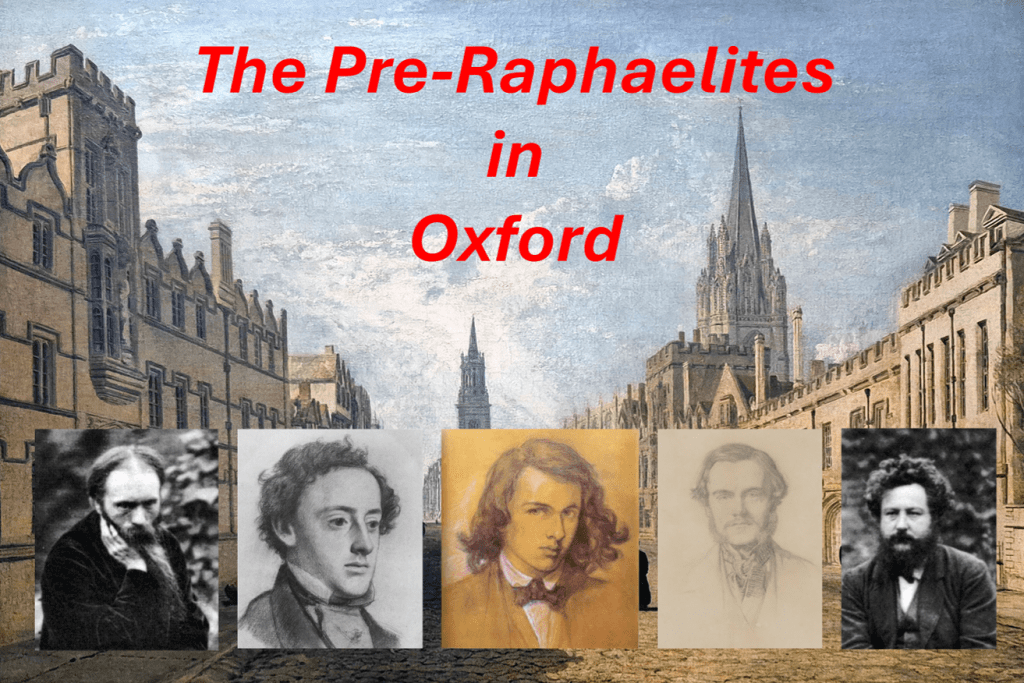
| Recently released: The Pre-Raphaelites in Oxford The City of Oxford provided a stunning backdrop to the stories of Inspector Morse, created by Colin Dexter. But Morse was not the only character to be enchanted by the ‘City of Gleaming Spires’. Around 130 years earlier Oxford was to prove influential to the group of real-life artists who formed the Pre-Raphaelite Brotherhood. The PRB wanted to move away from what they perceived as the stagnant academic art promoted by the Royal Academy in London and replace it with something more heartfelt, honest and less contrived. In following their ambitions these artists were to change British painting in a manner that has created a legacy that persists to the present day. A fascinating, detailed look at their close ties with Oxford and the importance of the City in their establishment of a new art for Britain. |
If you would like to see and hear this presentation, entitled: The Pre-Raphaelites in Oxford, please click on the Watch Now button below to take you to the video.
Further Information
If you know anyone who would like to receive the Art History with Anne Newsletter, please ask them to email anne.anderson99@talk21.com with the subject line: ‘Please add me to your mailing list’
Anne Anderson Art and Design History Channel
For a selection of some of my free access lectures please visit my YouTube channel via Google by typing into the search box: Anne Anderson Art and Design History Channel
Thanks to all of you who have watched films on the Anne Anderson Art and Design History Channel and particularly to those who have remembered to press the SUBSCRIBE button beneath the video window. It does not commit you to anything but helps with my stats. Thank you.
Help us to spread knowledge of Art and Design History to a wider audience:
Please email this Newsletter to a friend either in the UK or Abroad
 Anne Anderson