November 2024
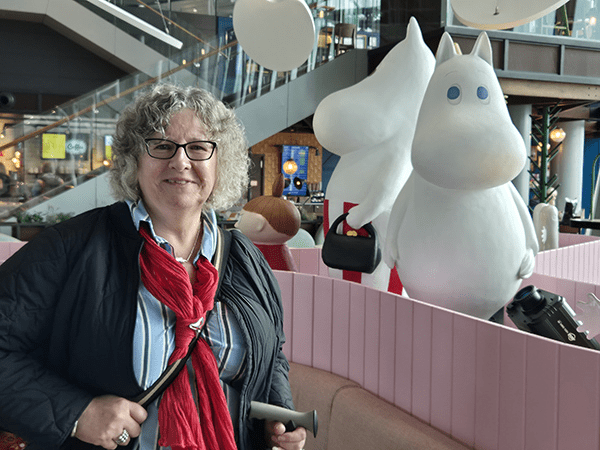
Well it’s Autumn again! I can hardly remember a year going by so fast. We have all been very busy with travel and visiting museums and art galleries, and, of course, thinking about material for future talks and articles for the website and YouTube Channel. This month’s picture was taken recently in the airport at Helsinki. I am sure that you all recognise me, but the two characters in the background are Moomins who are very much part of the Finnish cultural experience. If you are thinking about taking an interesting cultural weekend break, Helsinki offers a wonderful selection of museums and galleries and the architecture in the city is particularly rich in late-19th to early 20th century buildings relating to the country’s Jugendstil period.
Exhibitions
That you might like to visit
PARIS
Musée d’Orsay
Open until 19 January
Caillebotte Painting men
This exhibition focuses on Gustave Caillebotte (1848-1894) and his predilection for masculine forms and portraits of men.
LONDON
The National Gallery
Open until 19 January 2025

The block-buster exhibition for Autumn/Winter at the National Gallery London, Van Gogh: Poets and Lovers, promises to be spectacular: ‘We’re bringing together your most loved of Van Gogh’s paintings from across the globe, some of which are rarely seen in public.’ See up-close his Starry Night over the Rhône (1888, Musée d’Orsay) and The Yellow House (1888, Van Gogh Museum), as well as Sunflowers (1888) and Van Gogh’s Chair (1889), among many others. The exhibition runs through to 19 January 2025.
The Van Gogh exhibition is also the inspiration for the first of our live lectures in November and December.
Live Lectures for November and December
From Van Gogh to Mondrian
Running on Wednesdays during November and December, our next series of live Zoom talks by Anne follows our tried and tested format of a group of three lectures connected by a common theme. However, each lecture covers an individual topic within the overall theme and can be booked separately to suit your personal interests. Below, Anne comments on her choice of topics and provides information on the contents of the different talks.
So, for my autumn season of on-lines lectures I will be delving into Van Gogh’s life and the era in which he lived. His art was shaped, in turn, by Realism, Impressionism and Symbolism. At the time of his death, Hendrik Petrus Berlage, progenitor of the Amsterdam School, was about to transform the city. Seen as the intermediary between the Traditionalists and the Modernists, Berlage’s theories inspired De Stijl and Neues Bauen. Over three lectures I will trace the development of Dutch modernity from Van Gogh to Mondrian.
Van Gogh in Context
Lecture 1: To be given on Tuesday 26th November 2024 at 11am and repeated at 7pm BST
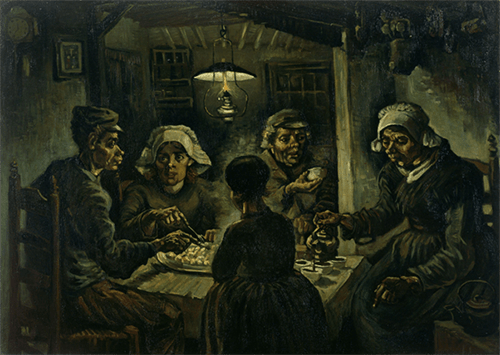
The Potato Eaters, Van Gogh Museum, 1885
You may recall that Tate Britian staged Van Gogh and Britian in 2019. The fledgling artist spent nearly three years in England between 1873 and 1876. He read Dickens and George Eliot and saw paintings by Turner and Millais. He witnessed the emergence a new genre of art, Social Realism. The Graphic magazine, founded in 1869, published striking images by Luke Fildes, Hubert Herkomer and Frank Holl focusing on the plight of the working classes.

Sunflowers, NG, London, 1888
On the other hand, it was during the 1870s that ‘Art for Art’s Sake’ emerged, arguing that a work of art did not have to communicate a moral or tell a story. Rather it might express a mood or an experience, such as listening to music or smelling a flower. The concept, which lay at the heart of the Aesthetic Movement, can be seen at its best in the sumptuous femme fatales of Dante Gabriel Rossetti and the dreamy maidens of Edward Burne-Jones. The Aesthetes, who took the lily and the sunflower as their totems, saw art as a means of personal expression not only in paint but also through dress and interior decor. What impact did these divergent artistic trends have on Van Gogh’s art?

Peach Trees in Blossom, Courtauld, 1889
Dutch modernity: from Hendrik Petrus Berlage to the Amsterdam School
Lecture 2: To be given on Tuesday 3rd December 2024 at 11am and repeated at 7pm BS

The Beurs van Berlage (Stock Exchange) Amsterdam
Considered the father of modern architecture in the Netherlands, Berlage threw off 19th-century historicism by turning to Rationalism: he insisted that the exterior of a building express its interior, functional design. He was also, perhaps rather surprisingly, inspired by the American architect Henry Hobson Richardson and after 1911 the organic architectural forms of Frank Lloyd Wright. His style relies on brickwork, his monumental brick walls creating form. His career falls into three periods: 1878 to 1903, this early phase culminating in the completion of the Amsterdam Exchange; 1903 to 1919, his mature period exemplified by commissions from the Kröller-Müller family; and finally, his late work from 1920 to 1934, influenced by Cubist forms. Berlage work shaped succeeding generations of Dutch architects, those of the Amsterdam school (1910-30), Michel de Klerk and Pieter Lodewijk (Piet) Kramer’ and the modernists J.J.P. Oud, Gerrit Rietveld, and Mies van der Rohe.

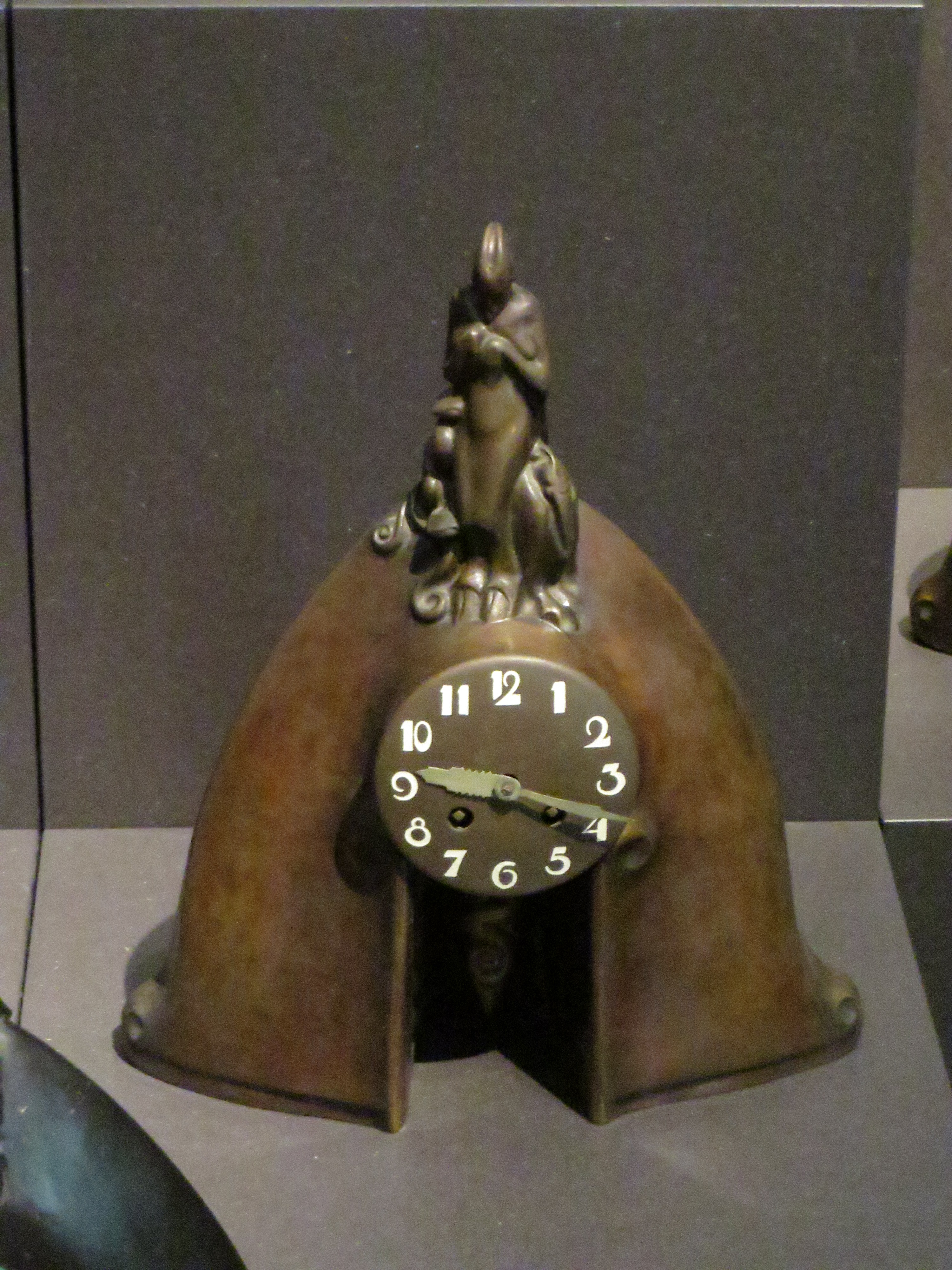
Amsterdam School Clock, attributed to Michel de Klerk
De Stijl: Theo van Doesburg, Pieter Mondrian and Gerrit Rietveld
Lecture 3: To be given on Tuesday 10th December 2024 at 11am and repeated at 7pm BST
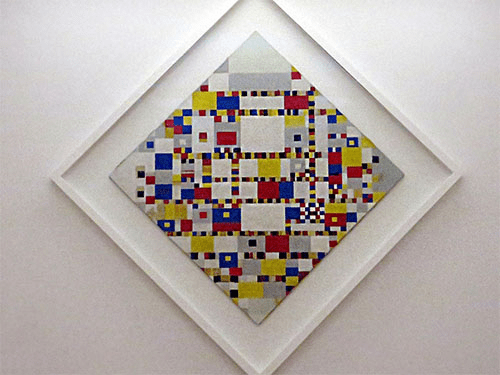
Victory Boogie-Woogie, Mondrian1944
De Stijl was in part a reaction to the expressionist architecture of the Amsterdam School. Its name comes from a journal, initiated by the Dutch painter, designer, writer, and critic Theo van Doesburg, which voiced the group’s theories. The principal members were the painters Piet Mondrian and Bart van der Leck and the architects Gerrit Rietveld, Robert van’t Hoff and J.J.P. Oud. The group devised an artistic philosophy dubbed Neoplasticism or the new plastic art ( Nieuwe Beelding in Dutch). According to Mondrian, ‘this new plastic idea will ignore the particulars of appearance, that is to say, natural form and colour.’ Rather it would ‘find its expression in the abstraction of form and colour….in the straight line and the clearly defined primary colours.’ Mondrian used only red/blue/yellow and black/white, only squares and rectangles, only straight and horizontal or vertical lines. Influenced by Theosophy, Mondrian’s ‘pure relations of universal forms’ were imbued with meaning and spirituality. However, it was architecture that proved to be the ideal art form to represent De Stijl’s spatial conceptions, as seen in van Doesburg’s Aubette, Strasburg and Gerrit Rietveld’s Schröder House in Utrecht.
How to Book
| The cost of each lecture is £10. Book all three lectures for £25. You can book an individual live lecture or the full series for either the morning or the evening presentation. To book your place please email Susan Branfield at susanbranfield77@gmail.com Please state your preferred time, Morning Lecture or Evening Lecture, for the zoom link as they have different codes. |
| You can pay by cheque or BACS (details will be supplied). Cheques should be made payable to ‘Anne Anderson’. Once you register and pay, you will be sent a separate email with your link. You will need this link to access the lecture on the day so please do not delete it. As the lectures will be delivered live by Zoom, you will be able to ask your questions in person at the end. You can also use the ‘Chat’ function. After the lecture you will be sent another private link so you can access the lecture on my YouTube Channel. Or you can pay directly by PayPal |
Dates and Times
Van Gogh in context
Lecture 1: Given live on Tuesday 26th November 2024 at 11am and repeated at 7pm BST
Lecture 1
Van Gogh in context
£10.00
Dutch modernity: from Hendrik Petrus Berlage to the Amsterdam School
Lecture 2: Given live on Tuesday 3rd December 2024 at 11am and repeated at 7pm BST
Lecture 2
Dutch modernity: from Hendrik Petrus Berlage to the Amsterdam School
£10.00
De Stijl: Theo van Doesburg, Pieter Mondrian and Gerrit Rietveld
Lecture 3: Given live on Tuesday 10th December 2024 at 11am and repeated at 7pm BST

Lecture 3
De Stijl: Theo van Doesburg, Pieter Mondrian and Gerrit Rietveld
£10.00

Lectures 1 to 3
Van Gogh Amsterdam School De Stijl
£25.00
| What’s New on the Channel |
| If you missed the free Live Zoom broadcast: Monet at Giverny: Celebrating 150 years of French Impressionism |
| August’s free Live Zoom broadcast proved to be very successful and the lecture is now available on the Anne Anderson Art and Design History Channel in our free access area. |
| Further Information |
| If you know anyone who would like to receive the Art History with Anne Newsletter, please ask them to email anne.anderson99@talk21.com with the subject line: ‘Please add me to your mailing list’ Anne Anderson Art and Design History Channel For a selection of some of my free access lectures please visit my YouTube channel via Google by typing into the search box: Anne Anderson Art and Design History Channel Thanks to all of you who have watched films on the Anne Anderson Art and Design History Channel and particularly to those who have remembered to press the SUBSCRIBE button beneath the video window. It does not commit you to anything but helps with my stats. Thank you. |
 Anne Anderson